
By Financial News Desk
In the volatile world of semiconductor manufacturing, memory chips have long been viewed as the industry’s "problem child"—a brutally cyclical commodity business defined by gut-wrenching booms and devastating busts. However, following Micron Technology’s latest earnings report, Wall Street is beginning to suspect that the old rules no longer apply. On Tuesday evening, Micron didn’t just beat expectations; it delivered a performance that analysts are calling a "paradigm shift," signaling that the artificial intelligence (AI) revolution has fundamentally altered the DNA of the memory sector.
Through a combination of staggering financial results, unprecedented long-term contracts, and a supply-demand imbalance that shows no sign of easing, Micron is positioning itself as a central toll-booth on the AI highway. As memory transitions from a commoditized component to a strategic bottleneck, the implications for the broader technology complex are profound.
I. Main Facts: Shattering the Ceiling
Micron Technology’s Tuesday earnings report served as a definitive refutation of the "AI bubble" narrative. The company reported quarterly revenue of $41.5 billion, obliterating the Wall Street consensus of $35.9 billion. Even more impressive were the profitability metrics: gross margins reached a staggering 84.9%, while earnings per share (EPS) landed at $25.11, significantly higher than the $20.86 analysts had penciled in.
However, the "shock and awe" of the report lay in the forward-looking guidance. Micron informed investors to expect $50 billion in revenue for the upcoming quarter—roughly $6.5 billion above consensus estimates. This guidance suggests a trajectory of growth that is almost unprecedented for a company of Micron’s scale.
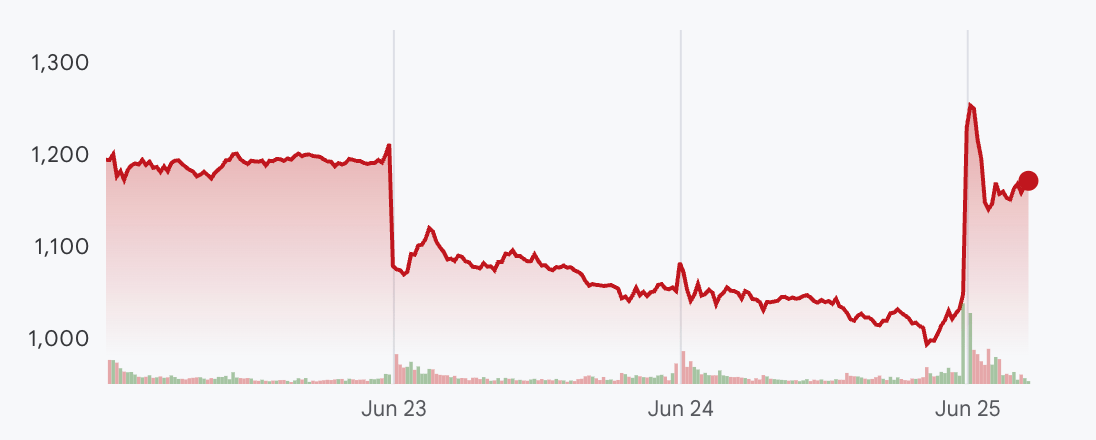
The market response was immediate. Micron’s stock, which closed Tuesday at $1,048.51, surged in after-hours trading, acting as a rising tide that lifted the entire semiconductor complex, including heavyweights like NVIDIA and AMD. The message from Micron was clear: the demand for High-Bandwidth Memory (HBM)—the specialized chips required to feed data to AI accelerators—is not just growing; it is insatiable.
II. Chronology: From Commodity to Strategic Asset
To appreciate the gravity of Micron’s current position, one must look back at the historical context of the memory industry. For forty years, the DRAM (Dynamic Random Access Memory) and NAND (flash memory) markets operated on a "weather-like" cycle. Prices would spike during shortages, leading manufacturers to overinvest in new capacity. This inevitably resulted in a supply glut, causing prices to crater and forcing companies to retrench.
The AI Pivot (2023–2024):
The emergence of Large Language Models (LLMs) and the subsequent explosion in AI infrastructure began to bend this cycle in late 2023. Unlike standard PC or mobile memory, HBM requires a complex manufacturing process involving the vertical stacking of DRAM dies. This process is significantly more difficult and resource-intensive, meaning capacity cannot be brought online overnight.
The Structural Shift (2025–2026):
By early 2026, the gap between supply and demand became a chasm. Micron’s core data center revenue, directly tied to AI, more than doubled sequentially in the most recent quarter, reaching $11.5 billion—a 653% increase year-over-year.

The Future Roadmap (2027 and Beyond):
Micron has now extended its forecast, stating that the supply-demand gap will persist well beyond 2027. With the groundbreaking of its New York "Megafab" in January 2026 and accelerated construction in Idaho, the company is racing to build the infrastructure required for the next decade. However, management warned that there is currently "no clear line of sight" to when supply will finally catch up to the AI-driven demand.
III. Supporting Data: The Anatomy of a Rerating
The sheer scale of Micron’s financial transformation is best understood through the lens of its internal metrics and new contractual obligations.
The Rise of DRAM
DRAM revenue reached $31.3 billion this quarter, up 67% from the previous quarter. It now represents 76% of Micron’s total sales. The average selling price (ASP) for DRAM rose by approximately 60% in a single quarter, reflecting the extreme pricing power Micron currently wields.
The SCA Revolution
Perhaps the most significant "hidden" data point in the call was the disclosure of 16 Strategic Customer Agreements (SCAs). These are five-year, "take-or-pay" contracts running from 2026 through 2030.
- Total Financial Commitments: $22 billion (including $18 billion in cash deposits and $4 billion in letters of credit).
- Pricing Structure: These contracts include a price ceiling (protecting customers from hyper-inflation) and a price floor.
- The Floor is the New Ceiling: Crucially, the "floor" price in these contracts is set at levels that would generate gross margins higher than Micron’s historical peak margins (low 60% range).
Cash and Capital Returns
Micron’s balance sheet is undergoing a radical cleanup. Net cash is projected to hit $140 billion by the end of fiscal 2027. Under the terms of the CHIPS Act agreements, restrictions on cash usage will expire on December 9, 2026. Following this date, Micron has committed to returning 100% of excess free cash flow to shareholders. Bank of America models $31.7 billion in buybacks for fiscal year 2027 alone—representing only a fraction of the projected $100 billion+ in trailing twelve-month free cash flow.
IV. Official Responses: Analysts and Industry Voices
The analyst community has responded with a mixture of relief and aggressive upward revisions.
Wedbush Securities: Dan Ives, a perennial tech bull, described the performance as a "drop the mic quarter." He noted that there are "no cracks in AI demand," providing a "bright green light" for investors to remain aggressive on core tech winners through the end of the year.
Bank of America: Lead semiconductor analyst Vivek Arya raised his price target to $1,550—the highest on the Street. Arya argued for a "structural rerating" of the stock, suggesting that Micron should no longer trade at a commodity-level P/E of 8x–10x, but rather a growth-multiple of 12x–15x.
Stifel: Analyst Brian Chin focused on the SCAs, noting that "the historical ceiling is now a floor." He described the contracts as concrete evidence that the boom-bust model of the last 40 years has been materially altered.
Morgan Stanley: Joseph Moore significantly lifted his FY27 EPS estimate by 40% to $168 per share. He remarked that DRAM fundamentals are in "uncharted territory" and will continue to improve as the data center market trajectories remain upward.
V. Implications: The "Memory Tax" and the Robotics Frontier
While the mood is overwhelmingly bullish, the report also introduced a sobering new concept: the "Memory Tax."
The Toll-Booth Effect
As Vivek Arya of BofA pointed out, memory now accounts for roughly 35% of total AI infrastructure capital expenditure (capex). Micron and its peers (Samsung and SK Hynix) have effectively become a toll-booth on the AI highway. Every dollar spent by Microsoft, Google, or Meta on an NVIDIA Blackwell chip must be accompanied by a significant payment to a memory provider.
If this "tax" becomes too high, it could lead to "demand destruction" in price-sensitive sectors like mobile phones and budget automobiles. The hyperscalers themselves pushed for the SCA pricing caps to ensure their own margins aren’t entirely consumed by memory costs.
Beyond the Data Center
Micron’s report also highlighted the next frontiers for memory demand:
- Automotive: The penetration of Level 2+ ADAS (Advanced Driver Assistance Systems) is expected to double by 2026. These vehicles carry five times the memory content of a standard car.
- Robotics: In a forward-looking statement, Micron noted that humanoid robots carry 10 times the memory content of a Level 2 vehicle. The company expects a "multi-decade memory demand cycle" in robotics to begin in the late 2020s.
Geopolitical and Macro Risks
Despite the stellar results, risks remain. A global recession could dampen enterprise IT spending, and the "CHIPS Act clock" is a reminder of the heavy government involvement in the sector. Furthermore, any disruption in the Taiwan supply chain—where Micron maintains significant operations—remains a "black swan" risk that no amount of contractual floors can fully mitigate.
Conclusion: A New Regime
Micron Technology has long been a bellwether for the semiconductor industry, but it has rarely been a leader in valuation. That is changing. By locking in five-year commitments and proving that AI demand is qualitative rather than just quantitative, Micron is attempting to exit the "commodity trap."
For the broader market, Micron’s results serve as a validation of the AI buildout. If the companies building the infrastructure are willing to deposit billions of dollars in cash to secure chip supply four years in advance, it suggests that the "AI bubble" has a much more solid foundation than its detractors claim. The theater is full, the mic has been dropped, and the memory industry has entered a new, highly profitable, and structurally different era.