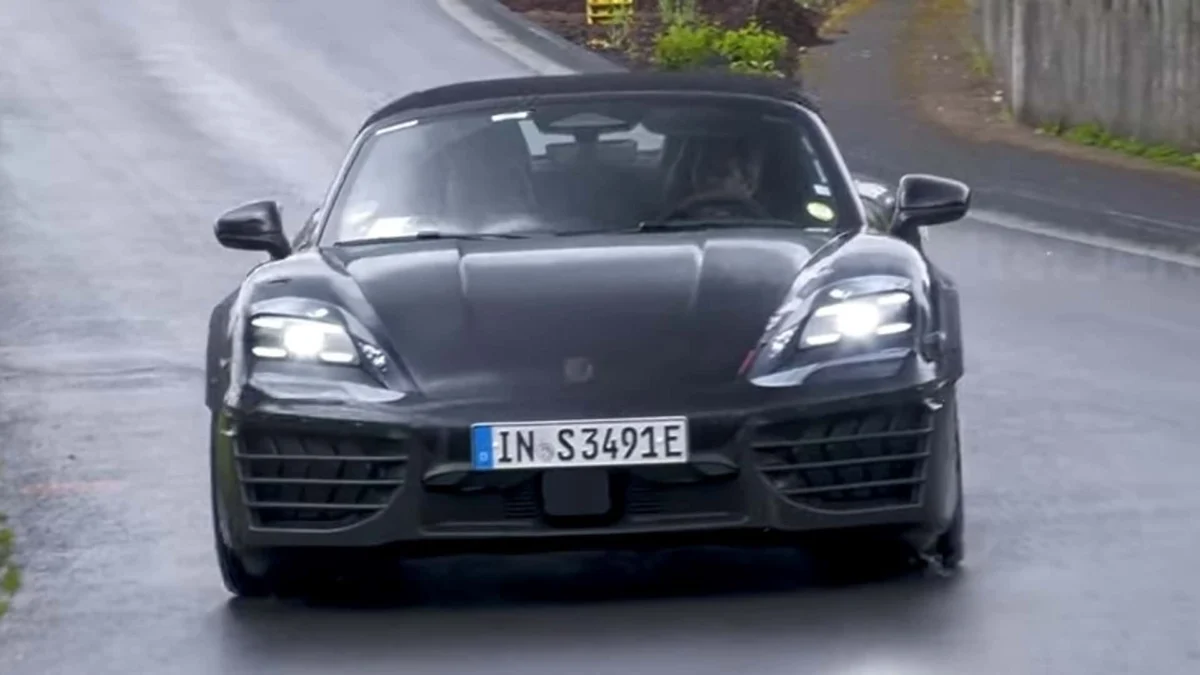
The automotive world is currently witnessing a high-stakes, behind-the-scenes evolution within the Volkswagen Group. For years, the industry has been fixated on Porsche’s transition of its legendary 718 Boxster and Cayman models into pure electric sports cars. However, recent sightings at the Nürburgring suggest that Porsche may not be the only brand utilizing this high-performance electric architecture. A mysterious prototype, bearing the unmistakable license plates of Ingolstadt, has emerged, pointing to an Audi-branded electric sports car that promises to challenge the very definition of the "German performance" segment.
The Chronology of a High-Voltage Evolution
The electrification of the mid-engine sports car segment has been a long, winding road. Porsche’s journey began in earnest as early as November 2022, when automotive spies first captured an open-top 718 testing without the familiar roar of a combustion engine. At the time, the industry assumed this was a standalone endeavor—a bold leap for Porsche to bring its handling-focused heritage into the battery-electric vehicle (BEV) era.
Fast forward nearly four years, and while the production-ready 718 EV has yet to grace showroom floors, the project has served as the bedrock for a broader group strategy. The recent emergence of an "Ingolstadt-registered" prototype at the Nürburgring suggests that Audi has been deeply involved in this platform’s development. This vehicle, widely referred to in industry circles as "Concept C," represents an early, near-production iteration of what will eventually become a flagship electric sports car for the Four Rings.
While Porsche has faced documented development hurdles—causing the 718 EV’s release to drift beyond its original 2025 target—Audi’s timeline is now aligning with an anticipated 2027 market launch. This multi-year delay is not necessarily a sign of failure; rather, it highlights the immense complexity of balancing weight, battery thermal management, and the "driver-focused" engagement that enthusiasts demand from these iconic brands.
Decoding the Differences: Design and Engineering
Despite the shared mechanical DNA, the Porsche and Audi models are poised to offer distinct experiences. One of the most significant differentiators lies in their structural philosophy. Spy footage and industry reports confirm that Porsche intends to remain loyal to the classic Boxster formula, utilizing a traditional fabric roof. This keeps the car’s weight distribution as low and centralized as possible, preserving the legendary agility of the 718.
Audi, by contrast, is taking a more avant-garde approach.
- The Targa-Only Approach: Sources indicate that the production-ready Audi Concept C will be sold exclusively with a retractable targa top. This will be a first for the modern Audi lineup, effectively turning the coupe into an open-air roadster at the touch of a button.
- Roof Architecture: Unlike the Porsche, which relies on a folding fabric mechanism, the Audi will feature two sophisticated roof panels that stow seamlessly beneath the rear deck. This design choice signals that Audi is positioning its offering as a "Grand Touring" sports car—a blend of performance and lifestyle utility rather than a track-focused weapon.
- The Cayman Factor: While the next-generation Porsche 718 will continue the tradition of offering both a Boxster (roadster) and a Cayman (coupe) body style, the Audi Concept C will not follow suit. It is expected to remain a singular, focused body style, emphasizing its status as an exclusive, design-led product.
The Powertrain Strategy: A Tale of Two Philosophies
Perhaps the most fascinating aspect of this project is how the two brands differ in their market positioning. Porsche has made it clear that while it is pushing for electrification, it will not abandon combustion entirely. Reports suggest that high-performance, internal combustion-engine (ICE) variants will remain available alongside the new 718 EVs for the foreseeable future. This "dual-track" strategy allows Porsche to cater to purists while simultaneously transitioning its broader customer base.
Audi is taking a significantly more aggressive stance. Spokesperson for Technical Development, Daniel Schuster, has indicated that the production version of the Concept C will be an electric-only affair. By committing to a strictly EV powertrain, Audi is attempting to shed its image as a manufacturer of derivatives and instead position this car as a pure-electric halo model.
Technical Architecture
The platform underpinning these vehicles is a modular masterpiece designed for scalability. While the base-level Concept C is expected to feature a rear-wheel-drive, single-motor configuration, the architecture is explicitly designed to support a dual-motor, Quattro all-wheel-drive system. This flexibility allows Audi to scale performance from an entry-level "fun" car to a high-output, precision machine capable of competing with the upper echelons of the sports car market.
Leveraging the Group Parts Bin
Audi’s development of the Concept C is a masterclass in corporate synergy. Much like the Lamborghini Temerario served as the technological bedrock for Audi’s upcoming "Nuvolari" supercar, Porsche has effectively acted as the lead engineer for this shared electric sports car platform.
By allowing Porsche—a brand synonymous with chassis dynamics—to perform the heavy lifting of R&D, Audi has been able to fast-track the development of its own model. This strategy suggests that the Volkswagen Group is moving toward a model where "brand-differentiating" software and design are layered over a common, highly capable electric chassis. This significantly reduces the exorbitant costs associated with developing a low-volume sports car from scratch.
Market Implications: Can They Succeed?
The billion-dollar question remains: Will these cars sell?
There is a palpable skepticism among enthusiasts. High-performance electric sports cars are a niche market. Buyers in this segment often prioritize sound, tactile feedback, and the mechanical symphony of an engine—elements that are fundamentally altered, if not entirely removed, in an EV.
- Porsche’s Advantage: Porsche is better positioned to navigate this transition. By keeping the gas-powered 718 in the lineup, they provide a "safety net" for customers who are not yet ready to embrace the silent, instant-torque nature of an EV.
- Audi’s Risk: Audi is putting all its eggs in the electric basket. Without an ICE fallback, the Concept C must be exceptional. It needs to provide a driving experience that is so compelling—perhaps through simulated shift points, active chassis tuning, or revolutionary interior tech—that owners won’t miss the combustion engine.
Furthermore, there is the question of the "R8 Legacy." Many enthusiasts had hoped for an entry-level R8 powered by the legendary 2.5-liter inline-five engine. While that dream has been shelved, the Concept C is clearly meant to fill that spiritual void. Whether the market is willing to accept a silent, battery-powered successor to the roaring R8 will determine the long-term viability of Audi’s new strategy.
Conclusion
The emergence of the Audi Concept C, built upon the hard-won engineering progress of the Porsche 718 EV, signals a new era for the Volkswagen Group. It is a period defined by shared innovation, cautious experimentation, and a race to define what a "sports car" looks like in a post-combustion world. While Porsche leans on its heritage to ease the transition, Audi is diving headfirst into the electric future.
As we approach the 2027 launch window, the industry will be watching closely. Whether these vehicles become the new benchmarks for performance or serve as cautionary tales of brand over-extension remains to be seen. What is certain, however, is that the Nürburgring will continue to be the proving ground where these silent, high-voltage machines fight for their place in automotive history.