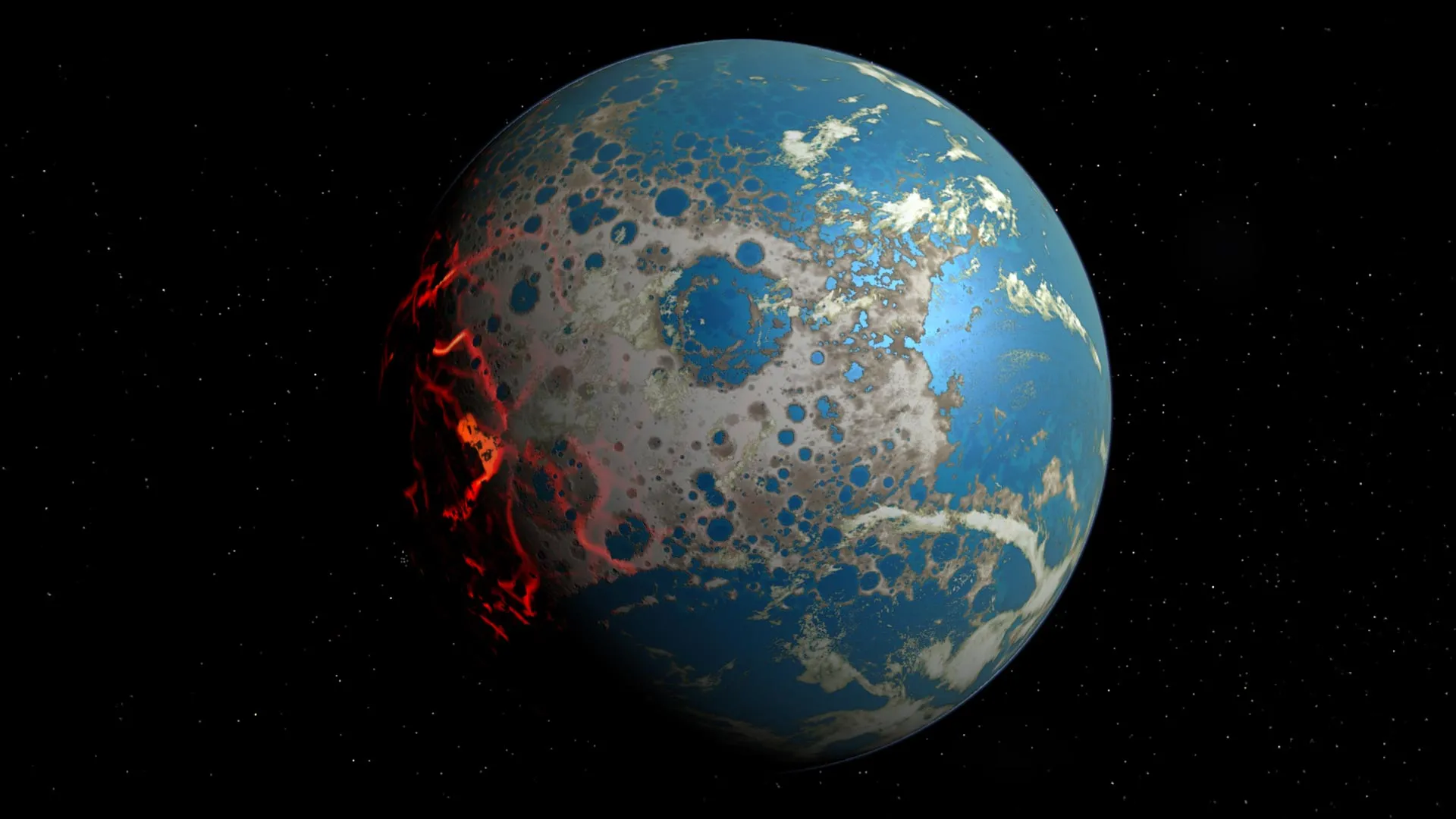
For decades, the popular imagination has painted the early Earth as a chaotic, hellish landscape—a place defined exclusively by destruction. We often view the Late Heavy Bombardment, an epoch of intense asteroid activity 4 billion years ago, as a series of catastrophic events that wiped the slate clean. However, a groundbreaking study led by scientists at the Southwest Research Institute (SwRI) suggests a radical revision of this history. According to their research, these violent impacts were not merely agents of destruction; they were the primary architects of the cradle of life.
By utilizing sophisticated computational modeling, the SwRI team has demonstrated that the kinetic energy of asteroid impacts fractured the planet’s crust, creating vast, porous subterranean networks. These networks, fueled by geothermal heat, acted as immense, planet-wide hydrothermal systems. These environments, researchers argue, provided the perfect chemical laboratory for the emergence and early evolution of prebiotic life.
The Genesis of a Habitable Planet: Main Facts
The study, published in AGU Advances, marks the first comprehensive attempt to quantify how asteroid impacts generated "permeability"—the ability of fluids to flow through solid rock—within the Hadean and Archean Eon crust.
The researchers utilized a high-fidelity "shock physics code" to simulate the immediate physical consequences of high-velocity impacts. When an asteroid strikes a planetary body, the energy release is astronomical, shattering rock into pulverized debris and creating a network of fractures deep beneath the surface. This fracturing allowed water to circulate, interacting with heat sources to create hydrothermal systems.
These ancient systems were not minor geological curiosities; they were industrial-scale chemical reactors. The models suggest that a single significant impact in the early Earth’s history could have generated as much as 100 times the hydrothermal activity currently observed in the geyser basins of Yellowstone National Park. By connecting surface water to the hot interior of the planet, these impacts transformed the Earth’s outer shell into a reactive, fluid-dynamic environment essential for the complex chemistry that eventually birthed biological life.
A Chronological Perspective: From Chaos to Complexity
To understand the significance of these findings, one must view Earth’s timeline through the lens of geological volatility.
The Hadean Eon (4.5 – 4.0 Billion Years Ago)
Shortly after the formation of the solar system, Earth was a molten, inhospitable sphere. As it cooled, it entered a period of relentless asteroid bombardment. During this time, the crust was thin and the interior was significantly hotter than it is today. The SwRI models show that the combination of this residual internal heat and the external energy provided by asteroid strikes created an environment where water could be forced deep into the planet’s cooling skin.
The Archean Transition (4.0 – 3.5 Billion Years Ago)
As the bombardment frequency began to taper off, the long-term effects of these impacts became apparent. The study estimates that the upper 5 miles (8 kilometers) of the Earth’s crust were remarkably permeable during this period. For nearly a billion years, the crust acted as a giant, subsurface radiator, circulating fluids that facilitated the transition from simple inorganic molecules to complex, life-sustaining precursors.
The Stabilization Phase
By 3.5 billion years ago, the bombardment had subsided enough that the crustal permeability began to decrease. By this time, however, the foundational conditions for life had already been established. The researchers argue that the "geochemical evolution" of the near-surface environment was effectively set in motion by the persistent fracturing of the previous billion years.
Supporting Data: Decoding the Mechanics of Impact
The strength of the SwRI research lies in its rigorous quantitative approach. The team did not rely on mere speculation; they utilized high-speed physics simulations to model a wide range of variables:
- Impact Dynamics: The simulations accounted for various asteroid sizes, velocities, and impact angles, calculating the exact volume of rock fractured by the kinetic energy release.
- Crustal Composition: Because the density and elasticity of rock determine how it shatters, the team modeled multiple crustal compositions, simulating everything from basaltic to granitic rock structures.
- Geothermal Gradients: The model incorporated the Earth’s internal cooling rate, which was much higher 4 billion years ago than it is today, influencing how long these hydrothermal systems could persist.
Perhaps the most startling data point is the sheer scale of the permeability. The team’s bombardment history model indicates that a significant volume of the upper 8 kilometers of the crust remained permeable for hundreds of millions of years. This suggests that the early Earth was not a solid, stagnant rock, but rather a "leaky" planet with a complex, subterranean plumbing system that facilitated chemical exchange on a massive scale.
Official Perspectives: Expert Insights
Amanda Alexander, the lead author of the study and a scientist at SwRI, emphasizes the shift in perspective that this research demands.
"While often considered catastrophic in the context of dinosaur extinction, impact bombardment was also likely critical for creating environments for prebiotic chemistry," Alexander stated. She notes that the scientific community has long searched for the specific environments where life could have originated. Hydrothermal vents on the ocean floor are a common candidate, but the SwRI research expands that scope to the entire global crust.
"This modeling is both novel and crucial for understanding the earliest environments life may have emerged from," Alexander added. "Because life could have originated or evolved in hydrothermal environments, it is important to understand and quantify the generation of these systems by impacts on the early Earth."
The researchers acknowledge that while the model provides a robust framework, it is only the beginning. Future studies will need to integrate geological field data from the oldest known rocks on Earth to see if they contain the chemical signatures predicted by the simulation.
Implications: Rewriting the Origin Story
The implications of this research are profound, extending far beyond our own planet. If asteroid impacts were the primary engine for creating habitable conditions on early Earth, then our understanding of "habitability" across the universe must change.
1. Rethinking the "Goldilocks" Zone
The traditional definition of a habitable zone—the distance from a star where liquid water can exist—may be insufficient. This study suggests that a planet’s habitability is also a function of its geological history and its exposure to celestial mechanics. A planet might be in the perfect location for life, but without the "kickstart" of asteroid-induced crustal fracturing, it may remain a sterile, inert rock.
2. A Template for Exobiology
When astrobiologists search for signs of life on exoplanets, they often look for water vapor or oxygen. The SwRI findings suggest that they should also look for evidence of geological fracturing. Planets with a history of heavy bombardment may have subterranean environments that are far more conducive to life than their barren surfaces would suggest.
3. The Resilience of Life
This research highlights a fascinating irony: the very events that we associate with the end of life—asteroid impacts—may be the reason life exists at all. It paints a picture of a planet that is not fragile, but resilient; a world that absorbs violence and transforms it into the energy necessary for growth.
Conclusion: Looking Toward the Future
The SwRI team’s work serves as a reminder that Earth’s history is a complex tapestry of destruction and creation. By moving beyond the binary view of impacts as purely destructive, we gain a much deeper appreciation for the intricate processes that allowed life to take root.
As the scientific community continues to analyze the geochemical signatures of the early Earth, these models will serve as a foundational guide. We are beginning to see that the Earth was not just "hit" by asteroids—it was hammered into shape, its crust forged into a vast, porous sponge that held the secret to life. The violent, fiery origins of our planet were not a hindrance to life, but, in many ways, its necessary catalyst. Future research will undoubtedly continue to peel back the layers of this ancient history, but for now, we have a new, compelling narrative: we are the children of a chaotic, bombarded, and brilliantly dynamic world.