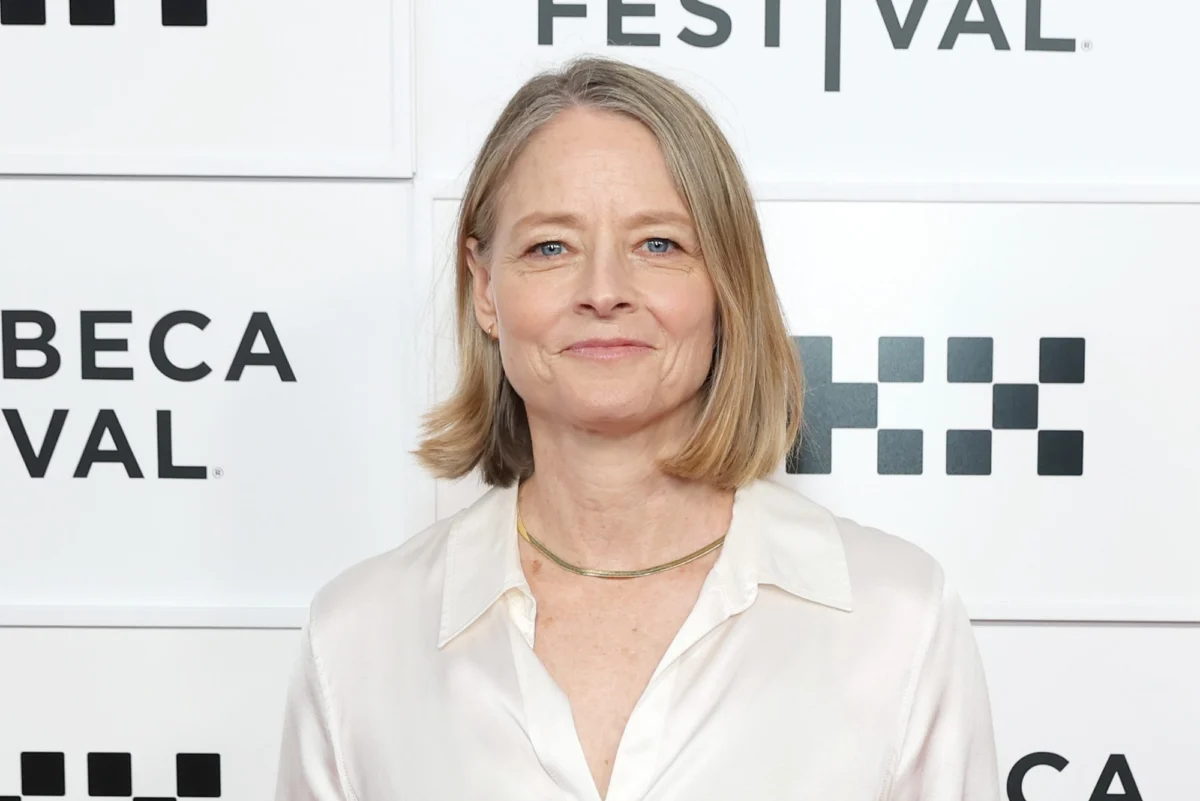
In an era where the boundary between human creative expression and machine-generated content is becoming increasingly porous, Hollywood finds itself at a defining inflection point. During a candid and thought-provoking appearance at the Aspen Festival of Ideas this week, legendary actress and director Jodie Foster ignited a broader conversation regarding the trajectory of the film industry. In a discussion titled "Who Owns the Future of Hollywood," moderated by former Sony Pictures CEO Michael Lynton, Foster pointed to the massive Apple blockbuster F1—starring Brad Pitt—as a potential litmus test for how artificial intelligence might be quietly, yet fundamentally, altering the architecture of cinematic storytelling.
The "F1" Hypothesis: Can AI Mimic the Soul of Cinema?
Jodie Foster’s critique of F1 was not delivered as a condemnation, but rather as an observation of a shifting paradigm. The film, which features high-octane racing sequences and a traditional narrative arc, has been a commercial juggernaut, grossing $634 million worldwide and earning four Academy Award nominations, including a win for Best Sound. Yet, for Foster, the film’s very perfection is what signals the arrival of the machine age.
"I don’t say this disparagingly—how could I? This movie went on to make millions of dollars," Foster noted, punctuated by a knowing laugh. "But I look at a movie like F1 and I’m like, F1 was made by AI. Wasn’t it? The structure was exactly the structure that you would learn in school. The actors say the lines exactly the way it would be written if a computer was writing exactly what would be the right thing for that time."
Foster’s comments highlight a growing anxiety among creative professionals: that the "formula" for a successful blockbuster—once the domain of veteran screenwriters and studio executives—has been so thoroughly codified by data analytics and algorithmic modeling that AI can now replicate it with frightening precision. By "dominating the technology," as Foster put it, studios can produce "big and beautiful" content that appeals to the broadest possible demographic, even if the creative DNA of the project feels synthesized.
A Chronology of Technological Disruption
To understand Foster’s perspective, one must look at the historical evolution of Hollywood’s relationship with technology. The industry has always been a marriage of art and engineering, but the shift from practical effects to Computer Generated Imagery (CGI) in the 1990s marked the first major divergence in how stories were crafted.
- The Digital Transition (1990s–2000s): The rise of CGI allowed directors to visualize the impossible. Films like Jurassic Park and The Matrix redefined spectacle. While labor-intensive, these tools remained firmly under the manual control of human artists.
- The Data-Driven Era (2010s): As streaming services began to dominate, the importance of viewer data skyrocketed. Platforms like Netflix and Apple began using algorithms to determine what audiences wanted to watch, often guiding casting decisions and genre development based on predictive modeling.
- The Generative AI Frontier (2023–Present): With the arrival of Large Language Models (LLMs) and advanced image-generation tools, the industry moved from using computers as a brush to using them as a co-author. The 2023 WGA and SAG-AFTRA strikes were direct responses to this encroachment, marking the first major labor battle over the definition of "creative work" in the age of automation.
Foster, who has witnessed decades of these transitions, views AI not as a singular event, but as "one more giant step forward into changing the industry." She acknowledges that the disruption is no longer just about visual spectacle, but about the very essence of human performance and dialogue.
Supporting Data: The Economics of Automation
The economic implications of AI in Hollywood are as significant as the artistic ones. During the Aspen panel, Michael Lynton posed the central question of the decade: "Is it going to replace actors and writers?"
Foster’s answer was pragmatic and sobering. "We do replace people," she admitted, citing the industry’s increasing reliance on digital doubles and AI-generated background extras. In the past, a large-scale crowd scene required the hiring of hundreds of background actors. Today, software can replicate a few dozen actors into a virtual throng, saving studios millions in logistical and payroll costs.
The economic pressure to reduce human overhead is immense, especially as production budgets for tentpole films like F1 continue to balloon. Foster’s solution lies in the power of organized labor. "We’re getting rid of a lot of jobs and hopefully, things like unions will be able to come in and say, ‘You can use my actor 20 times, but you’re going to pay him 20 times.’ And I think that’s fair."
This highlights the critical role of collective bargaining in ensuring that as AI scales, the compensation for human creators does not vanish. If an AI model is trained on the likeness or the writing style of a human, that human deserves a royalty commensurate with the value produced by their digital surrogate.
The Promise of "Dominating the Technology"
Despite her cautionary tone, Foster is not a Luddite. She identifies a clear distinction between using AI to replace human creativity and using it as a sophisticated, helpful tool. She pointed to her recent work in My Private Life, where she utilized AI to create dream-like sequences that would have been impossible or prohibitively expensive to capture through traditional means.
"What we all would love is that filmmakers would be able to dominate AI, and never lose sight of that," she explained. Even when the AI-generated imagery "made no sense" in a literal, rational way, it served the emotional and aesthetic intent of the director. This, for Foster, is the key: AI should remain a subordinate tool in the hands of a visionary director, rather than the primary architect of a project.
"If we are able to dominate AI consistently over time," she argued, "we will be able to make things that reflect us, and we can make things better." The goal, therefore, is not to ban the technology, but to ensure that the human "soul" of a film—the messy, irrational, and deeply personal choices—remains the driving force.
Implications for the Future of Hollywood
The implications of Foster’s warning are profound for both the industry and the audience. If the structure of a hit film can be perfectly simulated, does the audience lose the capacity to be surprised?
- The Homogenization of Content: There is a genuine risk that as AI-driven screenwriting becomes more prevalent, films will become increasingly similar, adhering to a "Goldilocks" zone of plot beats that maximize engagement while minimizing creative risk.
- The Value of "Human-Made" Art: Just as the advent of photography pushed painters toward abstraction and expressionism, the rise of AI film might drive a resurgence in human-centric, idiosyncratic storytelling. A "Human-Made" label could eventually become a premium marketing tag.
- The Regulatory Landscape: The legislative battle over copyright, digital likenesses, and the use of proprietary data to train AI models is only just beginning. The success of future films will depend not just on technology, but on the legal framework that defines who "owns" the output of a machine.
As of this writing, Variety has reached out to Apple, the producers of F1, and screenwriter Ehren Kruger for comment. While they have yet to respond, the conversation Foster ignited in Aspen will likely reverberate through executive boardrooms and writers’ rooms for years to come.
Ultimately, Jodie Foster’s reflection serves as a call to action. We are moving into an era where we can automate the mechanics of storytelling, but we cannot automate the human experience. Whether the future of cinema is one of sterile, algorithmic perfection or a new, AI-enhanced era of human expression depends entirely on who holds the remote control—and whether they are brave enough to let the machine do the heavy lifting without letting it write the script of our collective culture.