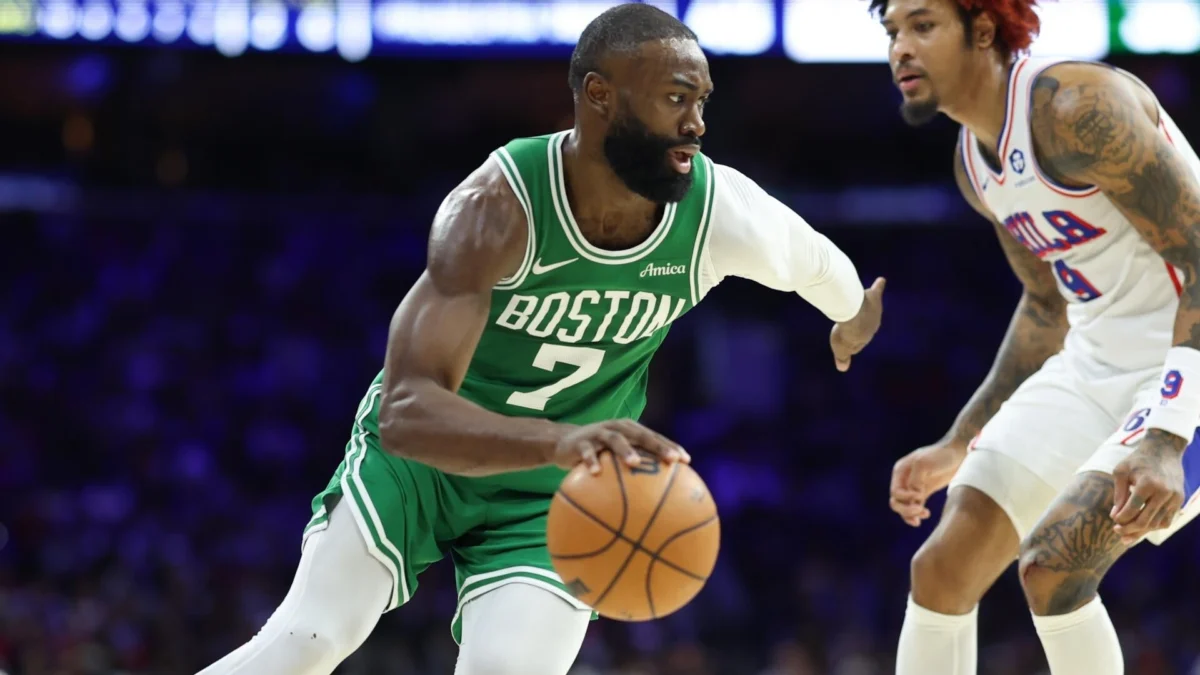
In a move that has sent shockwaves through the NBA’s competitive hierarchy, the Boston Celtics and the Philadelphia 76ers finalized a blockbuster trade on Wednesday that fundamentally altered the championship outlook for both franchises. By sending 2024 NBA Finals MVP Jaylen Brown to their Atlantic Division rivals in exchange for veteran star Paul George and a significant haul of draft capital, the Celtics have pivoted toward a new era, while the 76ers have aggressively positioned themselves as legitimate title contenders.
The market response was instantaneous. Within hours of the news breaking, the betting landscape shifted dramatically, reflecting a newfound optimism in Philadelphia’s championship pedigree and a skeptical view of Boston’s return on investment.
The Core Transaction: Breaking Down the Assets
The trade, which has dominated the news cycle since its announcement by ESPN’s Shams Charania, is complex in its long-term implications. For the Philadelphia 76ers, the acquisition of Jaylen Brown is a clear "all-in" maneuver. Brown, who finished last season averaging a career-best 28.7 points per game, brings elite two-way versatility and championship experience to a Philadelphia core that already features the explosive Tyrese Maxey and the perennial MVP-caliber threat Joel Embiid.
In return, the Boston Celtics receive:
- Paul George: A nine-time All-Star and future Hall of Famer who, despite being 36 years old, remains a highly efficient perimeter threat.
- Draft Capital: Two first-round picks, most notably an unprotected 2031 first-round pick, and two additional second-round picks.
The inclusion of the 2031 pick is particularly noteworthy, suggesting that Boston is betting on a potential decline in Philadelphia’s window, while the Sixers are betting that Brown is the final piece of a puzzle that leads to a Larry O’Brien Trophy.
A Chronology of the Fallout
The road to this trade was neither linear nor simple. To understand how we arrived at this pivotal moment, one must look at the turbulent events of the last few months:

- The Playoff Collapse: The narrative began in late spring, when the 76ers stunned the basketball world by eliminating the Boston Celtics in a gritty first-round playoff series. The series was defined not just by basketball, but by palpable animosity.
- The Viral Feud: In the aftermath of that series, tensions reached a boiling point when Jaylen Brown was caught on a viral livestream criticizing Joel Embiid, explicitly labeling him a "flopper." This public declaration of dislike created an immediate, glaring question mark regarding team chemistry following the trade.
- The "Giannis" Pivot: Behind the scenes, Boston’s front office was not looking to rebuild. Reports indicate that following their playoff exit, the Celtics aggressively pursued a deal for Milwaukee Bucks superstar Giannis Antetokounmpo, offering a package centered around Brown. When Milwaukee opted to send Antetokounmpo to the Miami Heat instead, Boston was left in a precarious position.
- The Decision: Faced with a fractured locker room dynamic and a star who had publicly insulted the franchise’s new cornerstone, Boston leadership chose to maximize their return while they still could, pulling the trigger on the Philadelphia deal.
Supporting Data: The Market’s Verdict
The reaction from the betting public has been visceral. According to data from DraftKings, the Philadelphia 76ers have seen their championship odds slashed from a +5500 longshot at the start of free agency to a legitimate contender at +2000 as of July 3.
Championship Odds Comparison (Post-Trade)
| Team | Odds (Pre-Trade) | Odds (Post-Trade) |
|---|---|---|
| Philadelphia 76ers | +5500 | +2000 |
| Boston Celtics | +650 | +1100 |
The disparity in the market’s reaction is striking. While Philadelphia has surged into the top tier of contenders—trailing only the San Antonio Spurs, Oklahoma City Thunder, New York Knicks, and the Celtics themselves—Boston has retreated. The Celtics’ odds to repeat as Eastern Conference champions have slipped from +230 to +425, signaling that oddsmakers view the departure of Brown as a net negative, despite the arrival of veteran big man Mitchell Robinson.
The Chemistry Conundrum
The most fascinating aspect of this trade is the human element. The NBA has seen "superteams" fail before due to personality clashes, and the Brown-Embiid pairing is perhaps the most scrutinized "arranged marriage" in recent memory.
Brown brings a scoring punch that ranks him among the league’s elite, while Maxey—who averaged 28.3 points per game—provides the backcourt speed to complement him. Add in the interior dominance of Embiid, and the rising star potential of 20-year-old VJ Edgecombe, and the 76ers possess an offensive ceiling that is arguably higher than any team in the East.
However, talent does not always translate to chemistry. The viral comments regarding Embiid’s style of play remain a hurdle. Whether these two can set aside their competitive vitriol for the sake of a championship run will be the primary storyline for the 76ers’ training camp in the fall.
Strategic Implications: Boston’s New Identity
For the Boston Celtics, the departure of Brown marks the end of a championship-winning era. By acquiring Paul George and adding Mitchell Robinson, the team is attempting to pivot toward a more seasoned, albeit aging, roster.

The strategy appears to be one of "retooling on the fly." By accumulating draft assets and acquiring a high-IQ veteran in George, Boston is hedging its bets. They are betting that George’s experience can provide the floor-spacing necessary to keep them relevant, while the future draft picks provide the liquidity to make further moves if the current iteration of the team fails to meet expectations.
However, the skepticism from the betting market is rooted in reality. Replacing a 27-year-old Finals MVP with a 36-year-old veteran is, on paper, a step back. The Celtics front office is effectively betting that their organizational culture is strong enough to absorb the loss of Brown and maintain their status as the kings of the Atlantic Division.
Conclusion: A High-Stakes Gamble
The trade represents a classic high-stakes gamble for both organizations. The Philadelphia 76ers have chosen to bet their immediate future on the explosive potential of a Brown-Embiid-Maxey trio, hoping that individual talent can override historical friction.
Conversely, the Boston Celtics have opted for a more conservative, asset-based approach, sacrificing a prime superstar to ensure they aren’t left empty-handed in a rapidly changing Eastern Conference. As the league enters the summer lull, all eyes will be on Philadelphia and Boston. Will the 76ers justify their shortened odds, or will the weight of the trade’s backstory prove too heavy to overcome?
One thing is certain: the landscape of the NBA has shifted, and the road to the 2027 title now runs through a much more complicated Philadelphia rotation. Fans and bettors alike are waiting to see if this trade will be remembered as the masterstroke that delivered a title or a cautionary tale of prioritizing talent over synergy. For now, the numbers have spoken: the market believes in the Sixers, but the true test begins when the ball tips off in October.