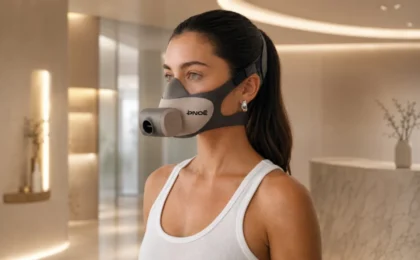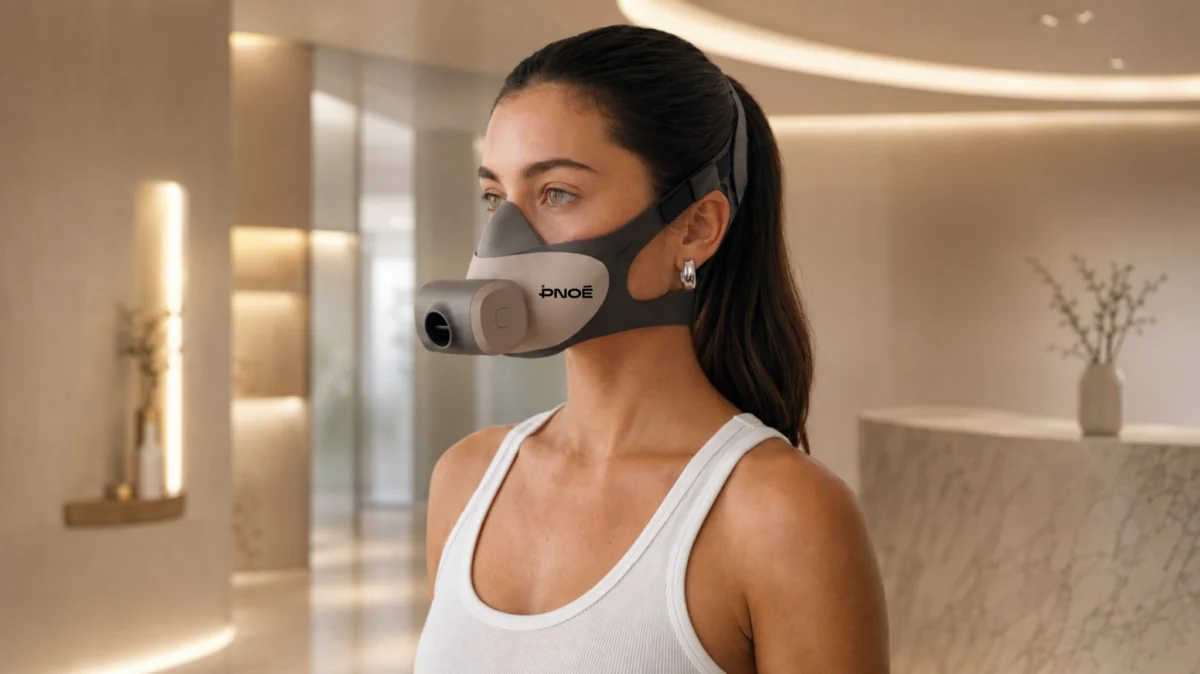
At first glance, the newest device from Massachusetts-based health-tech firm PNOĒ looks like something pulled directly from the wardrobe of a comic-book villain. The mask, which covers the nose and mouth and secures firmly around the back of the head, bears a striking resemblance to the intimidating gear worn by Bane, Batman’s hulking nemesis. However, the intent behind this piece of hardware is anything but menacing; it is designed to unlock the secrets of human performance and longevity.
By measuring the precise volume of oxygen consumed and carbon dioxide exhaled during an eight-minute session, PNOĒ’s technology translates complex respiratory data into actionable insights for nutrition, training, and long-term health. On October 1, the company is set to launch the PNOĒ 2.0, a significant evolution of its platform that promises to transition metabolic testing from the exclusive, lab-bound domain of elite athletes into the mainstream of gyms, spas, and wellness centers.
The Science of Breath: Breaking Out of the Lab
For over a century, metabolic testing has served as the gold standard for gauging cardiorespiratory fitness. By analyzing gas exchange, clinicians have historically been able to determine VO2 max—the maximum rate at which an individual’s body can utilize oxygen during intense exercise. It is a metric widely regarded by physiologists as one of the most accurate predictors of human longevity and overall metabolic health.
However, until recently, obtaining these metrics required bulky, expensive, and intimidating equipment found only in high-end sports labs or clinical hospitals. This barrier to entry meant that such testing was largely the province of professional athletes and the ultra-wealthy.
PNOĒ’s mission has been to shrink that "clinical cart" into a portable, user-friendly package. "We made it accessible to everyone," says Apostolos Atsalakis, co-founder and CEO of PNOĒ. The company’s technology captures 23 distinct biomarkers, including resting metabolic rate (the number of calories burned while at rest) and metabolic flexibility (the body’s efficiency in switching between fat and carbohydrate fuel sources). For wellness enthusiasts, these numbers offer a level of precision that blood panels and standard smartwatches simply cannot provide.
The Evolution of PNOĒ: A Chronology of Innovation
The roots of PNOĒ trace back to the University of Cambridge, where Atsalakis was completing his PhD in sensing technologies. During this time, the wearable device market was beginning to explode, yet Atsalakis felt that the industry was neglecting the most vital indicator of human function: the breath.
"I became fascinated by what the breath could reveal about the body," Atsalakis recalls. Alongside his childhood friend and current Chief Product Officer, Panos Papadiamantis, he set out to build a sensor that could bridge the gap between medical diagnostics and consumer-facing wellness.
- 2014: PNOĒ is founded, with initial operations established in Malden, Massachusetts, and Athens, Greece.
- 2019: The company participates in the Y Combinator Winter batch, entering the accelerator program just as the "longevity" industry was beginning to gain mainstream cultural traction.
- 2020–2023: PNOĒ secures $22 million in funding, including an $11 million round led by investors such as 50 Years and Google Maps co-founder Lars Rasmussen.
- October 2024: The scheduled launch of the PNOĒ 2.0, representing the culmination of years of iterative design with the Milan-based Design Group Italia.
The 2.0 iteration is the result of what Atsalakis describes as "a lot, a lot, a lot of iterations." Because a self-administered metabolic testing device of this caliber had never been built before, the design team had to rethink every component, resulting in a more compact, reliable, and hygienic device.
Removing the Middleman: The "Business in a Box" Model
Perhaps the most transformative change in the 2.0 version is the removal of the need for a trained operator. Current versions of the device require a technician to manage the calibration and data interpretation, which limits where the testing can occur.
The new self-serve model allows a user to simply enter a facility, strap on the mask, push a button, and sit for eight minutes. This "plug-and-play" capability effectively opens the door for implementation in standard gyms, wellness studios, and potentially even pharmacies.
The company employs a "business in a box" subscription model, costing businesses between $400 and $1,000 per month. This fee includes the hardware, the software platform, staff training, and marketing materials. For a business like a high-end gym (such as existing client Equinox) or a med-spa (like Restore Hyper Wellness), the value lies in integration. PNOĒ’s software doesn’t just provide raw data; it maps that data to the services the facility sells, allowing personal trainers or nutritionists to offer highly personalized, data-driven programs to their clients.
Supporting Data and Market Positioning
PNOĒ currently serves an impressive roster of high-profile clients, including the NBA, the Four Seasons, and the Mount Sinai Health System. While the United States accounts for 85% of their business—a market Atsalakis identifies as the world’s most advanced regarding longevity—the company is rapidly expanding its footprint into Europe, Latin America, and Asia.
With 110 employees and a growth rate exceeding 100% annually, the company has recently reached profitability. This financial health provides a stable foundation as they prepare to raise a Series B round in the coming 6–12 months.
The competitive landscape is, however, intensifying. PNOĒ occupies a unique "middle ground" in the market. On one end, you have traditional, expensive metabolic carts used by medical professionals; on the other, you have consumer wearables like Apple, Garmin, and Whoop, which provide estimates of VO2 max based on heart-rate variability and other proxies. PNOĒ differentiates itself by providing a clinical-level measurement of gas exchange without the clinical-level friction.
Regulatory Boundaries and Future Implications
Despite its clinical appearance and high-level accuracy, PNOĒ is careful to avoid the "medical device" label in its current marketing. The device is not currently FDA-cleared, and the company explicitly states that they do not provide medical recommendations or diagnoses.
"It’s like a body composition device, like a scale," Atsalakis explains. "A doctor cannot prescribe medication based on our results."
This distinction is vital for regulatory compliance, but it may not be the company’s permanent stance. Researchers have long explored the potential for human breath to serve as a diagnostic tool for diseases, including cancer and respiratory conditions. Atsalakis acknowledges that as the company’s data pool grows, the potential for flagging specific health issues increases. However, he remains pragmatic about the timeline. "We’re not there yet," he says, noting that full clinical diagnostic capabilities are likely years away, hindered by significant regulatory hurdles.
The Verdict: A New Standard for Wellness?
The shift toward "proactive health" is perhaps the defining wellness trend of the 2020s. As more individuals seek to optimize their biology rather than simply treating illness, the demand for high-fidelity data will only continue to rise.
By transforming the intimidating, mask-heavy metabolic test into a simple, eight-minute session, PNOĒ is positioning itself as the "scorecard" for the booming longevity industry. Whether the 2.0 version will achieve the same ubiquity as a heart-rate monitor remains to be seen, but the company has successfully cleared the two greatest hurdles in consumer health tech: accessibility and ease of use.
As the company prepares for its October launch, the focus is clear: put the mask on as many faces as possible. If the data is as compelling as the company claims, the "Bane mask" might soon be the most coveted accessory in the modern gym.