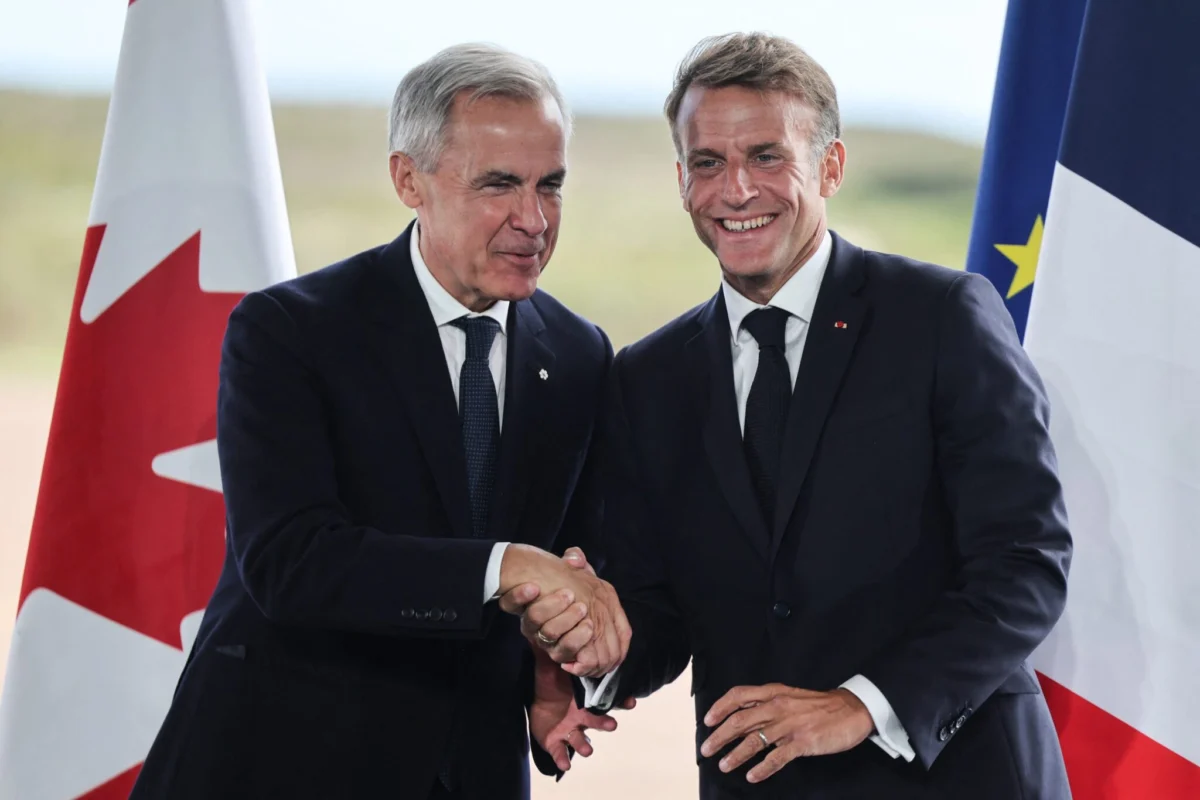
SAINT-PIERRE-ET-MIQUELON — In a move that signals a historic pivot in North American foreign policy, Canadian Prime Minister Mark Carney and French President Emmanuel Macron met Sunday to formalize a sweeping strategic partnership. The agreement, spanning the frontiers of space, defense, energy, and advanced technology, marks a definitive effort by Ottawa to diversify its geopolitical dependencies away from the United States and toward a deeper integration with the European Union.
The summit took place on the windswept French archipelago of Saint-Pierre-et-Miquelon, located just off the coast of Newfoundland. Against the backdrop of escalating trade tensions with Washington and a volatile global energy market, the two leaders outlined a vision for a "future-proofed" alliance built on shared democratic values and economic resilience.
Main Facts: A Multi-Sectoral Strategic Deepening
The core of the Sunday agreement rests on four primary pillars: aerospace cooperation, defense infrastructure, energy security, and technological sovereignty. Unlike previous bilateral agreements, this framework seeks to integrate the operational capacities of both nations’ space agencies and defense ministries.
Aerospace and Defense Integration
Prime Minister Carney announced that Canada and France would begin sharing critical infrastructure, including satellite launch systems and ground-based reception facilities. This move is particularly significant for Canada, which has traditionally relied on U.S. infrastructure for its space-based communications and surveillance. By partnering with France—a cornerstone of the European Space Agency (ESA)—Canada gains a secondary gateway to orbit, ensuring that its telecommunications and climate-monitoring capabilities remain robust regardless of political shifts in Washington.
The Energy Bridge
With the ongoing Iran war disrupting traditional supply lines in the Middle East and sending global fuel prices into a tailspin, energy security dominated a significant portion of the talks. President Macron explicitly identified Canada as a vital partner in France’s quest to secure alternative energy sources. The agreement paves the way for increased exports of Canadian Liquefied Natural Gas (LNG) from the Atlantic coast to French terminals, alongside a dedicated framework for the trade of critical minerals and rare earth elements essential for the green energy transition.
Technological Sovereignty
The leaders also committed to joint ventures in "frontier technologies," specifically quantum computing, supercomputing, and advanced satellite arrays. The goal is to create a Franco-Canadian technological ecosystem that can compete with the massive R&D spending of the U.S. and China, ensuring that both nations maintain control over their digital infrastructure and intellectual property.
Chronology: The Path to Saint-Pierre-et-Miquelon
The seeds of this weekend’s summit were sown over months of increasing friction between Ottawa and the White House. The timeline of this diplomatic shift highlights a rapid acceleration of Canadian-European rapprochement.
- The Tariff Escalation: Throughout the previous quarter, U.S. President Donald Trump intensified a campaign of economic pressure on Canada, utilizing tariffs and demands for concessions that Carney’s administration characterized as "economic coercion."
- The "51st State" Rhetoric: Diplomatic relations reached a nadir following repeated public suggestions from the U.S. executive that Canada should be absorbed as the "51st state," a sentiment that sparked widespread nationalist backlash across Canada.
- The EU Membership Pitch: Just days prior to his meeting with Macron, Prime Minister Carney delivered a landmark speech in which he embraced the prospect of Canada becoming the European Union’s first "associate member." This proposal served as a formal signal to the world that Canada was ready to look across the Atlantic for its primary economic and security architecture.
- The Greenland Precedent: The geopolitical atmosphere was further complicated by the recent U.S. deal regarding Greenland. While the deal kept Greenland under Danish control, it significantly expanded the U.S. military footprint in the Arctic.
- The Sunday Summit: Macron arrived in Saint-Pierre-et-Miquelon on Saturday, welcoming Carney to the French territory on Sunday morning. The choice of location—a piece of France in North American waters—was a deliberate symbolic gesture of the proximity and shared interests of the two nations.
Supporting Data: Economic and Geopolitical Metrics
The rationale for this realignment is grounded in stark economic and geographic realities.
The Energy Landscape
France, and Europe at large, is facing a severe energy deficit due to the Iran war. Canada, the world’s fourth-largest producer of oil and fifth-largest producer of natural gas, represents a stabilizing force.
- LNG Potential: Currently, the majority of Canadian energy exports are directed south to the U.S. The new agreement seeks to redirect a significant percentage toward Europe’s Atlantic coast.
- Critical Minerals: Canada holds some of the world’s largest deposits of 31 minerals considered "critical" by the EU and France, including lithium, cobalt, and nickel—the building blocks of the electric vehicle (EV) battery industry.
Geographic Significance
Saint-Pierre-et-Miquelon, though home to only 5,800 residents, serves as a strategic outpost. Its proximity to Newfoundland makes it the ideal site for shared ground-based reception facilities for North Atlantic satellite monitoring.
Economic Diversification
Canada’s trade is currently overwhelmingly concentrated with the U.S. (approximately 75% of exports). The "Associate Member" status with the EU would open a market of over 450 million consumers, potentially reducing Canada’s U.S. trade dependency by an estimated 15-20% over the next decade.
Official Responses: Quotes from the Summit
The rhetoric at the summit was one of defiance against isolationism and a celebration of "middle-power" cooperation.
Prime Minister Mark Carney:
"Canada and Europe will build an alliance for the future that will strengthen our collective resilience so we can live our lives as we choose, based on the values that we share. We are no longer content to be a junior partner in a continental monopoly. We are a sovereign nation with global ambitions, and today we choose a partnership of equals."
President Emmanuel Macron:
"This is an important moment. Our talks will allow us to strengthen our bilateral economic ties and defense relationship. Canada is a country with significant resources… What we want to do is conclude agreements to secure more liquefied natural gas that can be shipped to Europe’s Atlantic coast. Beyond energy, we are defending a shared vision of international law."
Regarding the recent U.S. deal on Greenland, Macron offered a measured but firm approval: "Danish sovereignty is being respected, international law is being respected. Anything that helps ease tensions is a good thing."
Implications: A New Global Geometry
The implications of the Carney-Macron summit extend far beyond the borders of Canada and France. This meeting may be remembered as the moment the "Post-War Consensus" in North America finally fractured, giving way to a more fragmented and multi-polar Atlantic reality.
1. The End of the "Special Relationship"?
For decades, the U.S.-Canada relationship was considered one of the most stable and integrated in the world. The shift toward France and the EU suggests that Ottawa now views the U.S. as an unpredictable partner. If Canada successfully pursues associate membership in the EU, it could trigger a fundamental rethinking of the North American Free Trade framework.
2. A Strategic "Third Way" for Middle Powers
The Canada-France alliance provides a blueprint for other "middle powers" looking to navigate the rivalry between the U.S. and other global titans. By pooling resources in high-tech sectors like quantum computing and space infrastructure, these nations can maintain a level of technological independence that would be impossible to achieve alone.
3. Arctic Sovereignty and Security
With the U.S. expanding its presence in Greenland and Canada deepening ties with France (a NATO ally with its own Arctic interests), the high north is becoming a crowded theater. The cooperation on launch systems and satellite monitoring suggests that Canada is preparing to assert its Arctic sovereignty with European assistance, rather than relying solely on the North American Aerospace Defense Command (NORAD).
4. Economic Resilience against Coercion
Carney’s focus on "economic coercion" is a direct response to the weaponization of trade. By diversifying energy exports and critical mineral supply chains, Canada is building a "shield" against potential future tariffs or trade wars. For France and the EU, this provides a reliable, democratic source of energy that is not subject to the whims of Middle Eastern conflict or Russian influence.
5. The Future of the EU
If Canada becomes an associate member, it would be a historic expansion of the European project beyond the European continent. This could redefine the EU not just as a regional bloc, but as a global community of democratic states aligned by economic and legal standards.
As the sun set over the rocky shores of Saint-Pierre-et-Miquelon, the message from Carney and Macron was clear: the Atlantic Ocean is no longer a barrier to be crossed, but a bridge to be fortified. In an era of "America First," Canada has decided that its best path forward may be to look East.