
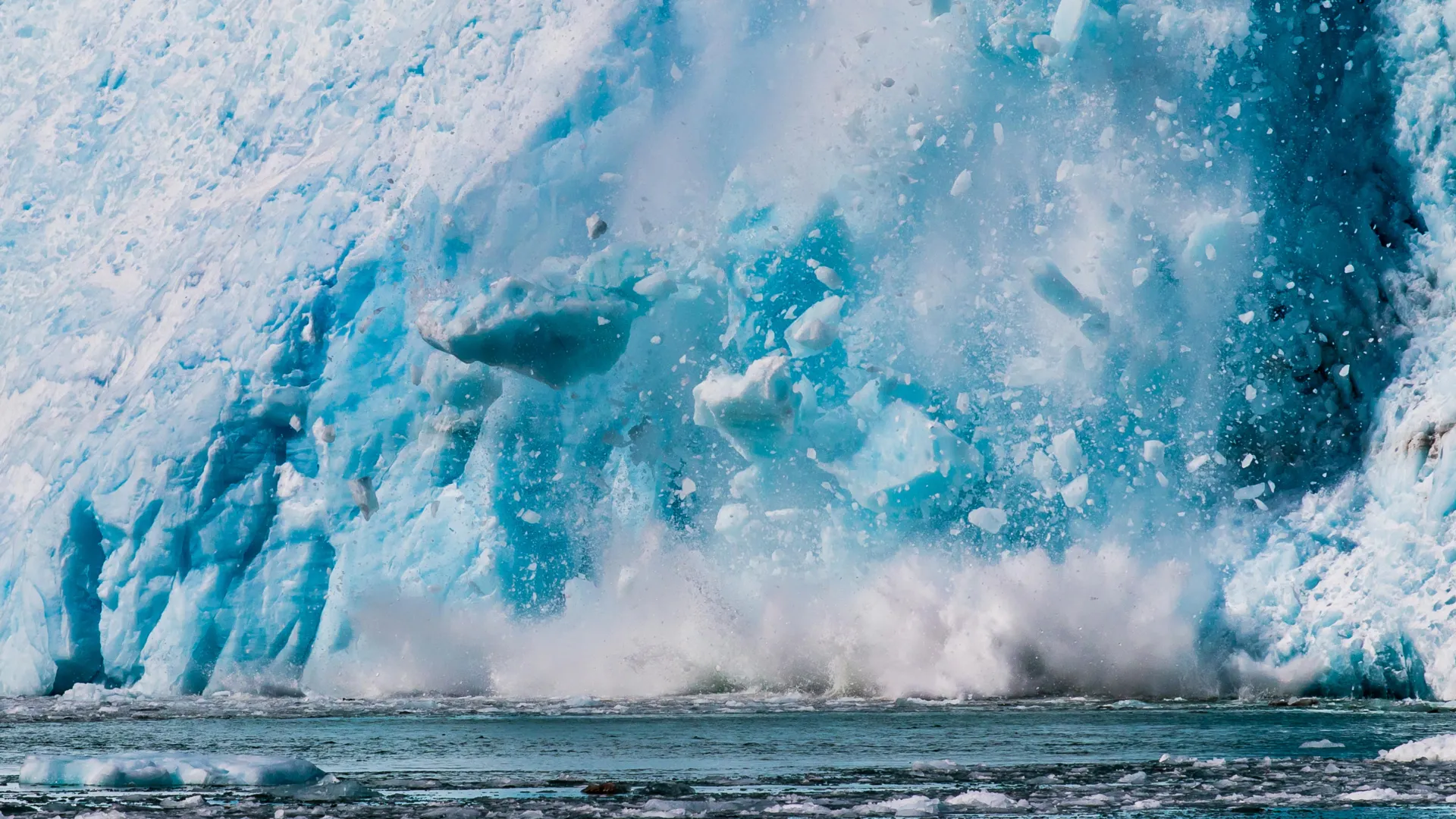
Alaska’s Vanishing Giants: New Satellite Radar Study Reveals Accelerating Glacier Melt

The majestic glaciers of Alaska, long considered the frozen sentinels of the North, are receding at an alarming pace. New research published in the journal Nature has unveiled a direct and chilling correlation between rising temperatures and the degradation of these massive ice bodies: for every 1 degree Celsius (1.8 degrees Fahrenheit) increase in average summer temperatures, the window for glacier melting extends by approximately three weeks.
This study, which utilizes cutting-edge synthetic aperture radar (SAR) technology, offers a more granular and consistent look at the state of Alaska’s glaciers than ever before. By monitoring thousands of glaciers from 2016 to 2024, researchers have moved beyond the limitations of traditional optical observation, providing a high-definition view of how extreme heat—and the resulting loss of protective snow cover—is fundamentally altering the Alaskan landscape.
The Technological Leap: Why Radar Changes Everything
For decades, glaciologists have relied on optical satellite imagery to track the "snowline"—the critical boundary separating the accumulation zone, where snow builds up to add mass, and the ablation zone, where melting occurs. However, optical monitoring is inherently flawed. It is entirely dependent on clear skies, consistent lighting, and the timing of the observations.
"In optical data, the snowline can be really hard to observe," says Mark Fahnestock, a co-author of the study and a researcher at the University of Alaska Fairbanks Geophysical Institute. "If you’re a day late taking your picture, it might have snowed on the entire glacier, and you can’t see where the bare glacier ice is down below and where the snow and firn is above."
Firn—the partially compacted, granular snow that acts as a buffer—is particularly difficult to identify using standard cameras, especially when cloud cover or shadows obscure the terrain. The new methodology, spearheaded by Albin Wells, a recent Ph.D. graduate from Carnegie Mellon University, operationalizes the use of Sentinel-1 radar satellites.
Synthetic aperture radar functions by transmitting microwave pulses toward the Earth’s surface and interpreting the returning signals to generate detailed topographical maps. Because radar waves penetrate cloud cover and operate independently of sunlight, the team was able to track over 3,000 Alaskan glaciers with a temporal resolution of just 12 days. This provides a year-round, consistent dataset that optical methods simply cannot replicate, effectively removing the "blind spots" that have historically hindered climate modeling.
Chronology of a Crisis: The 2019 Heat Wave
To understand the impact of extreme weather events on glacier mass, the research team focused heavily on the historic Alaska heat wave of June 23 to July 10, 2019. This event serves as a grim case study in how quickly atmospheric variability can strip a glacier of its defenses.
During those eighteen days, temperatures across much of the state soared 20 to 30 degrees Fahrenheit above historical averages. At the Ted Stevens Anchorage International Airport, thermometers hit 90 degrees—a staggering deviation from the typical summer high of the mid-60s.
The data captured by the Sentinel-1 satellites during this window was striking. The extreme heat forced glacier snowlines upward by nearly 350 feet in elevation. Under normal climatic conditions, those snowlines would not have reached such heights for another two months. By stripping away the protective layer of snow prematurely, the heat wave exposed the darker, more absorbent bare ice and firn beneath. This feedback loop accelerates melting, as the exposed surfaces absorb more solar radiation, leading to greater overall ice loss.
Supporting Data: Quantifying the Melt
The study introduces a vital metric for climate scientists: the "melt day." A melt day is defined either as a full 24-hour cycle of melting across an entire glacier or a cumulative period where the sum of melting across various glacier sections equals the total surface area of that glacier.
The data reveals that the melt season is lengthening significantly. By analyzing the nearly 3,000 glaciers across Alaska—every glacier larger than approximately half a square mile—the team discovered that short-term heat waves are not just minor fluctuations; they are major drivers of annual mass loss. In some mountain ranges, these warm periods caused glaciers to lose up to 28% more protective snow than they would in a typical, cooler year.
This loss of "mass balance"—the delicate equilibrium between the snow gained in winter and the ice lost in summer—is the primary indicator of a glacier’s health. When a glacier’s mass balance becomes persistently negative, it signals that the ice is not merely retreating but is in a state of terminal decline.
Coastal vs. Inland: A Tale of Two Climates
One of the study’s most nuanced findings is the distinct behavioral difference between coastal glaciers and those located deeper inland. While the overall rate of ice loss appears similar across the state, the mechanics of that loss vary significantly.
Coastal glaciers, influenced by maritime weather patterns, tend to experience higher rates of summer melting but also benefit from significantly higher winter accumulation. Inland glaciers, shielded from the immediate moisture of the Pacific, operate in a more arid environment with less seasonal snowfall.
"This is an important finding," says Wells. "It corroborates prior knowledge that glaciers in Alaska on the coastal side of mountains have more melt in summer and more accumulation in winter than those on the continental side of the ranges." This distinction is critical for climate modelers, as it suggests that the two groups of glaciers possess different levels of resilience—or vulnerability—to future climatic shifts.
Official Responses and Expert Perspective
The study, led by Albin Wells with contributions from Carnegie Mellon assistant professor David Rounce and UAF’s Mark Fahnestock, has been hailed as a landmark in operationalizing remote sensing for glaciology.
"Our ability to quantify these changes is really important," Wells noted in his post-publication remarks. "Melt extents and snowlines are proxies for glacier mass balance. These correlations with temperature begin to give a sense for how much melt or snowline retreat we can anticipate under future, warmer climates across the region."
The shift toward radar-based monitoring is being adopted by the wider scientific community as the new gold standard. By removing the guesswork associated with optical data, researchers can now provide policymakers with far more accurate predictions regarding sea-level rise and local water availability.
Implications: A Future Defined by Heat
The implications of this research are profound. As the average global temperature continues to climb, the findings suggest that the 3-week-per-degree-Celsius rule will likely hold true, leading to longer, more intense melt seasons.
The loss of Alaskan glaciers is not merely a regional issue; it is a global one. Alaska’s glaciers are significant contributors to sea-level rise, and their decline impacts everything from local salmon habitats to the hydroelectric potential of the state’s river systems.
Furthermore, the study underscores the extreme sensitivity of these frozen giants to "short-term climatic variability." While long-term warming trends are the primary concern, the frequency and intensity of heat waves like the one seen in 2019 are creating "shocks" to the system that the glaciers cannot recover from.
As we look toward the future, the work of Wells, Rounce, and Fahnestock provides both a warning and a tool. We now have the technology to monitor the pulse of the North with unparalleled precision. Whether that information is used to mitigate the impacts or simply to document the transformation of the Arctic, one thing remains clear: the ice is retreating, and the time for observation is rapidly turning into a time for urgent response.
The study, published in Nature, serves as a definitive reminder that in the high-stakes environment of climate change, the most critical data is that which we can no longer afford to ignore.