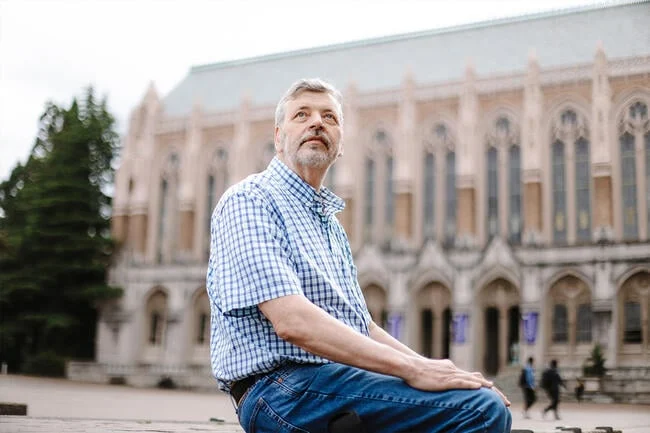
After a grueling four-year legal battle that traversed the halls of the Ninth Circuit Court of Appeals, the University of Washington (UW) has reached a definitive settlement with computer science professor Stuart Reges. The agreement, which includes a $600,000 payout for damages and legal fees, effectively concludes a high-profile constitutional clash over the boundaries of academic freedom, institutional speech, and the controversial practice of land acknowledgments.
The settlement marks a significant victory for civil liberties advocates, as it cements the right of faculty members to utilize their syllabi as forums for personal expression, even when that expression directly challenges institutional orthodoxy.
The Core Conflict: A Parody of Protocol
The dispute began in 2022 when Stuart Reges, a veteran teaching professor in the Paul G. Allen School of Computer Science & Engineering, opted to include a “parody land acknowledgment” in his course syllabus. While the University of Washington had begun encouraging faculty to include formal land acknowledgments—statements recognizing the Indigenous tribes upon whose traditional territories the university sits—the practice remained optional.
Reges’s version of the statement was a direct, provocative rebuttal to the university’s recommended text. He wrote: "I acknowledge that by the labor theory of property the Coast Salish people can claim historical ownership of almost none of the land currently occupied by the University of Washington."
Reges, who has long been a vocal critic of what he perceives as institutional virtue signaling, intended the statement as a critique of the university’s boilerplate language. However, the university administration viewed the insertion as an act of hostility. The fallout was swift: the university took the unprecedented step of removing the statement from his online syllabus and, subsequently, creating a “shadow section” of his course. This move allowed students to transfer out of Reges’s class if they found his views objectionable, an action that led to approximately 30 percent of his students abandoning his course.
A Chronology of the Legal Battle
The path to the settlement was paved with significant judicial scrutiny regarding the limits of administrative authority over faculty speech.
- February 2022: The controversy erupts as students and faculty express outrage over Reges’s inclusion of the parody statement. The university administration intervenes by editing his syllabus and facilitating student transfers.
- July 2022: Represented by the Foundation for Individual Rights and Expression (FIRE), Stuart Reges files a lawsuit in federal court. The complaint alleges that the University of Washington violated his First Amendment rights by retaliating against him for protected speech.
- December 2023 – May 2024: The Ninth Circuit Court of Appeals hears the case. A majority of the panel rules decisively in favor of Reges. The court finds that the professor’s speech was not “government speech” (which the university could control), but rather private speech protected by the First Amendment. The judges noted that Reges acted in his capacity as an individual scholar, not as a spokesperson for the university.
- September 2026: Facing the prospect of further litigation and mounting legal costs following the appellate court’s rebukes, the University of Washington enters into a final settlement agreement.
Understanding the Legal Precedent
The Ninth Circuit’s rulings in this case are expected to have long-lasting implications for public universities across the United States. The central question of the litigation—whether a professor’s syllabus is a personal academic document or a piece of government-controlled communication—has been answered in favor of the former.
The court’s majority articulated a clear distinction: when a professor speaks in their own capacity, they are not necessarily representing the official stance of the state or the institution. By attempting to police the content of Reges’s syllabus, the university crossed the line from regulating administrative requirements into the territory of viewpoint discrimination.
The court specifically highlighted that Reges faced “adverse employment actions,” including a formal, lengthy disciplinary investigation and an official reprimand. These actions, the court concluded, were a direct result of the university’s disapproval of the content of his speech, which it deemed a violation of the First Amendment.
Terms of the Settlement: A Permanent Guarantee
The settlement agreement signed by both parties is comprehensive, aiming to prevent any future retaliation against Reges for his political or social views. The core components of the agreement include:

- Monetary Compensation: The University of Washington will pay $600,000 to cover damages incurred by Reges and the significant legal fees associated with his four-year defense.
- Permanent Protection of Speech: The university has formally agreed never to remove, edit, or censor Reges’s parody land acknowledgment from his current or future syllabi.
- Non-Retaliation Clause: The university is strictly prohibited from initiating future investigations, creating “shadow sections” of his courses, or withholding salary increases or promotions as a result of his statements or any student complaints regarding his speech.
For Reges, the settlement is a vindication of his role as an educator who refuses to be compelled to speak institutional slogans. As stated in the settlement documentation, the university has effectively conceded that the syllabus is a space for faculty expression.
Official Responses and Institutional Stance
The university’s reaction to the settlement reflects the tension between their legal defeat and their institutional desire to maintain their prior position. A spokesperson for the University of Washington, Victor Balta, issued a statement emphasizing that the settlement should not be interpreted as an admission of wrongdoing.
“The university maintains that we acted appropriately, and this settlement is in no way an admission of any wrongdoing,” Balta said in an email. He further noted that the university chose to settle to avoid the escalating financial burden of continued litigation, rather than due to a change in their fundamental view of the case. He added, “Prof. Reges has retained his faculty position and continued teaching throughout this process.”
Conversely, the team at FIRE expressed a sense of triumph. Gabe Walters, the lead attorney for Reges, underscored the broader cultural significance of the ruling. “Reasonable people can disagree about the value of land acknowledgments,” Walters said in a press release. “What’s not up for debate is academic freedom.”
Broader Implications for Higher Education
The Reges case is part of a growing wave of litigation concerning the “institutionalization” of social and political speech within universities. Many public institutions have adopted standard practices for land acknowledgments, diversity statements, and mission-based rhetoric. Critics argue that these practices, while well-intentioned, often function as “compelled speech,” requiring faculty and students to subscribe to a specific ideological worldview to remain in good standing.
The Syllabus as a Forum
The settlement reinforces the concept that the classroom—and the materials used to conduct classes—must remain a bastion of intellectual diversity. If universities are allowed to standardize the speech of their faculty, the unique role of the professor as a critical thinker and challenger of the status quo is diminished.
The Cost of Administrative Overreach
The $600,000 price tag serves as a cautionary tale for public university administrations. Legal battles over First Amendment rights are not only costly in terms of taxpayer dollars but also damaging to the reputation of the institution. By overreacting to a professor’s speech, the university ended up fostering the very controversy they hoped to avoid, ultimately losing in court and paying a substantial financial penalty.
The Future of Land Acknowledgments
This case may prompt universities to rethink how they implement land acknowledgments. Rather than treating them as mandatory boilerplate language—or reacting with heavy-handed censorship when challenged—institutions may move toward a model of voluntary, organic expression. If a university wishes to express its institutional values, it must do so without trampling upon the individual rights of its faculty members to hold and express dissenting views.
Conclusion
The settlement of Reges v. Cauce is a watershed moment for academic freedom in the United States. It affirms that the university is a marketplace of ideas, not a corporate entity that can dictate the ideological output of its employees. As Stuart Reges continues his tenure at the University of Washington, his syllabus remains a testament to a hard-won victory: the right to speak one’s mind, even when the administration would prefer silence.
The case serves as a reminder to academic institutions everywhere: the First Amendment does not pause at the university gates. Protecting the right to dissent, even when that dissent is controversial or mocking, is not just a legal obligation—it is the bedrock upon which the entire academic enterprise is built.