In the annals of cinematic history, few filmmakers have dared to tackle the foundational texts of Western literature with the same structural audacity as Christopher Nolan. With his latest epic, simply titled The Odyssey, Nolan has once again enlisted an A-list ensemble to dismantle and reassemble one of humanity’s oldest stories. By utilizing his signature non-linear narrative style, Nolan transforms Homer’s ancient poem into a psychological character study, exploring the trauma of war, the hubris of leadership, and the crushing weight of divine expectation.
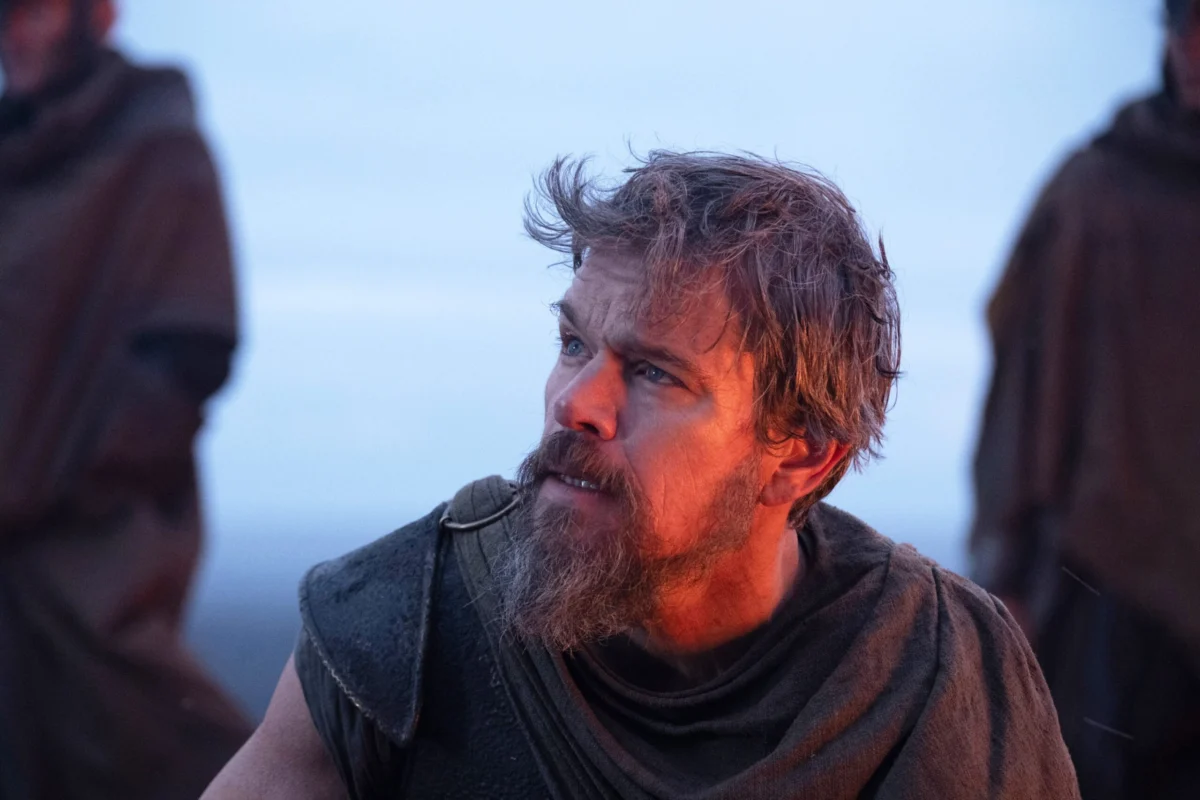
Clocking in at nearly three hours, the film serves as both a grand spectacle and an intimate meditation on homecoming. It is a work that demands the audience’s full attention, weaving together the accounts of a wandering bard—portrayed with haunting gravitas by Travis Scott—and the fragmented memories of Odysseus himself, played with weary intensity by Matt Damon.
The Chronology of a Hero’s Descent
To understand Nolan’s The Odyssey, one must navigate the temporal labyrinth he has constructed. The narrative does not move in a straight line; it pulses, alternating between the blood-soaked sands of Troy, the treacherous currents of the Mediterranean, and the suffocating tension of a palace in Ithaca under siege.
The Catalyst: The Trojan War
The tragedy begins long before the first ship sails. In the film’s opening act, we see an Ithaca defined by the strictures of Zeus’ law: hospitality. Odysseus, the king, is portrayed not just as a warrior, but as a man who values the sanctity of the guest. Yet, the peace is shattered by the abduction of Helen (Lupita Nyong’o), the queen of Sparta, by Prince Paris of Troy.
Nolan meticulously tracks the political machinations of the Greek coalition. The kings Agamemnon (Benny Safdie) and Menelaus (Jon Bernthal) initiate a war that would span a decade. It is here that we meet Sinon (Elliot Page), a pawn in Odysseus’ grand strategy. Through a series of brutal tactical decisions, Odysseus masterminds the Trojan Horse deception, an act that secures victory but sets the stage for his spiritual undoing. By weaponizing hospitality—the very thing he once held sacred—Odysseus invites the wrath of the gods.
The Odyssean Odyssey: A Decade of Exile
The journey home is depicted as a series of existential trials. After the fall of Troy, the gods turn their faces from the Greeks. The film presents the encounters with the Cyclops Polyphemus (Bill Irwin), the Laestrygonian giants, and the sorceress Circe (Samantha Morton) not merely as fantasy elements, but as manifestations of Odysseus’ failing morality.
The sequence involving the Underworld is particularly pivotal. Here, the ghost of Sinon confronts Odysseus, serving as the moral mirror of the film. The fallen soldier demands justice for the deceit that cost him his life. This haunting encounter forces Odysseus to confront his failures as a leader, specifically his refusal to honor the fallen with proper rites. As the prophet Tiresias (James Remar) foretells, the road home is paved with the bones of his crew, and Odysseus’ choice to withhold the truth from his men—about the Sirens, the whirlpool Charybdis, and the monster Scylla—serves as the film’s central act of betrayal.
The Homecoming: Ithaca Under Siege
The final act returns to Ithaca, twenty years after Odysseus’ departure. The kingdom is a shell of its former self, overrun by suitors vying for Penelope’s (Anne Hathaway) hand and the throne. Nolan strips away the romanticism often associated with this homecoming. Odysseus returns not as a conquering hero, but as a beggar, witnessing the corruption of his own home. The death of his dog, Argus, serves as a poignant reminder of the time stolen by his hubris. The climactic showdown, where Odysseus sheds his disguise to reclaim his throne, is filmed with a visceral, claustrophobic intensity, ending with the execution of the primary antagonist, Antinous (Robert Pattinson).
Supporting Data: Behind the Mythos
Nolan’s adaptation relies heavily on the dichotomy between the "Oral Tradition" and "Cinematic Realism."
- The Cast of Thousands: The ensemble includes heavy hitters like Charlize Theron as Calypso, who offers a seven-year reprieve on the island of Ogygia—a period the film frames as a drug-induced purgatory where Odysseus must confront his refusal to return home.
- The Symbolic West: The film’s conclusion features Odysseus vowing to sail west. In classical mythology, the west represents the setting sun and the land of the dead (Elysium). Nolan uses this to suggest that Odysseus’ journey is never truly over; he has moved from a warrior to a pilgrim seeking atonement.
- Production Philosophy: Nolan reportedly insisted on using practical effects for the naval sequences, mirroring the chaotic and unpredictable nature of the sea. The decision to use Travis Scott as a bard provides a bridge between the ancient rhythmic storytelling of Homer and modern, visceral soundscapes.
Official Responses and Creative Intent
In interviews surrounding the film’s release, Christopher Nolan has emphasized that he did not view The Odyssey as a "re-telling," but rather a "deconstruction."
"We often view Odysseus as a hero, but the text—if you look closely—is filled with his failures, his lies, and his abandonment of his duty to his men," Nolan stated during a press junket. "Matt Damon and I spent months discussing the psychology of a man who survives because he is willing to sacrifice everyone else, only to find that the prize at the end—his home—is a place he no longer recognizes."
Critics have noted that the film’s pacing is intentionally jarring, mirroring the disorienting nature of PTSD. By having characters like Sinon and Agamemnon return as visions in the Underworld, Nolan suggests that the true "monsters" in the story are the memories that Odysseus cannot outrun.
Implications for Modern Epic Cinema
Nolan’s The Odyssey signals a shift in how major studios approach public domain classics. By embracing the darker, more ambiguous themes of the source material rather than sanitizing them for mass consumption, the film challenges the audience’s appetite for complex storytelling.
The implications are twofold:
- Narrative Complexity as a Selling Point: The film proves that high-concept, non-linear narratives can still command massive box-office attention, provided they are backed by strong emotional grounding.
- The Re-evaluation of the Hero Archetype: By portraying Odysseus as a deeply flawed, and at times villainous, figure, Nolan aligns the film with contemporary discussions regarding the morality of war and the responsibilities of power.
As the credits roll and the screen fades to black, the audience is left with a singular, lingering question: is a hero defined by his triumphs, or by the wreckage he leaves in his wake? With The Odyssey, Christopher Nolan provides no easy answers, instead offering a cinematic experience that will be debated, dissected, and analyzed for years to come. The journey is not just Odysseus’; it is ours.