For decades, archaeologists excavating sites dating back to the Lower Paleolithic—some as far back as 780,000 years ago—have been baffled by a recurring discovery. Among the discarded stone tools, animal bones, and hearth remnants left behind by early Homo species, researchers frequently encounter pristine, unworked crystals. These stones were not utilized as weapons for hunting, tools for scraping hides, or even as decorative jewelry. They served no apparent utilitarian function, yet they were deliberately collected, transported, and preserved by our ancient ancestors.
What compelled a hominin living in the harsh reality of the Pleistocene to spend energy hoarding an object that provided neither food nor shelter? A groundbreaking new study published in Frontiers in Psychology suggests that the answer may not lie in complex human culture, but in a primitive, evolutionary attraction to the unusual that we share with our closest living relatives: the chimpanzee.
The Evolutionary Enigma of the "Useless" Stone
The archaeological record is replete with examples of ancient curiosity. From the Qesem Cave in Israel to various sites across the African continent, the presence of quartz and calcite crystals in contexts associated with Homo erectus and other early humans has long teased researchers. These objects stand out from the jagged, rounded, or fractured rocks that make up the typical landscape of the Paleolithic world.
If these stones were not tools, their presence implies a cognitive shift—a moment when a hominin looked at a rock and saw something beyond its utility. This suggests the early emergence of aesthetic sensibility or symbolic thought. However, defining the origins of "beauty" or "fascination" in the brain is notoriously difficult. By turning to our nearest evolutionary cousins, scientists have opened a new window into the prehistoric mind, suggesting that the roots of our attraction to geometry and transparency are at least six million years old.
A Mirror in the Forest: The Chimpanzee Experiments
To determine if the human fascination with crystals is a learned cultural behavior or an innate biological trait, a team of researchers led by Prof. Juan Manuel García-Ruiz of the Donostia International Physics Center conducted a series of experiments at the Rainfer Foundation in Spain.
The study focused on two groups of "enculturated" chimpanzees—apes that have been raised in environments with human contact, making them more comfortable with experimental protocols. The groups included individuals such as Manuela, Guillermo, Yvan, Yaki, Toti, Gombe, Lulú, Pascual, and Sandy. The methodology was simple: introduce crystals into their environment and observe whether the animals treated them differently than they treated ordinary, non-crystalline rocks of a similar size and weight.
The Monolith Test
In the initial experiment, researchers placed a large, eye-catching crystal—dubbed "the monolith"—next to an ordinary rock of identical proportions. The result was stark. While both objects were initially inspected, the chimpanzees rapidly identified the crystal as the superior object. The ordinary rock was discarded with relative indifference, while the crystal became the focus of intense investigation.
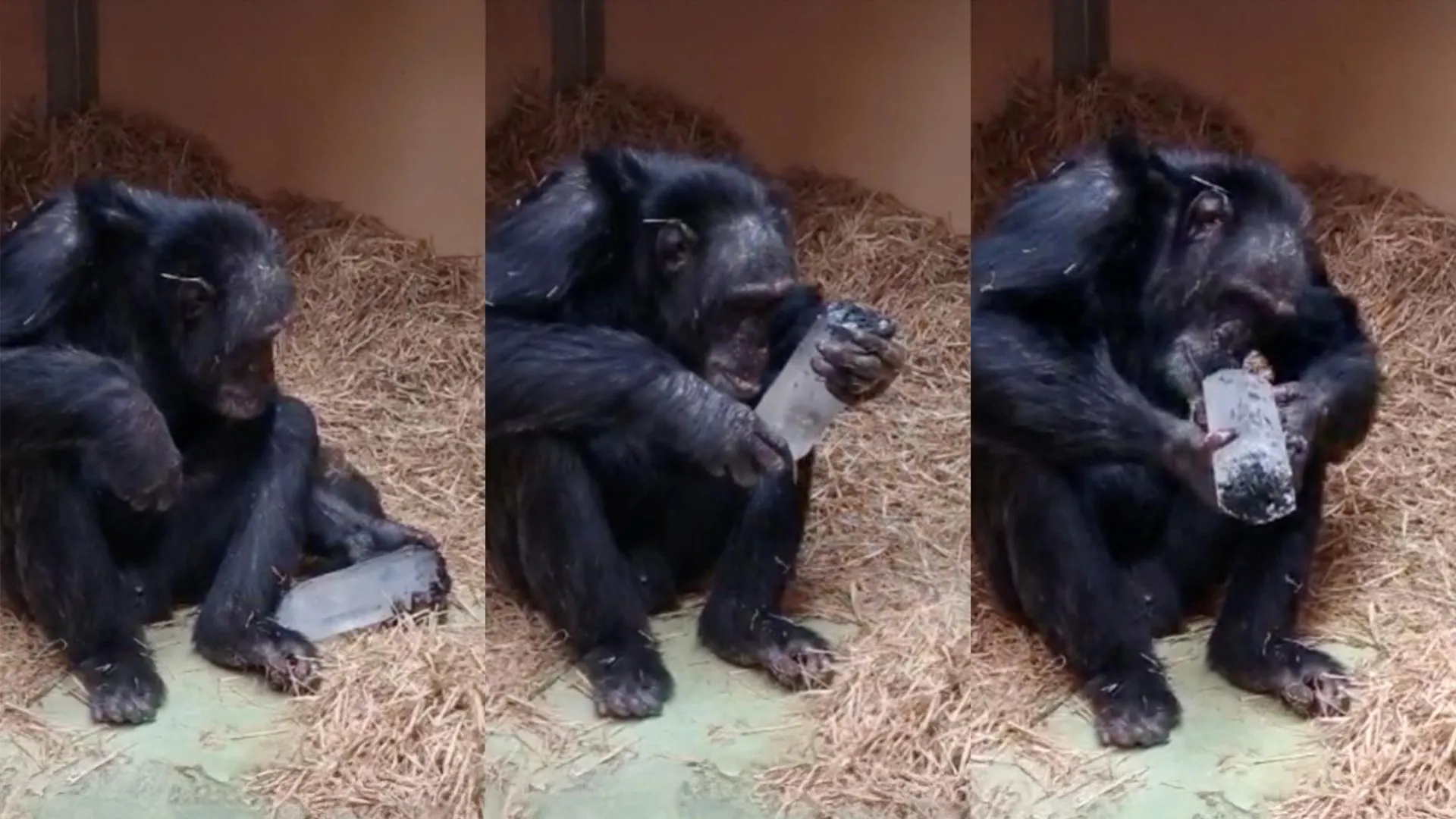
The researchers observed the chimps rotating, tilting, and examining the crystal from multiple angles. One individual, Yvan, displayed a level of attachment that transcended mere curiosity: he picked up the crystal and carried it back to the group’s sleeping quarters. The interest followed a predictable trajectory—the "novelty effect"—where engagement peaked upon first encounter and slowly waned as the chimpanzees grew accustomed to the object’s presence. In a testament to how highly the apes valued the stones, the caretakers ultimately had to trade bananas and yogurt to successfully retrieve them.
Discrimination and Sorting
The second phase of the study pushed the primates’ cognitive limits. The researchers mixed small quartz crystals into a pile of 20 ordinary, rounded pebbles. The chimpanzees identified and selected the crystals within seconds. Even when the researchers introduced more complex varieties, such as pyrite and calcite—which differ significantly in luster and geometric shape from quartz—the apes continued to distinguish the crystals from the surrounding rubble.
"The chimpanzees began to study the crystals’ transparency with extreme curiosity, holding them up to eye level and looking through them," García-Ruiz noted. The observation was consistent: the apes spent hours interacting with the crystals, peering through them as if testing their light-refracting properties.
Perhaps most revealing was the behavior of a chimpanzee named Sandy. She was observed transporting both pebbles and crystals in her mouth to a wooden platform, where she meticulously sorted them into distinct groups. She successfully isolated the three types of crystals—each with different levels of transparency, symmetry, and luster—from the mass of common pebbles. Because chimpanzees do not typically transport objects in their mouths, researchers hypothesized that Sandy was attempting to conceal the items, suggesting she perceived them as high-value possessions.
The Cognitive Appeal of Geometry
Why would a chimpanzee, or an early hominin, be so captivated by a crystal? The research team proposes that the answer lies in the unique physical properties of crystals, which set them apart from almost every other object found in the natural world.
In nature, most objects—rivers, trees, clouds, mountains, and animals—are defined by curved lines, branching fractal patterns, or irregular, jagged surfaces. Crystals are an anomaly. They are the only naturally occurring polyhedral solids that possess flat, perfectly geometric faces and straight edges. This striking, unnatural appearance likely acts as a "visual magnet" for the mammalian brain.
Early humans, navigating a landscape defined by chaotic, organic forms, would have found these rigid, symmetric, and often transparent structures to be jarringly different. The researchers suggest that this "visual salience" is the foundation of our aesthetic appreciation for crystals. It was a sensory experience so compelling that it eventually transitioned from simple curiosity to a form of symbolic gathering.
Official Perspectives: Nature vs. Culture
Prof. García-Ruiz, an expert in crystallography, emphasized that the study does not claim all chimps share the same level of interest. Just as in human populations, there is a spectrum of personalities. "There are Don Quixotes and Sanchos: idealists and pragmatists," he noted. "Some may find the transparency of crystals fascinating, while others are interested in their smell and whether they’re edible."
While these findings are compelling, the research team is careful to note the limitations of the current data. The subjects of the study were enculturated, meaning they are familiar with human-made objects and environments. Critics might argue that their interest was a result of human influence. Consequently, the team advocates for future research involving wild chimpanzee populations to see if this "crystal curiosity" persists in environments entirely untouched by human activity.
Implications: The Origins of Aesthetics
The implications of this study reach far beyond primatology. For years, the presence of crystals at Homo sites was viewed as a profound mystery—a potential sign of early "art" or religious behavior. By proving that a primate ancestor could find crystals inherently valuable without any cultural indoctrination, the study shifts the narrative. It suggests that our aesthetic and symbolic life did not emerge from a vacuum; rather, it was built upon a foundation of evolutionary biology that existed long before we became Homo sapiens.
"Our work helps explain our fascination with crystals and contributes to the understanding of the evolutionary roots of aesthetics and worldview," says García-Ruiz.
If our attraction to the geometric perfection of a crystal is a trait we share with our evolutionary cousins, it confirms that the human sense of beauty is rooted in the deep past. We have been captivated by the interplay of light and geometry for at least six million years. The crystals left behind in those ancient caves were not merely rocks; they were the first signs of a mind beginning to distinguish the ordinary from the extraordinary, a hallmark of the transition toward the human experience. As the research concludes, we now know with a new sense of clarity: we have had crystals in our minds since the very dawn of our lineage.