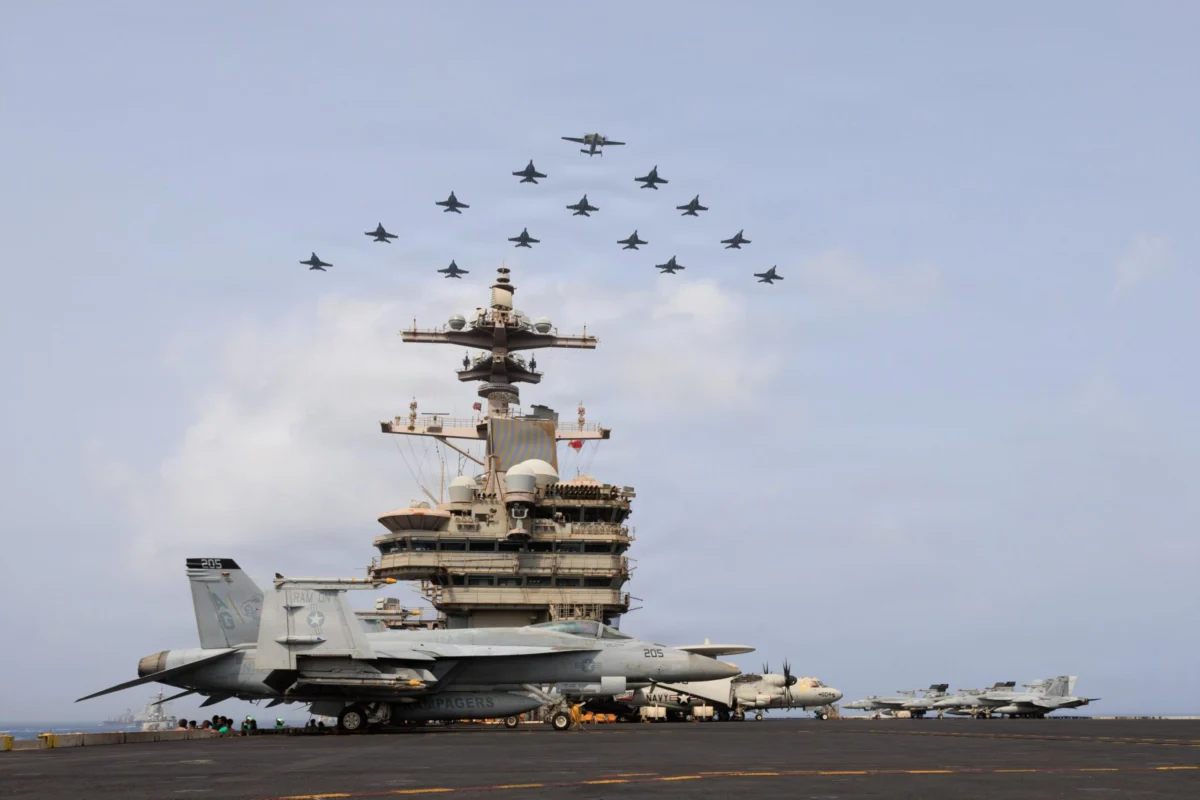
WASHINGTON D.C. / DUBAI – Global financial markets reacted with measured trepidation late Sunday as a series of intensive U.S. airstrikes against Iranian military assets in the Persian Gulf signaled a sharp escalation in a conflict that many experts now describe as an "undeclared naval war." Despite the quickening tempo of military operations and the targeting of critical infrastructure in the Strait of Hormuz, investors maintained a level of composure that has surprised some analysts, even as oil prices began a steady climb.
The conflict, which has transitioned from sporadic skirmishes to a sustained campaign of aerial and naval engagements, centers on the world’s most vital maritime chokepoint. As U.S. Central Command (CENTCOM) confirms its fifth round of strikes within a single week, the international community is grappling with the potential for a full-scale disruption of global energy supplies.
Main Facts: A Disconnect Between Combat and Capital
Late Sunday, U.S. stock futures showed signs of moderate strain. Futures tied to the Dow Jones Industrial Average dropped 100 points, representing a 0.19% decline. The broader S&P 500 futures fell by 0.27%, while the tech-heavy Nasdaq-100 futures saw the steepest decline, losing 0.48%. These figures suggest a "wait-and-see" approach from Wall Street, rather than a panicked sell-off.
In the energy sector, the reaction was more pronounced but lacked the "spike" typically associated with a major Middle Eastern conflict. U.S. oil futures (West Texas Intermediate) rose 3.2% to settle at $73.70 per barrel. Brent crude, the international benchmark, mirrored this move, climbing 3.2% to $78.45. Interestingly, gold—a traditional safe-haven asset—dipped 0.7% to $4,085 per ounce, a price point that reflects a significantly altered economic landscape compared to historical norms.
On the military front, the situation is increasingly volatile. CENTCOM announced a new wave of strikes on Sunday evening aimed at degrading the Islamic Revolutionary Guard Corps’ (IRGC) ability to harass civilian mariners. This followed a high-intensity 24-hour period where U.S. forces targeted Iranian missile sites, drone launch facilities, and naval assets.
Chronology: Seven Days of Escalation
The current crisis reached a fever pitch over the last week, characterized by a rapid increase in operational tempo. To understand the gravity of Sunday’s strikes, one must look at the sequence of events that led to the current standoff:
The Early Week: The Pattern Emerges
The week began with the first and second rounds of U.S. strikes following repeated Iranian attempts to seize or disable commercial tankers. These initial engagements were localized, focusing on mobile missile batteries that had been positioned along the Iranian coastline to threaten the shipping lanes.
Saturday: The Heavy Bombardment
By Saturday, the U.S. military posture shifted from defensive interceptions to aggressive degradation. Central Command reported hitting 140 targets in a single day. This massive sortie targeted:
- Missile and Drone Sites: Stationary and mobile units capable of launching precision-guided munitions.
- Naval Capabilities: IRGC fast-attack boats and command vessels.
- Ammunition Storage: Underground facilities housing anti-ship missiles.
- Infrastructure: Communication networks and coastal surveillance locations used to track commercial shipping.
Sunday Morning: Tactical Precision
Early Sunday, U.S. forces conducted a "few strikes" specifically targeting Iranian air-defense systems and small boat clusters near the Strait of Hormuz. These strikes were preemptive, designed to clear the way for larger naval movements and to protect the "Oman Corridor," a U.S.-backed shipping route.
Sunday Evening: The Fifth Round
The latest wave of attacks was triggered after an IRGC unit targeted a commercial vessel. U.S. forces successfully intercepted an Iranian missile and an accompanying drone before launching retaliatory strikes against the points of origin. This marked the third round of attacks within a 24-hour window, signaling that the U.S. has moved into a continuous cycle of engagement.
Supporting Data: Energy Flows and Shipping Security
The Strait of Hormuz remains the primary focal point of the conflict due to its unrivaled economic importance. Approximately one-fifth of the world’s oil consumption passes through this narrow waterway daily.
Shipping Statistics and the "Oman Corridor"
Since early May, the U.S. Navy and its allies have implemented a rigorous escort and monitoring program. According to military data:
- Vessel Transit: Over 800 commercial vessels have been successfully assisted through the strait.
- Oil Volume: Approximately 400 million barrels of crude oil have transited the region under U.S. protection during this period.
- The Alternate Route: In response to Iranian threats, the U.S. established an alternate corridor that hugs the coast of Oman. This route is designed to keep ships as far as possible from Iranian territorial waters, though Iran continues to contest its legality.
Market Sentiment and "Complacency"
Bob McNally, founder and president of Rapidan Energy and a former White House energy adviser, noted a peculiar trend in market behavior. Speaking to CNN, McNally described the rise in oil prices as "pretty tame" given the scale of the military action.
"Crude oil markets have been blowing off this geopolitical risk for years," McNally stated. He suggested that traders have become desensitized to Iranian threats, believing that the "worst of the Hormuz conflict is over." This confidence is rooted in the belief that U.S. naval dominance will prevent a total closure of the strait and that ship crossings are already beginning to recover. However, McNally warned that this "complacency" might be dangerous if the conflict escalates into a direct, sustained war that impacts production facilities rather than just shipping lanes.
Official Responses: Legal and Military Justifications
The escalation is not merely a military conflict but a legal and diplomatic one. Both Washington and Tehran have issued starkly different justifications for their actions.
The U.S. Position: Freedom of Navigation
U.S. Central Command’s official statements emphasize the "freedom of navigation" as the core objective. The strikes are framed as "degrading [Iran’s] ability to attack civilian mariners and commercial ships freely transiting the Strait of Hormuz." The U.S. maintains that international law permits the passage of vessels through the strait, regardless of Iranian claims.
The Iranian Position: The Memorandum of Understanding
Tehran has justified its aggressive posture by citing a Memorandum of Understanding (MOU) signed with the U.S. last month. The Iranian government argues that this document gives them the authority to regulate traffic within the strait to ensure regional security.
Iran has specifically targeted ships that refuse to use a "regime-backed corridor" that runs along the Iranian coast, viewing the U.S.-established Oman route as a violation of their sovereign rights. Furthermore, Iran has expanded its hostilities to include salvos against Gulf Arab neighbors, including Bahrain, Kuwait, Qatar, Jordan, and Oman, accusing them of facilitating U.S. "aggression."
Implications: The Risk of an Undeclared Naval War
While the markets remain relatively calm, maritime and military historians are sounding the alarm. Sal Mercogliano, a professor at Campbell University and a specialist in military and maritime history, argues that the current situation is far more perilous than the financial data suggests.
The "Facade" of the Ceasefire
In a recent analysis, Mercogliano described the supposed diplomatic efforts and previous ceasefires as a "facade." He noted that the frequency and intensity of the strikes indicate that the U.S. and Iran are already engaged in a conflict that lacks only a formal declaration.
"One of the things I fear is that we’re finding ourselves in this undeclared naval war," Mercogliano said. "And an undeclared naval war can escalate."
Potential for Regional Contagion
The implications of this conflict extend beyond the U.S. and Iran. The targeting of neighboring Arab states suggests that Iran is attempting to use regional instability as leverage. If countries like Kuwait or Qatar are drawn further into the military sphere, the impact on global LNG (Liquefied Natural Gas) markets could be catastrophic, potentially dwarfing the current fluctuations in oil prices.
The Economic Gamble
The current market stability relies on the assumption that the conflict will remain "contained" within the maritime domain. However, if Iran moves to strike oil production infrastructure—such as refineries or loading terminals in Saudi Arabia or the UAE—the "complacency" McNally described could vanish instantly. With gold prices already at historic highs of $4,085, any further destabilization could trigger a massive flight to safety, disrupting global equity markets.
Conclusion
As the sun rises over the Persian Gulf on Monday, the world watches to see if the "operational tempo" will continue to quicken. The U.S. appears committed to a policy of "active degradation" of Iranian capabilities, while Tehran seems unwilling to relinquish its primary source of geopolitical leverage: the ability to threaten the world’s energy lifeline.
For now, Wall Street is betting on a U.S. victory and a return to normalcy. But as the "undeclared naval war" enters its next phase, the line between a controlled military operation and a global economic crisis remains razor-thin. The coming days will determine whether the market’s current confidence is a sign of resilience or a profound miscalculation of the risks ahead.