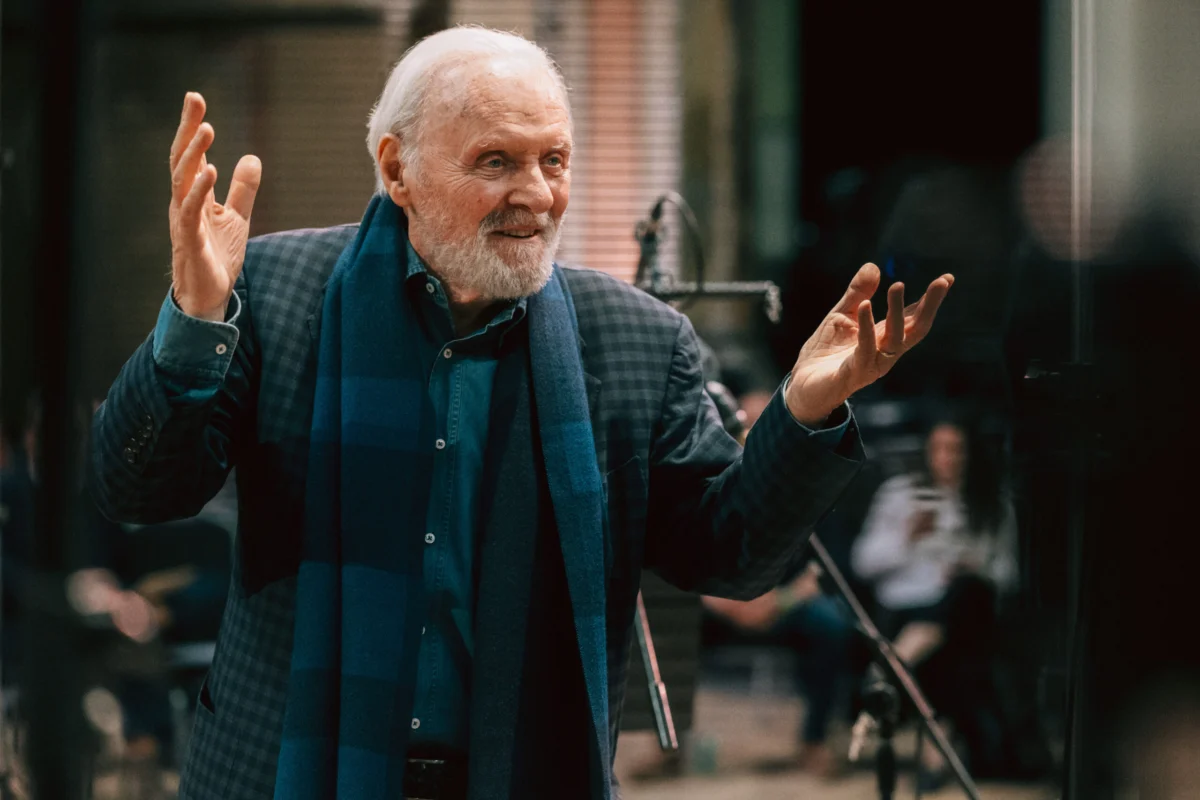
For the better part of half a century, the name Anthony Hopkins has been synonymous with the pinnacle of dramatic performance. From his chilling, Academy Award-winning portrayal of Hannibal Lecter in The Silence of the Lambs to his nuanced, heart-wrenching performance in The Father, Hopkins has navigated the human psyche with a precision that few actors in history have achieved. Yet, while the world watched his face on the silver screen, a parallel life—one of staves, melodies, and harmonic structures—was unfolding in the quiet solitude of his private studio.
Now, at 88, the legendary actor is stepping into a new arena, unveiling a lifetime of musical creation. In a landmark partnership, Hopkins has signed with the prestigious Decca Classics to release Life Is a Dream, a sweeping album that serves as a retrospective of over 60 years of original compositions. The project, conducted by the world-renowned Gustavo Dudamel and performed by the Philharmonia Orchestra, marks the first time these deeply personal works will be presented to a global audience in a formal recording.
A Lifetime of Sound: The Chronology of a Composer
To understand the weight of this new release, one must look beyond the accolades of Hollywood and into the formative years of a young boy in South Wales. Hopkins’ relationship with music predates his screen career by decades. He began playing the piano at the age of four, displaying an intuitive grasp of melody that bordered on the prodigious. By the time he was a teenager, he was not merely interpreting the works of Beethoven and Chopin, but actively composing original music for local theatrical productions.
The seeds of Life Is a Dream were sown in the 1940s, a decade that holds a central place in the composer’s memory. The album’s debut single, "Bracken Road," serves as a poignant entry point into this history. Part of a larger work titled 1947: Suite for Solo Piano and Orchestra, the piece acts as a musical cartography of his youth.
"Inspired by childhood memories of Margam, South Wales, it is a nostalgic musical portrait of the streets, meadows, farmland, and mountains that surrounded his family home in the 1940s," a representative for Decca Classics noted. For Hopkins, this project is not merely an album; it is a diaristic account of a life lived, a sonic tapestry woven from the threads of childhood nostalgia, familial love, and a career that has spanned the globe.
The Anatomy of the Project: Craftsmanship and Collaboration
Life Is a Dream is not an accidental collection of hobbyist sketches; it is a meticulously crafted body of work that showcases a lifetime of self-taught mastery. Beyond the nostalgic weight of the 1947 Suite, the album includes "My Fatherland," a composition deeply rooted in the traditional Welsh melodies that shaped Hopkins’ identity. Other tracks are dedicated to the people who defined his journey—his wife and his niece—highlighting the intimate nature of his creative process.
The recording sessions, held in London, brought together an ensemble of elite musicians. The inclusion of cellist Gregorio Nieto and pianist Sergio Tiempo adds a layer of virtuosity to the arrangements, but it is the baton of Gustavo Dudamel that brings the project its structural cohesion.
"Music was my first desire, my first wish," Hopkins reflected in a recent statement. "I’ve been composing music all my life. Some of these pieces have lived with me for decades and I still find myself returning to them."
This return to his roots has been a long time coming. Hopkins’ musical journey achieved significant public recognition in 2012, when he received a Classic Brit Award for Album of the Year for his contributions to And the Waltz Goes On. His transition to live performance culminated in a triumphant debut in Saudi Arabia in 2025, where the Life Is a Dream concert was performed by the Royal Philharmonic Orchestra, proving that his musical voice was just as compelling in a concert hall as it was in a film score.

Official Voices: The Intersection of Artistry
The collaboration between an icon of cinema and a titan of classical music has elicited profound respect from the industry. Gustavo Dudamel, whose own career is defined by pushing the boundaries of what classical music can be, spoke at length about the unique character of Hopkins’ work.
"Sir Anthony Hopkins is one of those rare artists whose creative voice transcends any single medium," Dudamel stated. "The same depth of imagination, humanity, and emotional truth that has defined his extraordinary work on stage and screen is present in his music. Listening to his composition, I am struck by its beauty, craftsmanship, and the unmistakable sense of wonder that animates it."
Dudamel continued, emphasizing the poetic nature of Hopkins’ approach: "Anthony approaches music with the heart of a storyteller and the instincts of a poet, creating sound worlds that are both deeply personal and universally resonant. It has been a privilege to collaborate with him… and to help bring to life the musical voice of an artist whose creativity knows no boundaries."
Laura Monks, president of Decca, echoed this sentiment, framing the signing as a milestone for the label. "His depth of talent and classical music knowledge, honed over a lifetime, is a joy to celebrate with this new album. Hearing his incredible compositions come to life at the recording sessions in London with Gustavo Dudamel and the Philharmonia Orchestra was a once-in-a-lifetime experience."
Implications for the Arts: The Polymath Legacy
The release of Life Is a Dream on August 21 carries significant implications for our understanding of the "celebrity artist." In an era where the lines between mediums are increasingly blurred, Hopkins stands as a reminder of the polymathic potential of the human spirit.
By formalizing his musical legacy with Decca Classics, Hopkins is shifting the narrative of his career. He is no longer just the actor who plays music; he is a composer whose music happens to be performed by some of the most distinguished orchestras in the world. This project invites listeners to re-evaluate his filmography through the lens of his musical sensibility. If we listen closely to his most iconic performances, we might now detect the same rhythmic timing, the same structural patience, and the same emotional resonance that he brings to his piano suites.
Furthermore, the album serves as an intergenerational bridge. It connects the 1940s landscape of post-war Wales to the contemporary classical stage, proving that the language of music is not bound by the chronological passage of time. For the listener, it offers a rare, intimate look at the inner life of one of the 20th and 21st centuries’ most guarded creative minds.
As Hopkins himself noted regarding his collaboration with Dudamel, the process of bringing these notes to life transformed them into a "pictorial landscape that invites the listener to feel and imagine something uniquely personal." With the release of Life Is a Dream, the world will finally be invited to walk through that landscape. Whether the listener is a longtime fan of his acting or a devotee of classical music, the arrival of this album marks a poignant, historic chapter in the life of Sir Anthony Hopkins—a man who, in his late eighties, is still finding new ways to tell his story.