The global robotics landscape is currently experiencing an unprecedented influx of capital, driven by the convergence of generative AI and mechanical engineering. As venture capital firms pour billions into humanoid startups, the industry is transitioning from a realm of speculative science fiction to a tangible, multi-billion-dollar industrial sector. Amidst this frenzy, Agility Robotics has emerged as a bellwether for the industry, opting for a high-stakes path to the public markets that distinguishes it from its heavily funded, private-equity-backed peers.
The State of the Humanoid Market: A Billion-Dollar Arms Race
The humanoid robotics market is currently awash in capital, reflecting a "gold rush" mentality among investors betting that the next decade will be defined by physical automation.
In late June 2026, AI2 Robotics, a Shenzhen-based innovator specializing in wheeled humanoid platforms, secured $735 million in a funding round that catapulted its valuation to nearly $3 billion. Earlier that year, Austin-based Apptronik—a company focused on manufacturing and logistics humanoids—closed a massive $935 million round. Backed by corporate heavyweights including Google, Mercedes-Benz, and John Deere, Apptronik’s valuation now exceeds $5.5 billion.
Perhaps most indicative of the hype cycle was the Series C funding round for San Jose’s Figure AI in late 2025. The startup, which focuses on general-purpose humanoid robots, reported a $1 billion injection of capital at an staggering $39 billion valuation. These figures highlight a sector that, while still nascent in terms of broad deployment, is viewed by institutional investors as the inevitable next step in the evolution of labor.
Agility Robotics: A Strategic Pivot to the Public Sphere
By contrast, Agility Robotics, led by CEO Peggy Johnson, is taking a markedly measured approach. The Oregon-based company recently announced a definitive agreement to go public through a merger with Churchill Capital Corp XI, a special-purpose acquisition company (SPAC) led by Michael Klein.
The transaction values Agility at approximately $2.5 billion and is projected to provide over $620 million in gross proceeds. Should the merger survive SEC review and receive the necessary shareholder approval later this year, Agility will achieve a historic milestone: becoming the first "pure-play" humanoid robotics company to trade on public markets.
This move offers retail investors their first real opportunity to gain exposure to the sector, which has until now been reserved for deep-pocketed venture capital firms. Furthermore, it provides the market with a rare, transparent view into the financial health of a business segment that typically guards its operational metrics with extreme secrecy.
Chronology of a Robotics Pioneer
Agility Robotics’ trajectory reflects the slow, deliberate maturation of the field. Founded in 2015 as a spinoff from Oregon State University, the company spent years in the shadows of academic research and early-stage prototyping. Based in Salem, Oregon, the company transitioned from experimental bipeds to the development of Digit, a humanoid designed specifically for the rigors of industrial environments.
The company’s leadership transition in recent years served as a signal of its shift toward commercialization. Peggy Johnson, whose previous experience includes serving as executive vice president of business development at Microsoft—where she helped spearhead the $26 billion acquisition of LinkedIn—and as CEO of the augmented reality firm Magic Leap, brought a seasoned executive’s rigor to Agility. Under her guidance, the company has pivoted from a research-focused organization to a high-volume production facility, scaling up its 70,000-square-foot manufacturing plant in Salem to meet a growing backlog of demand.
Defining the "Physical AI" Advantage
During a recent interview, Johnson emphasized that while the tech world is currently obsessed with Large Language Models (LLMs), the true competitive advantage in robotics lies in the "physical layer."
"The LLMs had the entire internet to train on," Johnson noted. "When you think about the physical AI of humanoids, that doesn’t quite exist yet." Agility views itself as the owner of perhaps the largest data lake of real-world operating robotics data. Unlike competitors who rely on choreographed laboratory demonstrations, Agility’s robots are currently working in live, industrial environments.
The Hardware Philosophy
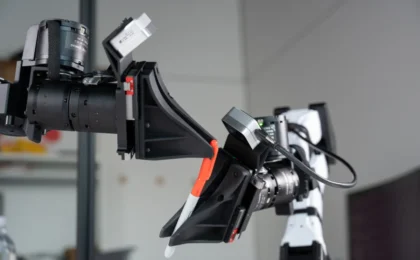
Digit is intentionally "unfussy." Standing 5’9” and weighing 160 pounds, the robot features signature "bird-like" reverse-bend knees. This design is not an exercise in biomimicry; it is a functional necessity. The geometry allows Digit to reach from floor level to overhead shelving without colliding with the rigid metal structures of warehouse racking. Similarly, its hands are purpose-built for the specific task of gripping heavy plastic totes, ensuring stability even as their contents shift during movement.
The Semantic Layer
While Agility prides itself on physical mechanics, it remains "LLM-agnostic." The company utilizes models such as Claude and Gemini to handle the "semantic layer"—the bridge between a human’s high-level intent and the robot’s mechanical execution. Johnson described a test where Digit was instructed to "clean up this mess." The robot analyzed a variety of trash items, correctly sorting recyclable materials from waste and identifying non-recyclable plastics like bubble wrap, proving that the integration of generative intelligence with physical actuators is already moving beyond the pilot stage.
Safety: The Competitive Gulf
A recurring theme in the conversation regarding the robotics industry is safety—a metric where Johnson believes Agility holds a significant lead over rivals.
"You can’t build your robot and then make it safe," she stated, emphasizing that safety must be "baked in" from the electrical system to the software architecture. This philosophy stands in stark contrast to the trend of viral,, but potentially uncertified, lab videos. Industrial environments are high-risk; the failure of a machine in a facility with human workers is not just a PR disaster, but a regulatory and liability nightmare.
This focus is timely. In late 2025, a lawsuit against Figure AI, initiated by a former head of product safety, alleged that the company dismissed internal warnings regarding the physical power of its units and their potential to cause injury. While Figure AI has disputed these claims, the incident underscored the growing tension between the rapid pace of development and the necessity for rigorous, industry-standard safety protocols.
Implications: The Future of Labor and the Home Market
Agility Robotics’ business model is built on "robots-as-a-service" (RaaS). Customers—including industry giants like Amazon, GXO Logistics, Toyota, and Mercado Libre—pay monthly fees for the utility of the robots rather than purchasing the hardware outright. This model has already secured more than $300 million in booked, multi-year revenue, representing a pipeline of roughly 1,000 robots currently being prepared for deployment.
Regarding the oft-asked question of when humanoids will enter the domestic sphere, Johnson remains pragmatic. She estimates a timeline of "10-plus years." The primary hurdle, she explains, is the chaos of the home. Warehouses are fixed, predictable environments with standardized workflows. Homes are cluttered, unpredictable, and dynamic, filled with pets, children, and misplaced objects.
"At least roads have some discipline to them," Johnson said, drawing a parallel to the challenges faced by the autonomous vehicle industry. "Most of the areas that humanoids will be operating in [at home] don’t."
For now, the focus remains firmly on the labor crisis. With over a million unfilled, physically demanding roles in the U.S. alone, Agility is positioning itself not as a replacement for human intellect, but as an essential support system for an aging, shrinking workforce.
As Agility heads toward its public listing, the message from the corner office is clear: "Our biggest competitor right now is just us," Johnson said. "How quickly we can execute, how quickly we can continue to add new skills." For the investors watching the SPAC transition, the success of Agility may well determine whether the humanoid era is finally upon us, or if it remains a well-funded, yet distant, aspiration.