MEDORA, N.D. – In a week marked by unprecedented legislative gridlock and open rebellion within his own party in Washington, President Donald Trump embraced a starkly different stage: the rugged plains of North Dakota, where he embarked on a meticulously choreographed tour celebrating America’s upcoming 250th birthday. Eschewing the traditional presidential role of navigating congressional impasses, Trump instead reveled in a series of highly theatrical appearances, signaling a distinct shift in focus from policy to pageantry as the nation approaches a significant historical milestone.
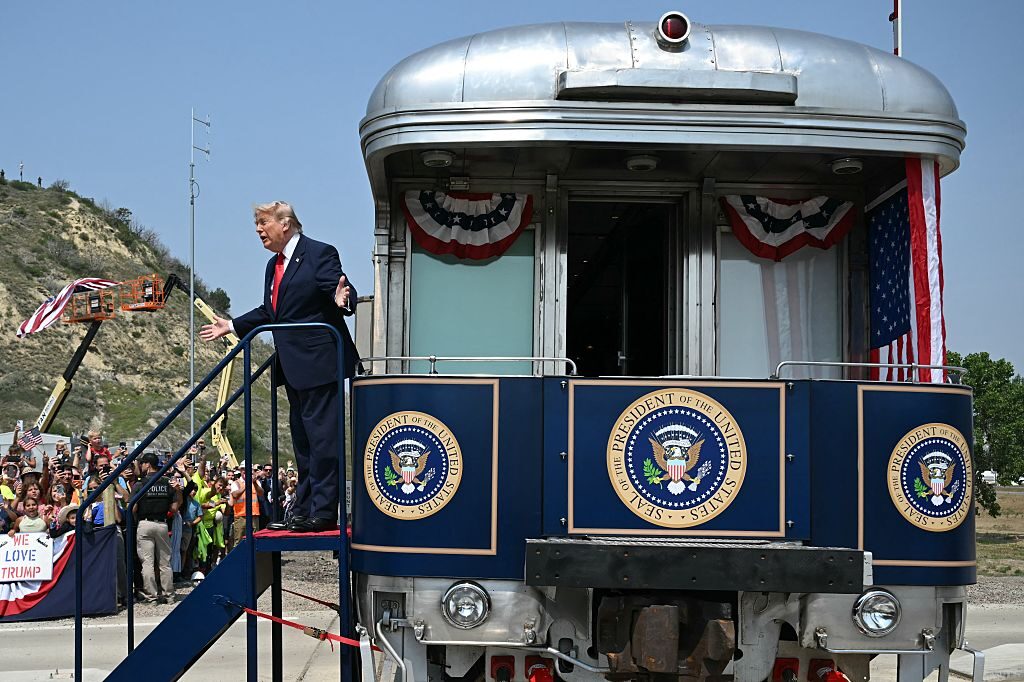
The spectacle unfolded dramatically on Wednesday as the 47th President emerged from a specially painted rail coach, adorned with patriotic motifs commemorating the nation’s quarter-millennium. With arms outstretched, a characteristic gesture, he was met by a cheering crowd in Medora, a small North Dakota town steeped in the legacy of Theodore Roosevelt. The scene was a vivid tableau of populist appeal, a deliberate counterpoint to the frustration brewing 1,600 miles away in the nation’s capital.
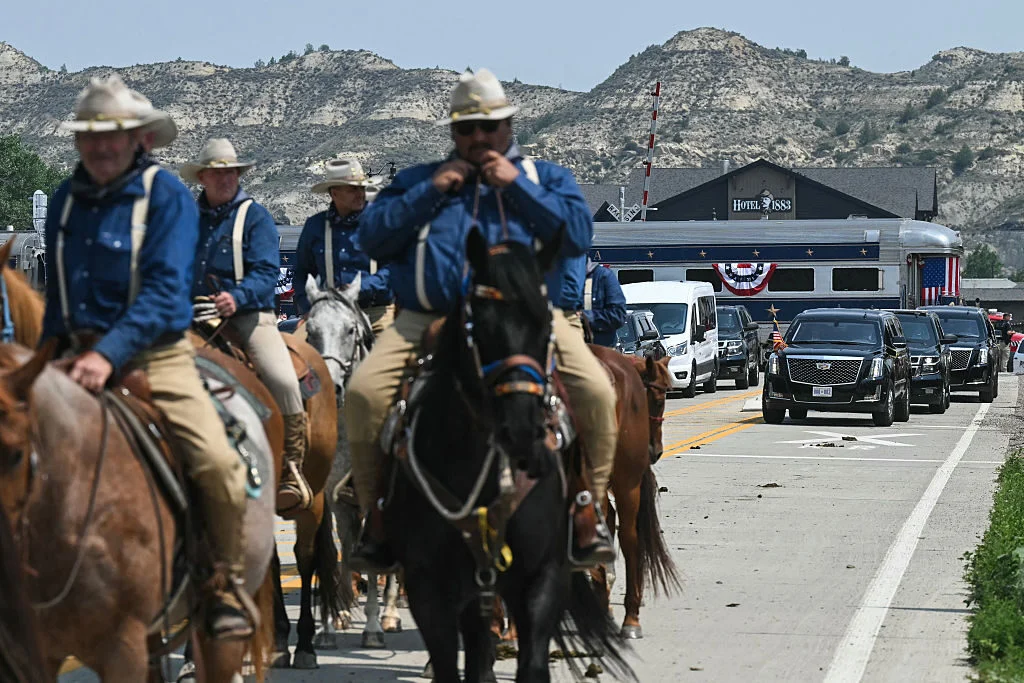
Moments later, the sense of historical immersion deepened as a procession of "Rough Rider" reenactors, on horseback and evoking the spirit of Theodore Roosevelt’s legendary cavalry, escorted Trump’s motorcade to the dedication of the Theodore Roosevelt Presidential Library. It was a visual declaration that the President was not merely far from Washington geographically, but ideologically and temperamentally removed from its grinding political machinery. All indications suggested a president relishing the freedom of this grand tour, seemingly unburdened by the legislative chaos engulfing his party.
A President’s Priorities: Spectacle Over Strategy
Trump’s intense focus in recent weeks has visibly drifted from the intricate legislative dance of Capitol Hill to the grand spectacle he intends to orchestrate around America’s 250th birthday. This pivot comes at a critical juncture, even as House Republicans experienced a dramatic meltdown, forcing an early recess and leaving Washington in a huff. Congressional Democrats, meanwhile, have been vocal in their criticism, arguing that the President should devote less time to celebration and more to addressing the economic pressures they contend his administration has exacerbated.
During his Medora address, Trump paid tribute to the 26th President, Theodore Roosevelt, whom he called "a man who I have long admired, he’s one of the few – I don’t admire too many people." In a characteristic blend of homage and self-promotion, he quickly pivoted to his own political triumphs, reminding the audience that he was "back in North Dakota because I won this state with the most votes in the history of the presidency."
The speech itself was a microcosm of Trump’s unique communication style. After griping about a "broken teleprompter," he recounted a purported "conversation" he had earlier with an AI-generated version of Roosevelt, who died in 1919, delving into the intricacies of the Panama Canal. This technological anachronism, juxtaposed with the historical reenactment, underscored the blend of modern showmanship and historical narrative Trump sought to create. An "eye-popping comment" about his sons and the Medal of Honor, though details remained vague, further added to the unconventional nature of the remarks.
Defiance also permeated his message, particularly regarding the oppressive "heat dome" parked over the eastern United States. "On July 4, it’s going to be approximately 107 degrees out [in Washington]," he declared, issuing a personal challenge to the weather. "I’m going to make a really long speech – just to show that I can do anything." This statement, laced with bravado, cemented the impression that the upcoming national celebration would be as much a testament to his own endurance and will as it would be to the nation’s history.
Washington’s Woes: A Tale of Disconnect
The President’s Medora appearance was just one facet of a broader pattern illustrating his intense focus on legacy projects and celebratory events. These include plans for a ballroom overhaul, a Reflecting Pool renovation, an arch adjacent to the Arlington Memorial Bridge, and elaborate military flyovers and events leading up to and on July 4th. This preoccupation stands in stark contrast to the legislative disarray that has consumed Washington.
On Tuesday, while Trump was preoccupied with praising Supreme Court decisions that favored him and lambasting those that didn’t, House Republicans abruptly departed Washington two days ahead of schedule. Their early exit was precipitated by a group of conservative members who maintained a floor blockade, effectively grinding legislative proceedings to a halt and highlighting deep fissures within the GOP caucus.
When questioned about the President’s involvement in resolving the blockade, or his stance on the House leaving town, a White House official offered a terse, non-committal response: "We continue to work with Congress to secure a defense bill that comports with the administration’s priorities." The statement, delivered via email, conspicuously avoided any mention of direct presidential intervention in the House fracas, making it clear that the White House was content to leave the internal party dispute to House GOP leaders.
Indeed, as Trump departed Washington for Medora, he displayed no visible signs of concern regarding his party’s legislative meltdown. Speaking from under the wing of a newly acquired Air Force One jet, a gift from Qatar, the President-in-chief largely focused on bragging about the lavish aircraft. "They just completed it. They made it appropriate for a president, that means the security and all of the different bells and whistles they put on. Very complex stuff, but it’s really quite something," Trump enthused, contrasting it with a new Boeing-built Air Force One that he claimed wouldn’t be ready for another "two years." He added, "Frankly, we couldn’t build a plane like this because we wouldn’t be willing to spend the kind of money necessary. They spent top dollars," referring to the Qataris, and proudly noting the massive jet’s dark blue-red-and-gold paint scheme, which he designed: "Never been a plane like it."
Democratic Dissent and Economic Anxieties
This display of presidential pomp and focus on celebratory events drew sharp criticism from Democrats, who argue that the administration is out of touch with the everyday struggles of American families. The day before Trump’s departure, Massachusetts Democratic Rep. Lori Trahan, flanked by party leaders, contended that the President should prioritize economic relief over elaborate celebrations.
"This weekend, America turns 250 years old," Trahan stated at a press conference. "And whether families are filling up their tanks to hit the road or firing up the grill at home, they’re bracing for what it’s going to cost them, because a year and a half into Donald Trump’s presidency, life has only gotten harder for the vast majority of Americans." Her remarks underscored a fundamental disagreement over the nation’s priorities, highlighting a chasm between the administration’s celebratory agenda and the economic anxieties felt by many voters.
Trump’s tour is not confined to North Dakota; he is slated to deliver remarks at Mount Rushmore on Friday night as part of his second planned Dakota swing. Notably, during these appearances, he has made no public appeals for congressional Republican harmony, further solidifying the perception of his detachment from the legislative battles consuming his party.
This pattern of disengagement was also evident earlier in the week during a Monday Oval Office event, where Trump raised eyebrows by publicly dissing a bipartisan housing measure. This bill had garnered significant support from many House and Senate Republicans, who had intended to champion it in their re-election campaigns.
Instead, Trump informed reporters that his singular legislative goal was the voter ID bill known as the SAVE America Act. This unwavering obsession with the bill, which would introduce strict voter ID requirements and restrictions on mail-in voting, persists despite pleas from Senate GOP leaders to abandon it. They argue that the measure has no realistic chance of clearing the Senate’s 60-vote legislative threshold. "Here’s what I would like to say, much more than a bill, the big deal, it’s a yawn. Some people say, ‘It’s wonderful.’ To me, compared to the SAVE America Act, just about everything is a big yawn," Trump declared with a dismissive tone, underscoring his laser-like focus on an issue central to his political base, even if it lacked broad legislative viability.
Conspicuously absent from Trump’s rhetoric this week has been any mention of the House’s now-stalled fiscal 2027 defense policy or State Department appropriations measures. His silence on these critical legislative items reinforces the narrative that his attention is almost exclusively consumed by his 250th anniversary plans and personal political agenda.
"Can’t Help Himself": Accusations of Politicization
The President’s approach to the national milestone has drawn sharp criticism from Democratic lawmakers, who accuse him of politicizing what should be a unifying national celebration. During a June 24 Judiciary Committee hearing, Democratic Sen. Alex Padilla of California voiced strong objections, stating that Trump "can’t help himself, especially with things that don’t involve him, don’t praise him, don’t highlight him."
Padilla elaborated, accusing the President of hijacking the anniversary for personal gain. "President Trump couldn’t help but try making America’s 250th birthday all about himself. Right around this time last year, we saw him start to hijack and politicize America 250 events," Padilla asserted. He further alleged, "The president has created a whole new entity called Freedom 250 – confusing to some – to funnel money from taxpayers and donors to pay for his pet projects and events." These accusations highlight a growing concern among critics that the upcoming national celebration is being co-opted for political and personal branding purposes rather than serving as a bipartisan moment of reflection.
Adding to the legislative paralysis, Trump’s intensive 250th planning has done little to build political momentum for a third budget reconciliation measure. This package of conservative wish-list items is sought by some House and Senate Republicans, including Speaker Mike Johnson of Louisiana, who hoped to pursue it after the July 4 recess. The lack of presidential engagement could represent a significant missed opportunity for the GOP to pass key legislation just months before the midterm elections.
The legislative calendar further complicates matters: the House is slated to be in session for a mere eight days in July, followed by an extended August recess from July 24 to August 31. With such deep intra-party bad blood, the prospect of House Republicans coalescing around another reconciliation bill in just eight days seems exceedingly doubtful, and a presidential intervention to foster such unity appears equally improbable.
The Partisan Divide and a Look to the Future
Trump’s personal promotion of the upcoming July 4th celebrations underscores the partisan nature critics have highlighted. "I will be speaking at approximately 9 P.M., preceding the Fireworks which again, like the Airshow, will be approximately ten times larger than any Fireworks in the History of our Country. So, if you like Airplanes and Fireworks and President Trump, be there!" he wrote in a Friday Truth Social post, effectively framing the national holiday as a personal invitation to his supporters.
With few, if any, Democrats reportedly planning to attend the event, the partisan divide around the celebration is stark. Texas Republican Sen. John Cornyn, who recently lost his primary to a Trump-backed candidate, reportedly called the partisan nature of the celebration "sad," echoing concerns about the erosion of bipartisan national unity.
Amidst the pageantry and political maneuvering, Trump also offered a glimpse into his post-presidency aspirations. As he toured the Theodore Roosevelt Presidential Library, a monument to a past president’s legacy, Trump reflected on his own future library, slated to be erected in Miami. "I’m getting some ideas," he replied, tapping his temple, "I’m getting some good ideas." This brief comment reveals a president keenly aware of his place in history and actively shaping his own legacy, even as his current term faces myriad challenges.
The closing scene of Trump dancing on stage to "YMCA" before departing Medora provided a telling image for many observers. Longtime political commentator Geraldo Rivera, speaking to NewsNation, suggested that he increasingly perceives a second-term president who has begun "mailing it in" and "is already thinking about his new life." This analysis captures the essence of a presidency seemingly shifting from the relentless pursuit of legislative victories to the curated performance of leadership, focused more on personal narrative and celebratory spectacle than the daily grind of governance. The 250th anniversary, therefore, becomes not just a national celebration, but a stage for a president to define his own terms and legacy, far from the madding crowd of Washington’s political battles.