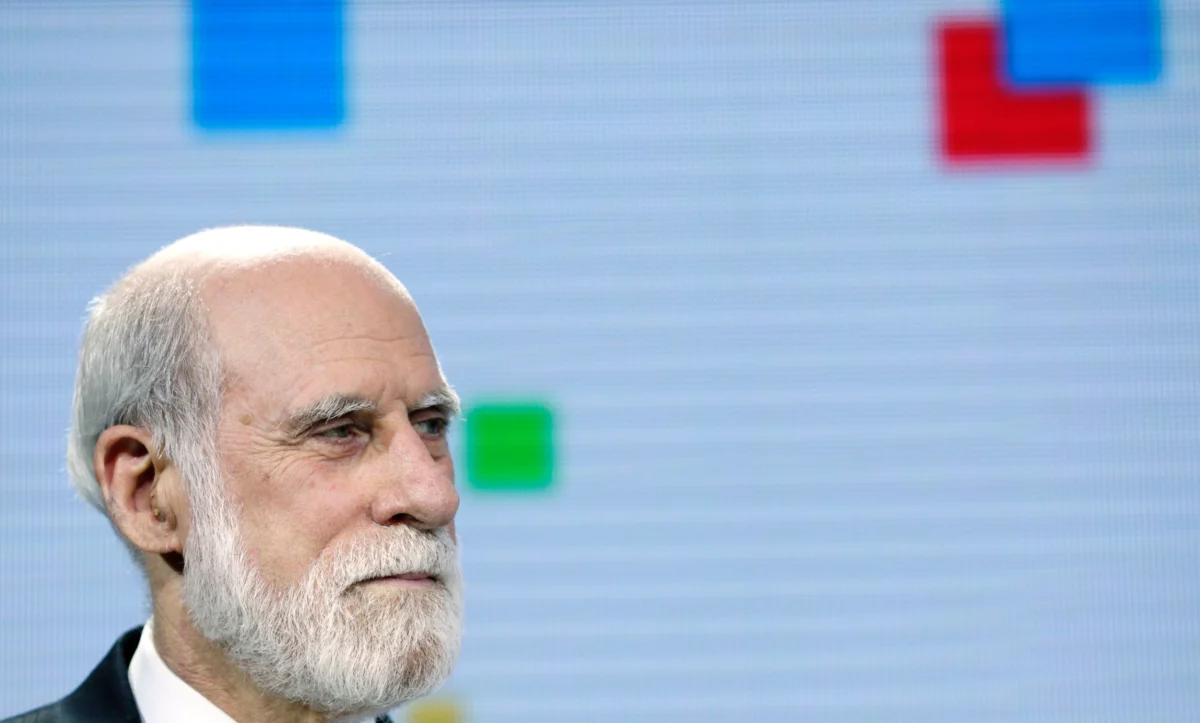
Next week, a chapter of technological history that spans over half a century will quietly come to a close. Vinton “Vint” Cerf, the visionary engineer widely revered as one of the “fathers of the internet,” will step down from his long-held position as Vice President and Chief Internet Evangelist at Google. His departure marks the end of a two-decade tenure at the search giant, capping a career that fundamentally reshaped the architecture of human civilization.
The announcement was made during the Open Frontier conference, hosted by the Laude Institute, where Cerf appeared via video feed. The news was shared by his longtime colleague and friend, UC Berkeley professor Dave Patterson—a titan in his own right, known for co-developing RISC processor architecture.
“Vint has been at Google for more than 20 years, and he is retiring a week from today,” Patterson told the assembly, prompting a thunderous round of applause from an audience that included some of the most influential minds in computer science. “I think we ought to give him a round of applause for a relatively good career.”
A Foundation Built on Protocols: The Chronology of an Icon
To understand the magnitude of Cerf’s departure, one must look back to the 1970s, a period of primitive computing that Cerf helped transform into a global, interconnected nervous system. Along with his collaborator Robert Kahn, Cerf developed the Transmission Control Protocol and Internet Protocol (TCP/IP). These were not merely technical specifications; they were the “rules of the road” that allowed disparate, incompatible computer networks to communicate seamlessly.
Without the foundational work of Cerf and Kahn, the internet as we know it—an open, decentralized, and borderless network—would not exist. Their architecture allowed for the modular expansion of the web, enabling the growth of the World Wide Web, the cloud, and eventually the entire digital economy.
Key Milestones in a Storied Career:
- 1970s: Development of TCP/IP at DARPA, laying the groundwork for the modern internet.
- 1980s: Instrumental in the transition of ARPANET to TCP/IP, effectively birthing the internet.
- 2005: Joins Google as Vice President and Chief Internet Evangelist.
- 2004: Receives the ACM Turing Award, often referred to as the "Nobel Prize of Computing," alongside Robert Kahn.
- 2005: Awarded the Presidential Medal of Freedom by George W. Bush for his contributions to the digital landscape.
For the past twenty years, Cerf has served as the intellectual face of Google, acting as a bridge between the company’s engineering culture and the global policy community. As the internet became “fully evangelized,” Cerf’s role evolved into a unique blend of corporate statesmanship, historical stewardship, and technological futurism.
The Panel: Architects of the Open Frontier
Cerf’s final public appearances as a Google executive reflect the intellectual circles he has navigated for decades. At the Open Frontier conference, he sat on a panel alongside industry heavyweights who have spent their careers building the scaffolding of modern software.
The panel included:
- Dave Patterson: RISC architecture pioneer and academic luminary.
- François Chollet: Creator of Keras, the deep-learning library, and co-founder of Ndea.
- John Ousterhout: Stanford professor and the creator of the Tcl programming language.
- Matei Zaharia: Co-founder and Chief Technologist of Databricks.
The discussion served as a masterclass in the philosophy of durable systems. As the tech industry pivots toward the next frontier—Artificial Intelligence—the panelists debated the risks of centralization versus the necessity of open-source infrastructure. Cerf, whose own career was built on the decentralized, permissionless nature of the internet, offered a sobering perspective on the path forward.
The Future of AI: A Plea for Standardization
While much of the conference conversation centered on the risks posed by a few well-resourced labs hoarding AI capabilities, Cerf directed his attention toward the future of inter-agent communication. He argued that the rise of AI agents—autonomous software capable of coordinating with one another—will necessitate a return to the rigid, standardized protocols that defined his earlier work.
“The agentic model of AI, with multiple agents from multiple sources interacting with each other, is going to force composability, and a requirement for interoperability and standardization,” Cerf predicted.
He dismissed the notion that natural language (like English) would suffice as a protocol for machines. Instead, he warned of the “telephone game” phenomenon, where ambiguity and translation errors could lead to catastrophic misunderstandings in an automated economy.
“I don’t think English is going to be the best choice,” Cerf explained. “There’s a flexibility in it, but there’s ambiguity, and I think precision for interagent interaction is going to be very, very important. An agent really needs to be sure the other agent understands what it is that they just agreed to do together. Imagine a bunch of agents talking to each other in natural language—you know, that’s kind of terrifying.”
Implications for the Tech Industry
If Cerf is correct, the current "AI gold rush" is merely a prelude to a new protocol war. Companies that successfully define the standards for how AI agents communicate will exert significant influence over the next century of commerce. Just as TCP/IP became the invisible, universal language of the internet, the next generation of protocols will determine whether the AI landscape remains open or fragments into proprietary, non-interoperable silos.
This represents a classic "Cerfian" challenge: the conflict between the convenience of centralized, "walled-garden" AI models and the necessity of a robust, decentralized, and interoperable standard. His departure from Google removes a central voice of the "old guard," yet his warning provides a blueprint for the next generation of architects to follow.
A Legacy of Style and Substance
Beyond his technical prowess, Cerf is remembered for his distinct personality and his penchant for professional sartorial choices. In an industry defined by hoodies and sneakers, Cerf has remained famously committed to the three-piece suit.
During the panel, Dave Patterson recalled meeting a young Cerf in the 1970s. “He’s always been the best-dressed computer scientist I’ve ever met,” Patterson remarked. “My memory of Vint is that he came as a grad student with a shirt and tie in the ’70s.”
Cerf, characteristically humble yet witty, offered an explanation for his enduring style. “It absolutely is true,” he said. “I even had a vest, and for some reason I always wanted to stick out, and instead of having long hair, and something in my nose, I thought just dressing differently was one way to do it.”
Conclusion: An End, Not a Retirement
While Google declined to comment on the transition, the impact of Cerf’s two decades at the company is undeniable. He helped navigate the search giant through the expansion of the web into the mobile era, the rise of cloud computing, and the early stages of the generative AI revolution.
As he steps away from his executive responsibilities at the age of 83, the consensus among his peers is that Cerf’s work is far from finished. His career has always been characterized by an insatiable curiosity and a commitment to the public good. Whether through his ongoing work on the Interplanetary Internet or his advocacy for digital preservation, Vinton Cerf remains a singular force in technology.
As the tech world looks toward an increasingly complex, agent-driven future, the principles Cerf championed—openness, interoperability, and precision—remain the most essential tools in the kit. He leaves behind not just a legacy of protocols, but a challenge: to ensure that the tools of the future are as durable and accessible as the internet he helped build.