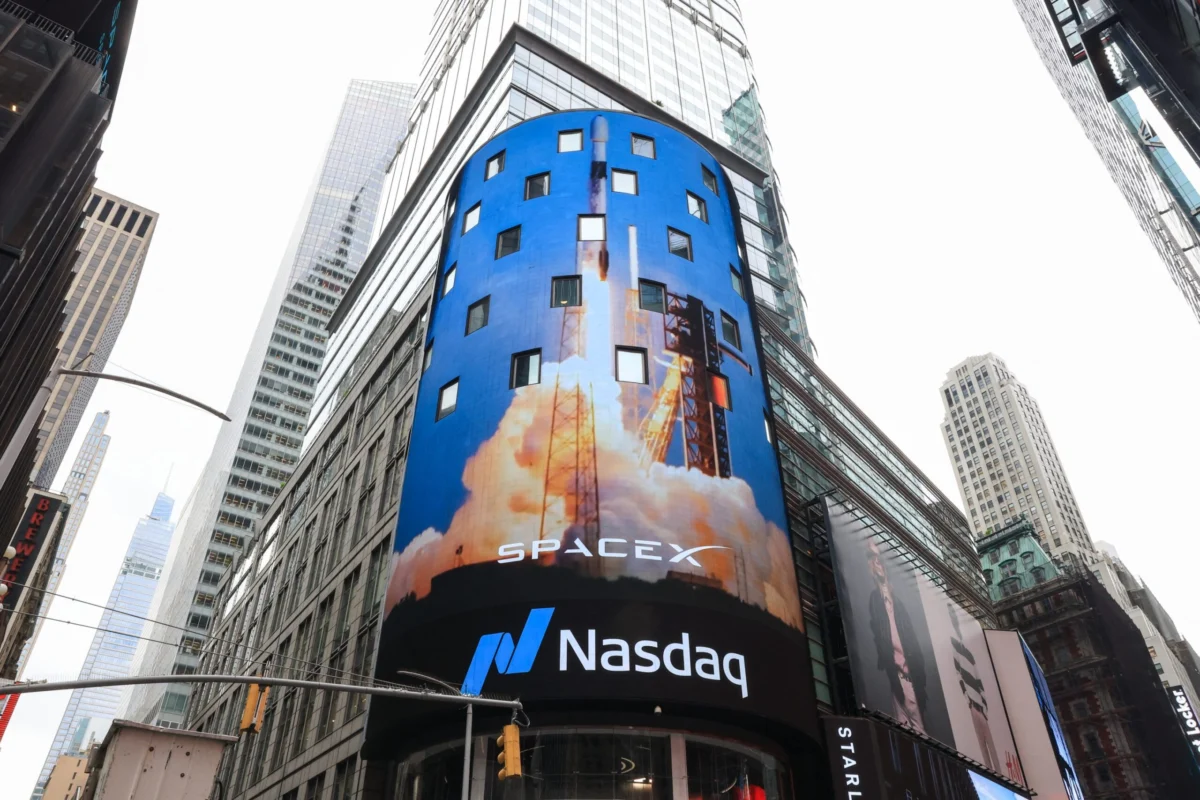
The global financial landscape is currently witnessing a capital raising cycle of historic proportions. As investors flock to the long-awaited initial public offering (IPO) of Elon Musk’s SpaceX—a move that has already siphoned an estimated $75 billion from private and public coffers—the focus is shifting toward the next frontier of the silicon age: the public debuts of artificial intelligence titans OpenAI and Anthropic.
However, beneath the veneer of record-breaking valuations and "swarming" investor interest, a profound schism has emerged among Wall Street’s elite analysts. The primary point of contention is whether this flood of new equity issuance is a sign of a healthy, growing economy or a classic "canary in the coal mine" signaling an imminent market collapse. While the stock market has shown remarkable resilience against geopolitical shocks—ranging from trade tensions to regional conflicts in the Middle East—the sheer volume of new shares hitting the market is forcing a re-evaluation of the current bull run’s longevity.
Main Facts: A Tsunami of Capital
The scale of current equity issuance is staggering, even by the standards of the post-pandemic recovery. SpaceX’s historic IPO, which saw investors compete for a piece of the aerospace pioneer, raised a monumental $75 billion. This event alone would be enough to define a fiscal year, but it is merely the opening act.
Industry insiders and market trackers are now bracing for the public listings of OpenAI, the creator of ChatGPT, and its primary rival, Anthropic. Both companies are expected to tap the public markets for tens of billions of dollars later this year, capitalizing on the insatiable appetite for generative AI technologies.
This surge in IPO activity follows a massive secondary offering by Alphabet, Google’s parent company, which successfully netted $85 billion earlier this month. When combined, these figures represent one of the most significant transfers of capital into equity in modern financial history.
For some, this represents the ultimate validation of the AI and private space sectors. For others, it raises the specter of "liquidity exhaustion." The fundamental question facing the market is simple: can the system absorb hundreds of billions in new shares without devaluing existing holdings or signaling a peak in investor sentiment?
Chronology: From the Dot-Com Bubble to the AI Boom
To understand the current anxiety, one must look at the historical precedents of equity issuance cycles. Markets rarely move in a vacuum, and the timing of massive IPO waves has historically been a reliable, if painful, indicator of market cycles.
1999: The Tech Bubble Peak
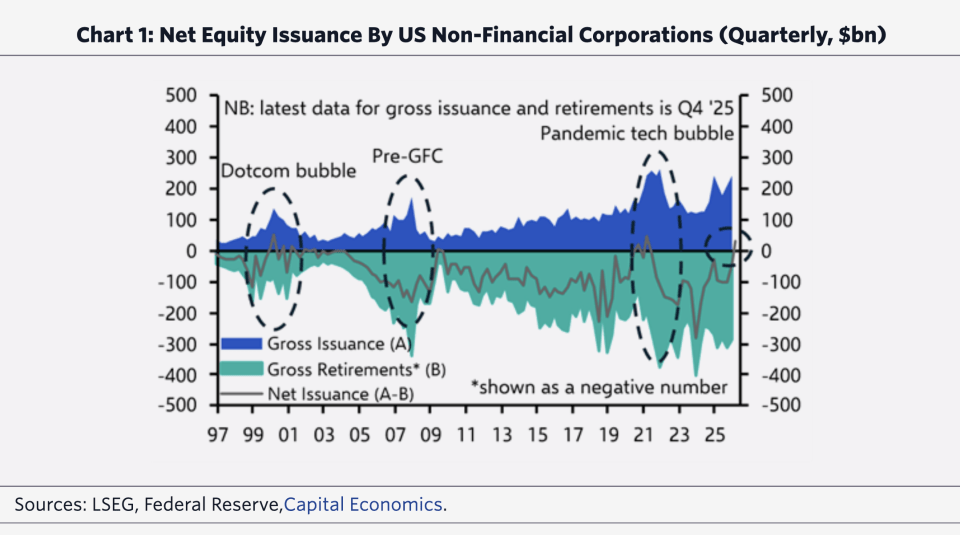
The late 1990s saw a similar "swarm" of investor interest. Gross equity issuance surged as every company with a ".com" suffix sought to capitalize on the nascent internet. By the end of 1999, issuance reached record highs. What followed in 2000 was a devastating bear market and a recession that wiped out trillions in market value.
2007: The Housing and Credit Peak
Before the Great Financial Crisis, 2007 was marked by a flurry of financial sector issuances and large-scale IPOs. Companies were raising capital at the height of the housing bubble. By 2008, the market had turned, leading to the worst economic downturn since the Great Depression.
2021: The Post-Pandemic Euphoria
The most recent example occurred in 2021, fueled by SPACs (Special Purpose Acquisition Companies) and record-low interest rates. Equity issuance hit fever pitch as companies rushed to go public at sky-high valuations. The subsequent year, 2022, saw the S&P 500 drop nearly 20% as inflation spiked and the bubble burst.
2023–2026: The AI Ascent
The current cycle began in earnest in early 2023. At that time, U.S. stock issuance was at a modest quarterly run rate of approximately $30 billion. As of mid-2024, that figure has quadrupled to roughly $120 billion per quarter. With SpaceX now public and the AI "Big Two" (OpenAI and Anthropic) on deck, the trajectory of 2026 is starting to mirror the final stages of previous peaks.
Supporting Data: The Bear Case vs. The Bull Case
The debate is currently centered on two conflicting interpretations of market data, provided by Capital Economics and Deutsche Bank.
The Warning: Capital Economics and the "Final Innings"
Jonas Goltermann, the chief markets economist at Capital Economics, views the current environment with significant trepidation. His analysis points to the fact that net equity issuance by U.S. non-financial companies turned positive in the first quarter of this year, even before the massive SpaceX and Alphabet moves.
"History suggests caution is in order," Goltermann noted in a recent Friday brief. "Major IPOs and periods of high issuance of equity have often preceded peaks in the U.S. equity market."
Goltermann’s data suggests that when companies rush to issue shares, it is often because they—and their investment bankers—perceive that valuations have reached a ceiling. By "cashing out" or raising capital at these levels, they are effectively timing the market. He warns that the AI equity boom may be "approaching its final innings," drawing direct parallels to the 1999 and 2021 environments.
The Opportunity: Deutsche Bank and the Demand-Driven Rally
Conversely, analysts at Deutsche Bank, led by Jim Reid, offer a much more optimistic reading of the same data. By analyzing upcycles in share supply over the last 30 years, Reid found that issuance waves typically coincide with strong stock market returns, rather than market stress.
According to Deutsche Bank’s research, equity issuance waves over the past three decades have produced:
- Median 3-month returns: ~8%
- Median 12-month returns: >20%
Reid argues that the causality is often misunderstood. "Companies tend to issue when equity demand is strong, earnings momentum is healthy, and investor risk appetite is elevated," Reid wrote. "In other words, causality usually runs from strong markets to issuance, rather than issuance causing markets to fall."
The Deutsche Bank perspective emphasizes that today’s market is not driven by "pure speculation" like the 1999 bubble, but by "robust earnings growth" and a "modest overall equity positioning."
Official Responses and Analyst Perspectives
The broader financial community is divided, with the rhetoric reflecting the high stakes of the AI revolution.
The Skeptic’s View:
Jonas Goltermann of Capital Economics acknowledges that current valuations are not as "overextended" as they were in 1999. However, he remains steadfast that the patterns are too similar to ignore. "There are more and more similarities between the current market environment and that around previous equity market peaks," he warned. His stance is that the supply of new shares will eventually overwhelm the available demand, leading to a natural correction.
The Strategist’s View:
Jim Reid of Deutsche Bank counters that the "demand side" of the equation is the defining feature of 2024 and 2025. He points to the fact that household balance sheets are currently flush with cash and have significant capacity to absorb new supply. Furthermore, the massive level of corporate buybacks—where companies like Apple and Meta return billions to shareholders—acts as a counterweight to the new issuance, keeping the net supply of shares manageable.
Corporate Sentiment:
While OpenAI and Anthropic have not released official statements regarding the specific timing of their debuts, the "mood music," as Goltermann calls it, remains positive. Corporate leaders in the AI space are operating under the assumption that the "AI transition" is a multi-decade shift, justifying the massive capital raises required to build the necessary infrastructure (data centers, chips, and energy sources).
Implications: What Lies Ahead for Investors?
The divergence between the "issuance-as-a-peak" theory and the "issuance-as-a-sign-of-strength" theory has significant implications for both retail and institutional investors.
1. The Liquidity Test
The upcoming OpenAI and Anthropic IPOs will serve as a litmus test for market liquidity. If these offerings are oversubscribed and lead to a "pop" in share price, it will validate the Deutsche Bank thesis that demand remains insatiable. If, however, these IPOs struggle or lead to a broader sell-off in tech, it may signal that the market has finally reached its saturation point.
2. The Quality of Earnings
Unlike the dot-com era, many of the companies currently raising capital—or those like Alphabet and Nvidia that anchor the market—are generating record profits. If earnings continue to grow at a pace that justifies these valuations, the "high issuance" may simply be a byproduct of a massive industrial expansion. If earnings begin to miss expectations, the high issuance will be viewed in retrospect as a classic exit strategy by insiders.
3. The "Final Innings" Risk
If Capital Economics is correct, the AI boom is entering its most dangerous phase: the blow-off top. In this scenario, the SpaceX IPO will be remembered as the moment the "smart money" began to offload risk onto the public. Investors would be wise to maintain defensive positions and look for signs of narrowing market breadth.
4. Household Resilience
A critical factor that may prevent a repeat of 2008 is the state of the consumer. As Jim Reid noted, household capacity to absorb supply is high. Unlike previous cycles where investors were over-leveraged, the current rally has seen a significant amount of "sidelined" cash finally entering the market.
Conclusion
The historic IPO of SpaceX and the looming debuts of OpenAI and Anthropic represent a pivotal moment for the global economy. We are witnessing the financialization of the next industrial revolution. Whether this surge in equity issuance is the fuel for a continued ascent or the weight that finally breaks the market’s back remains the most critical question on Wall Street.
For now, the "mood music" remains upbeat, but as history reminds us, the loudest music often plays just before the lights go out. Investors must weigh the undeniable momentum of AI and aerospace against the cold, hard data of previous market cycles. In the coming months, the performance of these new shares will tell us whether we are at the beginning of a new era or the end of a legendary run.