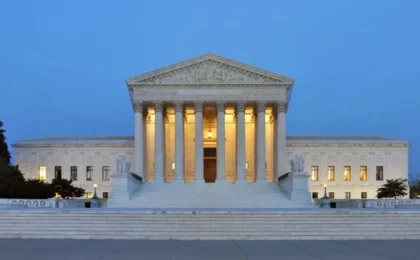
In a significant decision that clarifies the intersection of state election administration and federal statutory mandates, the United States Supreme Court ruled on Monday in Watson v. Republican National Committee that federal law does not prohibit states from counting absentee ballots that arrive after Election Day, provided they are postmarked by the deadline.
The 5-4 decision reverses a controversial ruling by the U.S. Court of Appeals for the Fifth Circuit, which had previously invalidated a Mississippi statute permitting a five-day grace period for mail-in ballots. The Supreme Court’s majority opinion, authored by Justice Amy Coney Barrett, relied on a textualist interpretation of federal election statutes, ultimately concluding that the "election" of federal officials is completed the moment the voter casts their ballot, regardless of when that ballot is processed by postal authorities.
The Core Legal Conflict: Defining "Election Day"
At the heart of Watson v. Republican National Committee lay the interpretation of three specific federal election-day statutes: 2 U.S.C. § 7, 2 U.S.C. § 1, and 3 U.S.C. § 1. These provisions mandate a single Tuesday in November for the election of the President, Vice President, and members of Congress.
The Republican National Committee (RNC), the Mississippi Republican Party, and the Libertarian Party of Mississippi argued that these statutes establish a "hard stop." Their position was that federal law requires all ballots to be in the physical possession of election officials by the close of polls on Election Day. They contended that allowing a grace period—even for ballots demonstrably cast before the deadline—effectively extends the election beyond the federally mandated day, thereby infringing upon the uniformity of the federal electoral process.
The Court, however, rejected this interpretation. Writing for the majority, Justice Barrett posited that the defining element of an "election" is the act of the voter choosing a candidate, which is an event finalized when the ballot is marked and placed into the mail. The majority pointed to the Uniformed and Overseas Citizens Absentee Voting Act (UOCAVA) as evidence that Congress has long understood ballot-receipt deadlines to be a matter of state, rather than federal, discretion.
Chronology of the Litigation
The legal battle over Mississippi’s voting procedures followed a winding path through the federal judiciary:
- Initial Challenge: Following the implementation of Mississippi’s five-day grace period law, the RNC and state-level political organizations challenged the statute, arguing that it violated the federal mandate for a uniform Election Day.
- District Court Level: The law was initially scrutinized under the lens of administrative burden and the potential for federal preemption.
- Fifth Circuit Intervention: The U.S. Court of Appeals for the Fifth Circuit sided with the plaintiffs, ruling that Mississippi’s law was inconsistent with federal statutes. The court’s decision created a significant constitutional friction point, as it suggested that states lacked the authority to establish receipt deadlines that extended beyond the federal date.
- Supreme Court Review: The Supreme Court granted certiorari, setting the stage for a high-stakes showdown over the limits of state election sovereignty.
- Oral Arguments: During arguments, the Court probed the definitions of "casting" a vote versus "receiving" a vote. Justices expressed interest in the logistical realities of the U.S. Postal Service and the impact of delivery delays on the disenfranchisement of voters.
- Final Ruling: On Monday, the Court issued its decision, with Justice Barrett bridging the ideological divide to form a majority with Chief Justice John Roberts and Justices Sonia Sotomayor, Elena Kagan, and Ketanji Brown Jackson.
The Ideological Divide: Majority vs. Dissent
The ruling in Watson represents a rare alignment on the modern Supreme Court, illustrating that disputes over election administration do not always fall along traditional partisan lines. By joining the Court’s three liberal members, Justice Barrett and Chief Justice Roberts emphasized a narrow legalistic approach, avoiding broader constitutional pronouncements.
Justice Samuel Alito, writing in dissent, expressed profound concern regarding the implications of the ruling. Joined by Justices Clarence Thomas and Neil Gorsuch, with Justice Brett Kavanaugh joining in part, Alito argued that the electorate’s collective choice is not truly "authoritative" until the ballots are collected and counted.
"The integrity of an election depends on the certainty of its results," Alito wrote. He warned that allowing ballots to arrive days after the election creates a "floating" window for results to change, which he argued could foster public distrust and heighten the risk of systemic fraud. The dissent emphasized that the further an election is removed from a single, definitive moment of closure, the more vulnerable the democratic process becomes to perceptions of impropriety.
Implications for Election Administration and Federalism
The Supreme Court’s decision carries profound implications for the 2026 election cycle and beyond. By upholding the Mississippi law, the Court has effectively reinforced the principle of state-level control over the logistical "mechanics" of voting, provided those mechanics do not explicitly contradict federal mandates.
1. Protection of Voter Enfranchisement
For election officials, the ruling provides a degree of certainty. In an era where postal service delivery times have fluctuated, the ability to count ballots postmarked by Election Day ensures that voters who have complied with all requirements are not disenfranchised by logistical delays outside of their control.
2. State Sovereignty
The ruling serves as a victory for proponents of federalism. It reaffirms that states retain broad latitude to craft election procedures that account for their specific demographic and geographic realities, such as rural access to mail services.
3. The "Moving Target" Concern
Critics of the ruling remain concerned about the potential for prolonged vote-counting processes. In close races, the knowledge that significant blocks of ballots remain uncounted until several days after the election can delay the declaration of winners, which some argue exacerbates political instability and public skepticism regarding election outcomes.
Unresolved Questions and Future Litigation
While the Court’s ruling provides clarity on the specific Mississippi statute, it conspicuously left several doors open. The majority framed the question narrowly, declining to issue a broad ruling on the full scope of Congressional authority to regulate federal elections.
Furthermore, the Court sidestepped a complex, late-raised argument regarding whether ballots that remain in the custody of the U.S. Postal Service on Election Day can ever be considered "cast." By declining to rule on this, the Court has left open the possibility for future litigation should a different state pass a more expansive grace period or if federal election statutes are amended by Congress.
The case has now been remanded to the Fifth Circuit for further proceedings consistent with the Supreme Court’s opinion. While the immediate outcome in Mississippi is settled, the legal community anticipates that Watson will serve as a foundational precedent for future challenges to mail-in ballot procedures across the United States.
Conclusion
The Supreme Court’s decision in Watson v. Republican National Committee represents a critical moment in the ongoing national debate over election integrity. By prioritizing the voter’s act of casting a ballot over the administrative receipt of that ballot, the Court has reaffirmed a standard that protects the individual voter’s participation. However, as evidenced by the sharp dissent, the tension between the desire for administrative efficiency and the necessity of public trust in election results remains an unresolved challenge for American democracy.
As the nation moves forward, election officials, legal scholars, and voters alike will be watching closely to see how states navigate the balance between maximizing participation and ensuring the rapid, transparent resolution of electoral contests. For now, the "postmark rule" stands as a constitutionally permissible mechanism in the administration of federal elections.