

We are socialized from birth to treat our existence as a race. From the moment we enter the education system, we are ranked, graded, and sorted. By the time we reach adulthood, this competitive framework has become so deeply ingrained that we describe our journey as "the game of life."
It is a pervasive metaphor, reinforced by everything from Milton Bradley’s 1860 board game—which remains a cultural staple—to the endless stream of self-help literature promising the "secret" to winning. However, as modern society becomes increasingly obsessed with metrics of status, career prestige, and social comparison, a critical question emerges: Have we traded the pursuit of a meaningful life for the hollow pursuit of a victory that doesn’t exist?
The Anatomy of a Cultural Delusion
To understand why viewing life as a game is a modern tragedy, one must first define what a game actually is. A game is a closed system governed by arbitrary, external rules. Its primary function is to create a hierarchy of winners and losers based on metrics that, in the grand scheme of the universe, possess no intrinsic value.
When we apply this framework to our daily existence, we externalize our self-worth. We begin to view our careers, our children’s achievements, and our social circles not as sources of joy or connection, but as scoreboards. This shift in perspective transforms the "Good Life"—a concept traditionally rooted in philosophy, ethics, and internal contentment—into a series of quantifiable KPIs (Key Performance Indicators).
Chronology of a Competitive Mindset
- The 19th Century Origins: With the rise of industrialization, the "Game of Life" board game was introduced. It reflected the Victorian-era obsession with social mobility and material accumulation, setting a template for the American Dream that prioritized visible success.
- The Mid-20th Century Escalation: Post-WWII economic expansion brought about the professionalization of the middle class. Life became synonymous with "climbing the ladder," and the game became more rigorous, characterized by suburban homeownership and corporate stability.
- The Digital Era (Present Day): The advent of social media has turned the "game" into a spectator sport. We no longer just compete with our neighbors; we compete with curated highlight reels from across the globe, leading to a constant, low-level hum of anxiety regarding our relative standing.
The Quantitative Trap: Why Meaning Cannot Be Measured
The most dangerous aspect of treating life as a game is the prioritization of the measurable over the meaningful. We can easily compare the market value of a house, the salary of a job, or the prestige of a university. These are objective data points.
However, the components that actually constitute a "good life"—integrity, the depth of one’s relationships, the capacity for empathy, and the pursuit of intellectual curiosity—are fundamentally subjective. Because they cannot be placed on a leaderboard, they are often relegated to secondary importance by those fixated on winning.
Supporting Data on Social Comparison
Psychological studies, such as those conducted by Leon Festinger in his Social Comparison Theory, suggest that human beings have an innate drive to evaluate themselves in comparison to others. In the absence of objective standards, we turn to our peers. When these comparisons are filtered through a competitive lens, the results are almost universally negative:
- The Upward Comparison Effect: Leads to feelings of inadequacy, envy, and the "imposter syndrome."
- The Downward Comparison Effect: Leads to arrogance, a lack of self-awareness, and the erosion of genuine community.
Neither state is conducive to human flourishing. By prioritizing the "score" over the "substance," we hollow out the very experiences that make life worth living.
The Erosion of Relationships
Perhaps the most damaging implication of the "game" mentality is what it does to our interpersonal connections. Healthy, fulfilling relationships require a foundation of mutual support—a genuine desire for the other person to thrive.
When you perceive life as a zero-sum game, your success becomes inextricably linked to someone else’s perceived failure. If your neighbor gets the promotion you wanted, or if a friend’s child gets into an elite school, the competitive mindset frames these events as personal losses. This creates a psychological barrier to intimacy. You cannot be a true friend to someone you are secretly trying to outrun.
Implications for Modern Society
This friction manifests in several ways:
- Transactional Relationships: People are evaluated based on what they can "bring to the table" or how they enhance one’s status, rather than for their intrinsic character.
- Performance Anxiety: Constant competition leaves little room for vulnerability. If life is a game, admitting to struggle or failure is a tactical error. This leads to profound isolation, as individuals hide their true selves to maintain a "winning" image.
- Pyrrhic Victories: Many individuals achieve the external markers of success—the corner office, the vacation home, the accolades—only to find that they have sacrificed their health, their family life, and their own sense of self to attain them.
Reclaiming Autonomy: Playing by Your Own Rules
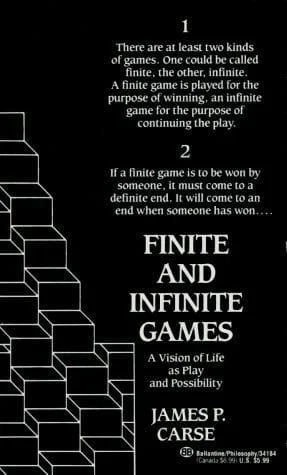
The philosopher James Carse, in his seminal work Finite and Infinite Games, distinguishes between two types of activity. A "finite game" is played for the purpose of winning, with a clear beginning and end. An "infinite game" is played for the purpose of continuing the play.
To live a truly good life, one must step out of the finite game. This requires a radical act of autonomy: defining your own criteria for success. When you stop chasing the arbitrary goals set by society—prestige, consumption, and rank—you regain the agency to align your actions with your values.
The Strategy for Autonomy
- Audit Your Metrics: Identify which parts of your life are being managed for "points" rather than for personal satisfaction. Ask yourself: "Would I still pursue this goal if no one were watching?"
- Cultivate Internal Feedback Loops: Shift your focus from external validation to internal standards. Are you becoming a more ethical person? Are you deepening your understanding of the world? These are metrics that cannot be taken away by external circumstances.
- Embrace the "Losses": Recognize that failure is not a sign that you are losing the game; it is an inevitable component of the human experience. When you stop fearing "losing," you gain the freedom to take risks, follow your passions, and live authentically.
Implications for the Future
As we look toward the future, the societal obsession with the "game of life" faces a reckoning. In an era of increasing economic uncertainty and rapid technological change, the old metrics of success are becoming less reliable. The corporate ladder is thinning; the traditional path to stability is shifting.
Those who remain tethered to the competitive model will find themselves increasingly frustrated by a world that no longer rewards their old playbooks. Conversely, those who treat life as an infinite, creative process—a journey of discovery rather than a race to a finish line—will find themselves better equipped to navigate the complexities of the 21st century.
Final Thoughts: The Proper Place of Competition
It is important to state that competition is not inherently evil. It is a vital, stimulating aspect of the human experience. When we play sports, engage in games, or push ourselves to excel in a creative endeavor, we are testing our limits. These activities provide structure, excitement, and a healthy outlet for our drive.
The danger lies not in the competition itself, but in the conflation of the game with the reality of our existence. By all means, play to win on the golf course, on the field, or in your hobbies. But when the game ends, leave the scorecard on the field.
Do not bring that ledger home. Do not bring it to the dinner table. Do not use it to measure the worth of your spouse, your children, or yourself. Life is far too fragile, far too complex, and far too fleeting to be treated as a game. It is not something to be won; it is something to be lived, experienced, and shared. When we finally let go of the need to be "winners," we may finally find the freedom to be human.