
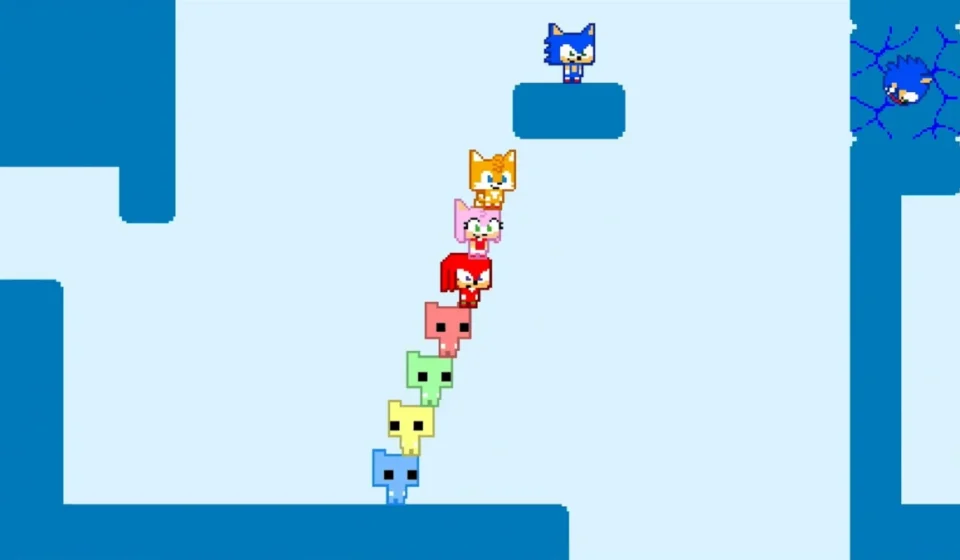
The Indie Revolution: Why Sega’s Takashi Iizuka Sees the Future of Gaming in the "Backrooms" Model

In an era defined by ballooning development budgets, decade-long production cycles, and the high-stakes pressure of "AAA" gaming, a surprising philosophical shift is emerging from the upper echelons of the industry. Takashi Iizuka, the veteran producer of the Sonic the Hedgehog franchise, has pointed toward an unlikely benchmark for the future of interactive entertainment: the runaway success of low-budget horror phenomena like Backrooms.
While promoting the collaborative title Sonic Pico Park—a project born from a partnership between Sega and the indie developer Tecopark—Iizuka highlighted a growing disconnect between massive financial investment and audience satisfaction. His remarks arrive at a pivotal moment in 2026, where the market is increasingly favoring agile, creatively bold indie titles over the monolithic, risk-averse blockbusters that have dominated the last decade.
The Convergence of Media: Cinema and Gaming Parallelisms
During a recent interview with GamesRadar, Iizuka drew a direct parallel between the challenges facing the video game industry and the current landscape of Hollywood.
"It’s a little bit a different type of media, but the movie industry is kind of going through similar issues that we in the game industry are going through," Iizuka explained. "You see movies like Backrooms and Obsession, these much smaller creative efforts that are still becoming these great successful hits. I see a parallel in the movie industry to what’s happening in the game industry regarding the amount of investment and the actual entertainment that people are consuming and enjoying."
The comparison is striking. Both industries have spent years trapped in an arms race of scale—larger budgets, hyper-realistic graphics, and marketing campaigns costing hundreds of millions of dollars. Yet, as Iizuka suggests, the "biggest" projects are no longer guaranteed to be the most culturally resonant or profitable.
Chronology of a Shift: From Blockbuster Dominance to Indie Ascendance
To understand why Iizuka’s perspective is resonating, one must look at the trajectory of the market over the last several years.
The Era of "Big" (2018–2024)
For nearly a decade, the industry standard was clear: bigger was better. AAA studios focused on "service-based" games, massive open worlds, and cinematic fidelity that required teams of hundreds, if not thousands, of developers. The expectation was that a project had to cost $200 million or more to be considered "premium."
The Market Correction (2025–2026)
By 2025, signs of fatigue began to manifest. High-profile titles with massive budgets faced public struggle—not necessarily because they were "bad" games, but because their bloated budgets made it nearly impossible to meet internal profit projections. Simultaneously, the audience’s appetite shifted toward "snackable" but high-quality experiences.
The Current Moment (June 2026)
The release of Sonic Pico Park serves as a case study for this new approach. By partnering with a nimble indie studio like Tecopark, Sega was able to bypass the bureaucratic sludge of a full-scale internal AAA production. The result is a game that feels fresh, experimental, and—most importantly—fun. It is a "sweet treat" that bridges the gap between major releases, proving that brand prestige can be maintained through smaller, more focused efforts.
Supporting Data: The Numbers Behind the Sentiment
The data confirms Iizuka’s intuition. During the recent Summer Game Fest, industry analyst Geoff Keighley presented figures that sent shockwaves through the development community.
In the first half of 2026, 10 out of the 14 new games on Steam to sell over one million copies originated from independent studios. These games, often developed by teams of fewer than 50 people, are outperforming high-budget titles in terms of both ROI (Return on Investment) and player engagement.
Conversely, "AAA" projects are facing an existential crisis. Titles like Marathon have struggled to reconcile their massive development costs with a changing player base that is increasingly wary of traditional monetization and "live service" bloat. When a $200 million title is compared against a $5 million hit that offers higher engagement, the fiscal logic of the entire industry begins to fracture.

Official Responses and Industry Philosophies
Iizuka’s praise for the indie model isn’t just a PR soundbite; it reflects a genuine change in the philosophy of Sega’s leadership. The ability of indie studios to "quickly iterate on ideas" is the core competitive advantage that Iizuka identifies.
"AAA development just can’t [iterate quickly] due to lofty expectations and extended timelines," Iizuka noted.
When a studio spends five years on a single game, the design philosophy is often "locked in" long before the game reaches the consumer. If the market trend shifts during that half-decade, the studio is stuck with an outdated concept. In contrast, indie developers can pivot in weeks, responding to community feedback and viral trends in real-time. This agility is what allowed films like Backrooms to capitalize on internet culture so effectively, and it is the same agility that Iizuka believes will save gaming from stagnation.
Implications for the Future of Interactive Media
The implications of this shift are profound for both the players and the industry at large.
1. The Rise of the "Mid-Budget" Tier
We are likely to see a resurgence of the "middle-market" game—projects that are not indie in the basement sense, but are not bloated $300 million experiments either. Companies like Sega are setting a precedent: partnering with small, specialized teams to bring major IPs to life in new ways.
2. Creative Risks Over Fiscal Safety
For years, AAA studios avoided innovation because they couldn’t afford to fail. By lowering the cost of entry, studios can take more creative risks. If a project costs $10 million to produce rather than $200 million, the studio can afford to be weird, experimental, or niche.
3. A Focus on "Entertainment Value"
The most significant shift is the definition of "value." For years, value was defined by "hours of content" or "graphical fidelity." Now, value is being redefined by "engagement" and "delight." Sonic Pico Park is a testament to the idea that a game doesn’t need to be 100 hours long to be worth a player’s time and money.
4. Cultural Resonance
Movies like Backrooms and Obsession succeeded because they tapped into a collective cultural nerve. They were "events" because they felt authentic and raw. By adopting this indie mindset, the gaming industry has the potential to move away from the "assembly-line" production style that has made many modern games feel hollow.
Conclusion: A New Horizon for Gaming
Takashi Iizuka’s observations are a wake-up call for the "Old Guard" of the video game industry. The success of indie developers isn’t a fluke; it is a signal that the market is ready for a change in pace.
As we look toward the remainder of 2026 and beyond, the most successful publishers will likely be those that stop trying to make every game a "world-ending" blockbuster and start empowering teams to build smaller, more focused, and ultimately more creative experiences. If the industry can successfully learn from the lean, hungry, and highly effective model of the indie scene—and the horror-movie disruptors like Backrooms—the future of gaming may be far more diverse, exciting, and profitable than anyone expected.
The era of the "Mega-Budget" may not be over, but the era of the "Indie-Inspired" is clearly just beginning.