The global quest to achieve carbon neutrality hinges on our ability to manage the lifecycle of carbon dioxide (CO₂). While CO₂ is the primary driver of anthropogenic climate change, it is also a massive, untapped carbon reservoir. For decades, the chemical industry has looked to "carbon capture and utilization" (CCU) as a holy grail, with the conversion of CO₂ into methanol standing out as one of the most promising avenues for creating sustainable fuels and chemical feedstocks.
However, the path from waste gas to liquid fuel has been obstructed by a stubborn thermodynamic paradox. A team of researchers from the Dalian Institute of Chemical Physics (DICP) at the Chinese Academy of Sciences (CAS), led by Professors Jian Sun and Jiafeng Yu, has recently unveiled a breakthrough that promises to resolve a decades-old technical stalemate, potentially revolutionizing how we manufacture methanol at scale.
The Thermodynamic Dilemma: Why Methanol Synthesis Stalls
To understand the significance of the DICP study, one must first appreciate the chemical "tug-of-war" that occurs within a catalytic reactor. Methanol synthesis from CO₂ and hydrogen is thermodynamically favorable at lower temperatures, meaning the reaction naturally wants to move toward the desired product under cool conditions.
The catch, however, lies in the kinetic barriers. CO₂ is an exceptionally stable, inert molecule. At lower temperatures, the energy required to "activate" or break the bonds of CO₂ is prohibitive, leading to sluggish reaction rates and poor catalytic performance. Naturally, engineers have historically responded to this by cranking up the heat.
Higher temperatures provide the kinetic energy needed to get the reaction moving. Yet, this introduces a secondary, detrimental pathway: the reverse water-gas shift (RWGS) reaction. This competing process favors the production of carbon monoxide (CO) and water rather than methanol. Consequently, increasing the temperature to improve yield inevitably causes selectivity to plummet, creating a persistent trade-off that has plagued industrial methanol production for generations.
Chronology of a Breakthrough
The journey toward this latest discovery did not happen overnight. It is the culmination of years of fundamental research into metal-support interactions at the atomic level.
- 2010s – The Era of Incremental Gains: Researchers globally focused on refining traditional copper-based catalysts (Cu/Zn/Al). While improvements were made, they were largely marginal, failing to address the fundamental trade-off between activity and selectivity.
- Early 2020s – The Shift toward Nano-Engineering: The scientific community began moving away from "brute force" thermal methods, focusing instead on surface science and structural engineering. The DICP team specifically began investigating the "Strong Metal-Support Interaction" (SMSI) effect—a phenomenon where the metal nanoparticles and their support substrate interact to create unique electronic environments.
- 2023 – Designing the Overlayer: The research team, led by Professors Sun and Yu, hypothesized that if they could spatially isolate specific reaction steps on different parts of the catalyst surface, they could decouple the competing reaction pathways.
- 2024 – Validation and Publication: Following rigorous testing and atomic-level characterization, the team published their findings in the journal Chem, confirming that their novel overlayer structure successfully outperformed commercial standards by a factor of three.
Supporting Data: By the Numbers
The performance metrics reported by the DICP team are not merely incremental; they are disruptive. In testing conducted at 300°C and a pressure of 3 MPa, the researchers achieved a space-time yield of 1.2 g·g_cat⁻¹·h⁻¹.
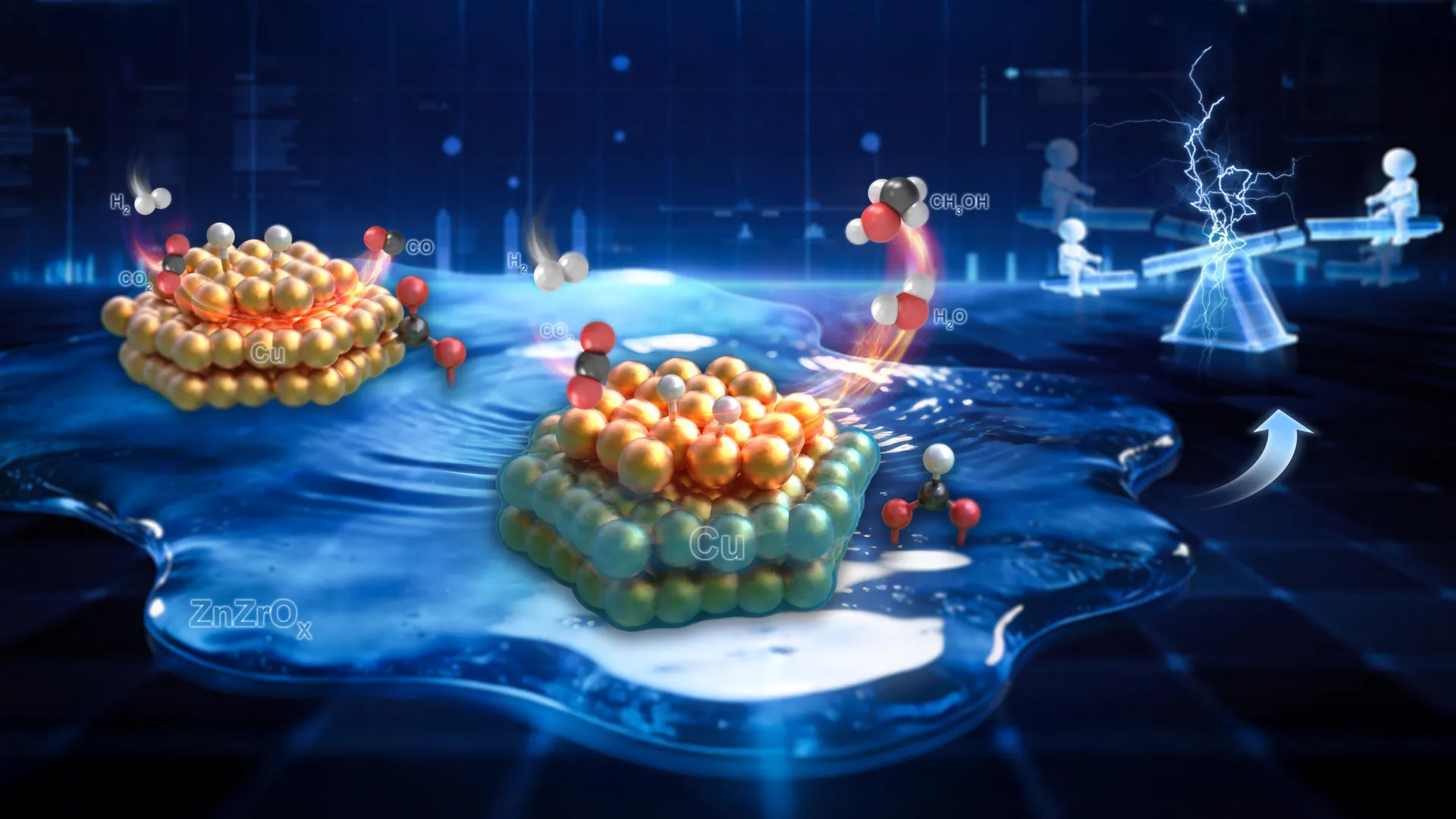
To put this in perspective, this rate is approximately three times higher than the performance of conventional Cu/Zn/Al catalysts used in current industrial settings. The structural innovation lies in the use of an SMSI-driven overlayer that effectively creates "traffic lanes" for the molecules.
By restructuring the catalyst surface, the team fundamentally changed the reaction pathway. In conventional catalysts, the process typically starts with the difficult task of breaking the C=O bond in CO₂ before hydrogenation can begin. In the new DICP catalyst design, the reaction is redirected. Hydrogenation occurs first on zirconia (ZrO₂) sites, and the cleavage of the C=O bond is deferred. This "hydrogenation-first" approach significantly suppresses the formation of CO byproducts, allowing the catalyst to remain highly selective for methanol even as it maintains high overall activity.
Official Responses and Expert Perspectives
The research has garnered significant attention from the international catalysis community. Prof. Jian Sun, the lead researcher, characterized the development as a foundational shift in methodology.
"Our study may provide a new pathway to addressing the long-standing trade-off between activity and selectivity in methanol synthesis from CO₂," Sun stated in an interview following the publication. "By fundamentally changing the sequence of the reaction pathway—prioritizing hydrogenation on specialized sites—we are essentially forcing the chemistry to favor our desired outcome, rather than fighting against the thermodynamics of the reverse water-gas shift."
Industry observers note that while the laboratory results are impressive, the transition to industrial application will be the next critical hurdle. Peer reviewers have highlighted the stability of the overlayer structure as a key factor to watch. If the catalyst can maintain this 300% efficiency increase over thousands of hours of operation under industrial pressures, it could drastically reduce the capital expenditure required for carbon-to-methanol conversion plants.
Implications for a Carbon-Neutral Future
The implications of this discovery extend far beyond the laboratory walls of the Dalian Institute of Chemical Physics. If methanol can be produced efficiently and selectively from CO₂, it changes the economic calculus of green energy.
1. The Methanol Economy
Methanol is more than just a chemical solvent; it is a versatile energy carrier. It can be easily transported as a liquid, stored, and utilized in existing infrastructure. By scaling up this new catalyst, industries could utilize CO₂ captured from flue gases of power plants or direct air capture (DAC) units to create "e-methanol." This liquid fuel could then serve as a carbon-neutral feedstock for shipping, aviation, and the production of plastics.
2. Decarbonizing Chemical Feedstocks
Currently, the vast majority of global methanol production relies on steam reforming of natural gas, a process that releases significant quantities of CO₂. By switching the source of methanol to recycled CO₂ and green hydrogen (produced via electrolysis using renewable electricity), the industry could effectively close the carbon loop. This transition would turn a major industrial carbon emitter into a carbon-negative sector.
3. A Template for Catalyst Design
Perhaps the most significant takeaway from the DICP study is the success of the "spatial separation" design philosophy. By proving that SMSI-driven overlayers can physically partition reaction steps, the team has provided a blueprint for other chemists. Researchers working on ammonia synthesis, nitrogen fixation, and other challenging catalytic processes may now adopt similar structural engineering strategies to overcome their own "activity-selectivity" bottlenecks.
Conclusion: A Turning Point
The history of industrial chemistry is a history of overcoming thermodynamic limitations through the clever application of catalysts. The DICP team’s work represents a milestone in this tradition. By successfully navigating the trade-offs that have stymied researchers for years, they have unlocked a more efficient way to utilize our most abundant waste product.
As the world continues to search for scalable solutions to the climate crisis, the ability to turn CO₂ into high-value chemical products like methanol is no longer just a theoretical possibility. With the success of this new catalyst design, it is becoming an industrial reality. The challenge now shifts from the laboratory to the pilot plant, as engineers work to scale this breakthrough and integrate it into the global energy architecture. If the results hold at scale, we may look back at this moment as the start of the "Methanol Era"—a period where carbon dioxide ceased to be a liability and became the building block of our sustainable future.