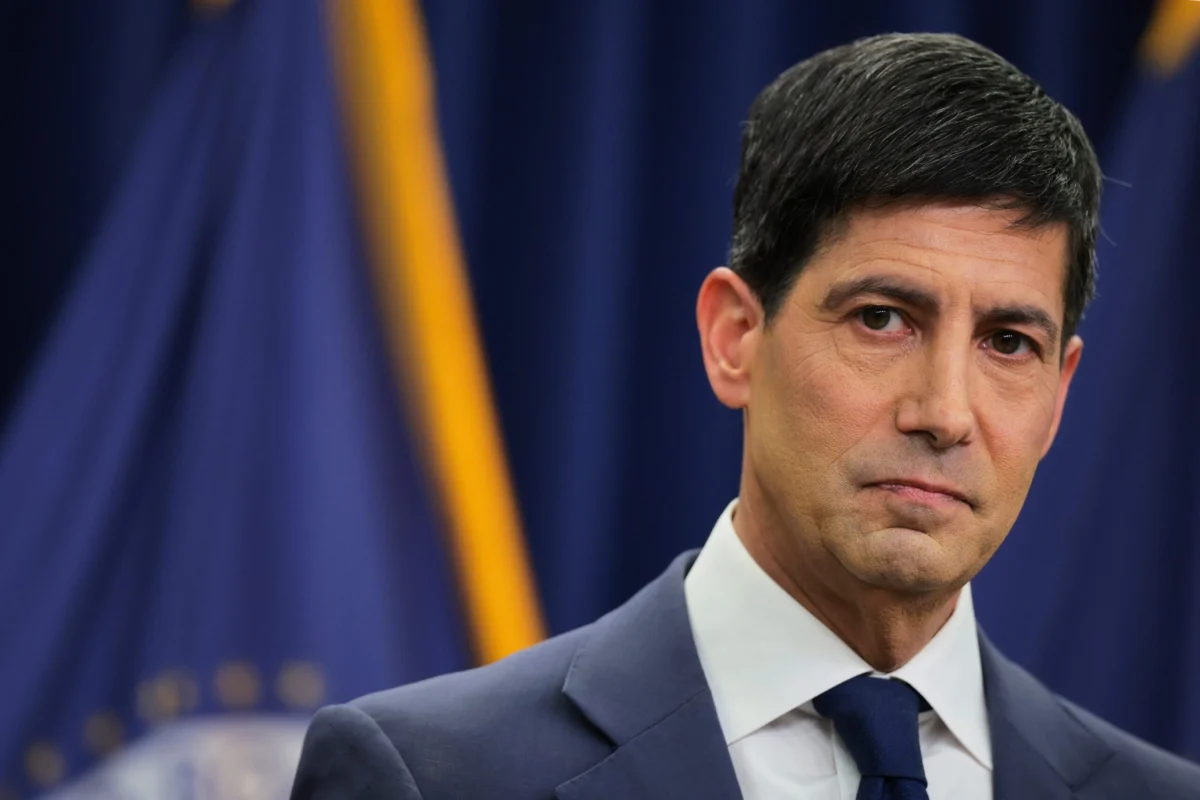
WASHINGTON D.C. — The era of Kevin Warsh at the Federal Reserve has officially begun, not with the whispered reassurances of a political ally, but with the sharp, clarion call of a monetary hawk. In his first policy meeting since taking the helm from Jerome Powell, Chairman Kevin Warsh delivered a performance that blindsided Wall Street and signaled a profound shift in how the world’s most powerful central bank communicates with the public.
While the Federal Open Market Committee (FOMC) elected to hold the benchmark federal funds rate steady at a range of 3.5% to 3.75% on Wednesday, the accompanying policy statement and Warsh’s subsequent press conference painted a picture of a central bank ready to resume tightening. By stripping away years of "easing bias" and dismantling the tradition of forward guidance, Warsh has reclaimed the element of surprise—a move that sent shockwaves through equity and bond markets alike.
Main Facts: The "Hawk" Re-Emerges
The primary takeaway from Wednesday’s proceedings was the resolution of a months-long debate regarding Warsh’s true ideological leanings. Observers had spent the lead-up to his appointment wondering which version of the 56-year-old would occupy the chair: the principled hawk who resigned from the Fed in 2011 in protest of quantitative easing, or the more recent "dovish" candidate who argued that Artificial Intelligence (AI) would suppress inflation and justify lower rates.
The answer was definitive. Warsh leaned heavily into his hawkish roots, emphasizing a "unanimous and unambiguous" commitment to returning inflation to the 2% target. For five years, inflation has hovered at roughly double that mandate, a failure Warsh characterized as "unacceptable."
Key outcomes from the June 2026 meeting include:
- Rate Decision: Rates held at 3.5%–3.75%.
- The Dot Plot: A significant hawkish shift, with nine out of 18 officials now projecting at least one more rate hike before the end of the year.
- Forward Guidance: Officially scrapped. Warsh stated the Fed would no longer provide markets with a roadmap for future moves, forcing investors to rely on raw economic data.
- Task Forces: The creation of five new panels to overhaul Fed operations, ranging from the balance sheet to the impact of AI on the labor market.
Chronology: From Resignation to the Chairmanship
To understand the weight of Wednesday’s meeting, one must look back at Warsh’s unconventional trajectory to the top of the Federal Reserve.
The 2011 Protest
Kevin Warsh first made waves as a young Fed Governor during the Great Financial Crisis. However, in 2011, he took the rare step of resigning, citing deep-seated concerns over the Fed’s massive bond-buying programs (Quantitative Easing). He argued then that the Fed was overstepping its bounds and risking long-term price stability—a stance that cemented his reputation as a hardline hawk.
The "Audition" Phase (Late 2025 – Early 2026)
As Jerome Powell’s term neared its end, Warsh emerged as a frontrunner for the role. During this period, his rhetoric shifted. In a series of op-eds and speeches, he adopted a more nuanced, almost dovish tone. He argued that the U.S. economy was undergoing a productivity revolution driven by AI, suggesting that growth was not an enemy of price stability. This "new" Warsh suggested that the Fed should not fear a booming economy, a message that resonated with a White House eager for low rates to fuel a "national renewal."
A Contentious Confirmation
Warsh’s confirmation hearing in early 2026 was among the most polarized in history. Critics, led by Senator Elizabeth Warren, accused him of being a "sock puppet" for the executive branch, alleging he had traded his hawkish principles for a chance at the Chairmanship. Warsh largely ignored the barbs, focusing instead on a critique of the Powell Fed’s "delayed" response to the inflation of 2021–2022.
The June 17, 2026, Meeting
The suspense culminated at 2:00 p.m. on Wednesday. The release of the FOMC statement was the first sign that the "audition" was over. The language was lean, devoid of the usual qualifiers, and focused squarely on "price stability." By the time Warsh took the podium at 2:30 p.m., the markets realized the hawk had returned.
Supporting Data: Markets React to the "Warsh Shock"
The financial markets, which had largely priced in a more conciliatory or "political" Fed, reacted with immediate volatility. The transition from an easing bias to a potential tightening cycle caught many traders off guard.
Equity Markets
The Dow Jones Industrial Average, which had touched a record intraday high earlier Wednesday on hopes of a "dovish hold," reversed course violently. The blue-chip index plunged 507 points by the closing bell.
- S&P 500: Declined 1.2%.
- Nasdaq Composite: Fell 1.3%, led lower by tech giants whose valuations are highly sensitive to interest rate expectations.
- Sector Performance: Communication services and technology were the hardest hit, as the prospect of "higher for longer" rates dampened enthusiasm for high-growth AI ventures.
Fixed Income and Money Markets
The "Warsh Shock" was most evident in the Treasury market. The yield on the 2-year Treasury note, a sensitive barometer of Fed policy, spiked 16 basis points to 4.21%.
In the fed funds futures market, the probability of a rate hike in October shifted from a negligible outlier to a "coin flip" (roughly 52%). This represents a massive repricing of risk in the span of a single afternoon.
The Boom Context
The market’s "fit" comes at a time of significant "animal spirits" in the private sector. The SpaceX IPO—one of the largest and most anticipated in history—has recently flooded the market with liquidity and optimism. Warsh’s hawkish turn is seen by some, including veteran analyst Jon Hilsenrath, as a deliberate attempt to put "speed bumps on the boom" to prevent the economy from overheating.
Official Responses: Independence and Ideology
The reaction to Warsh’s first meeting has been split along predictable ideological lines, though Warsh himself remained stoically detached from the political fray.
The Fed Chair’s Defense
During the press conference, Warsh was asked repeatedly about his previous comments regarding the "fear of growth." He deflected, pointing to his new task forces as the proper venue for evaluating AI’s impact. However, on the subject of the 2% inflation target, he was uncompromising.
"The ‘two’ is to the left of the decimal point," Warsh told reporters. "For now, ‘zero’ is to the right. That is our mandate. It is a message this institution has missed for five years, and it is a message we will now deliver with clarity."
Political Criticism
Senator Elizabeth Warren, a vocal opponent of Warsh’s appointment, remained skeptical. While some saw his hawkishness as a sign of independence from the White House, Warren’s camp suggested that the sudden shift in tone was evidence of an unpredictable and "erratic" leadership style that could jeopardize the labor market.
The White House Stance
President Trump, who has spent the last year oscillating between threatening to fire Jerome Powell and demanding 0% interest rates, recently pivoted to a stance of "total independence" for Warsh. Following the meeting, the White House remained uncharacteristically quiet. Warsh, for his part, demurred when asked if he had consulted with the President, simply stating, "On the president, I don’t have anything for you."
The "Fed Whisperer’s" Take
Jon Hilsenrath, the former Wall Street Journal reporter known for his insight into central bank thinking, noted that Warsh’s strategy seems to be a calculated restoration of the Fed’s credibility. "Warsh has built a 15-year argument on the premise that inflation is a choice," Hilsenrath said. "By acting now, he’s telling the world that he is making a different choice than his predecessor."
Implications: A New Framework for Central Banking
The long-term implications of Wednesday’s meeting extend far beyond a 507-point drop in the Dow. Warsh is attempting to dismantle the "Forward Guidance" era that has defined central banking for nearly two decades.
The Death of Forward Guidance
By stating, "I can’t give you any guidance on what we’re going to do next," Warsh is returning the Fed to a "data-dependent" model where the markets must interpret economic indicators without a safety net. This move is intended to reduce the "Fed Put"—the idea that the central bank will always step in to support markets—and to force a more disciplined pricing of risk in the private sector.
The Five Task Forces
Warsh’s announcement of five task forces is a strategic masterstroke designed to buy time while he retools the institution. These panels will examine:
- Communications: How to simplify the Fed’s message.
- The Balance Sheet: Managing the roll-off of assets.
- Data Sources: Integrating real-time private sector data.
- AI and Labor: Determining if productivity gains are truly disinflationary.
- The Inflation Framework: Re-evaluating the 2% target’s implementation.
These task forces, due to report by year-end, provide Warsh with a "buffer" against political and market pressure. When faced with difficult questions about unemployment or specific market bubbles, he can now point to an ongoing formal study.
Accountability and Credibility
Ultimately, Kevin Warsh has staked his Chairmanship on the idea that the Fed’s primary failure over the last half-decade was a lack of resolve. By blaming recent inflation on Middle East conflicts in the official statement, he provided a nod to external pressures, but his verbal testimony made it clear that he views price stability as an internal responsibility.
As the "animal spirits" of the 2026 economy continue to roar—fueled by tech IPOs and AI optimism—Warsh has positioned himself as the "adult in the room." Whether the economy can handle the "speed bumps" he is preparing to install remains the multi-trillion-dollar question for the remainder of the year. For now, the message is clear: the Fed is no longer following the markets; it is leading them.