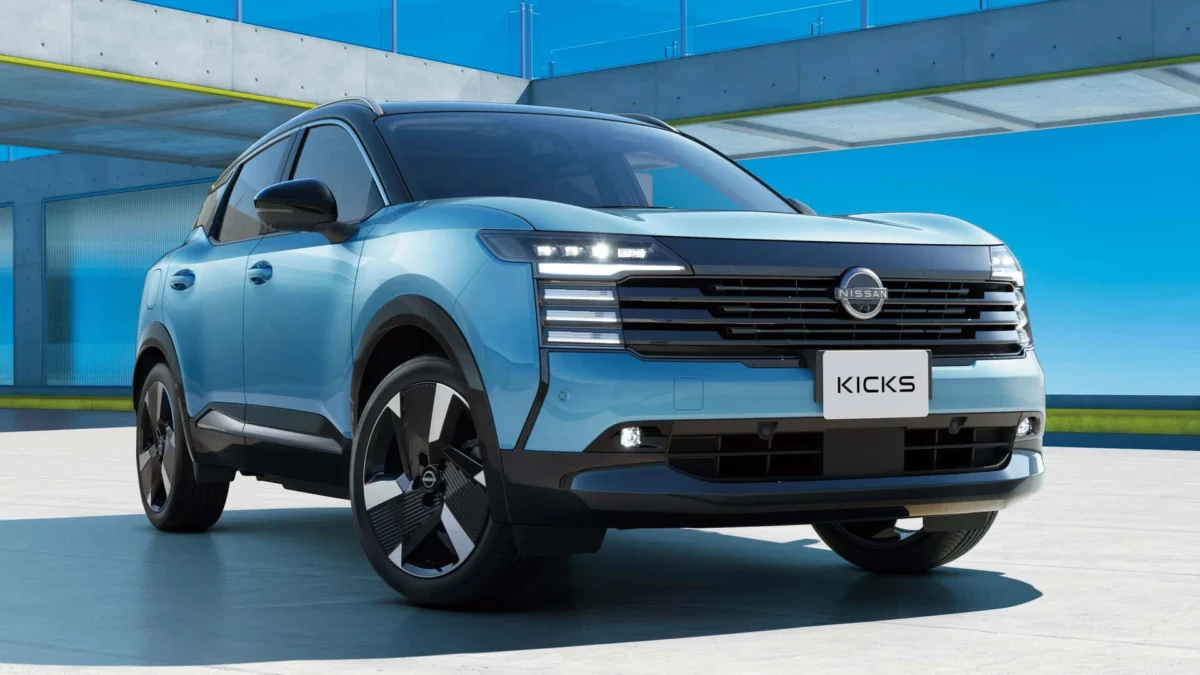
The global compact crossover market is witnessing a significant shift as Nissan officially rolls out the second-generation Kicks in its domestic Japanese market. Debuting on June 18, the refreshed model brings a suite of technological upgrades, most notably the integration of Nissan’s third-generation e-Power hybrid system. While this highly anticipated powertrain is now standard for Japanese consumers, its absence in the North American market remains a point of contention for enthusiasts and efficiency-minded drivers alike.
The Core Innovation: Third-Generation e-Power
At the heart of the new Japanese-market Kicks lies the proprietary e-Power system, a sophisticated "series hybrid" configuration. Unlike traditional hybrids that use an electric motor to assist a combustion engine, the e-Power system functions primarily as an electric vehicle.
The powertrain utilizes a 1.4-liter four-cylinder gasoline engine that acts exclusively as an onboard generator. This engine charges a high-output battery, which in turn feeds power to an electric motor that drives the wheels. By decoupling the internal combustion engine from the drivetrain, Nissan has created a vehicle that provides the instantaneous torque and linear acceleration characteristic of a battery-electric vehicle (BEV) without the "range anxiety" associated with plug-in charging.
This third-generation iteration features improved energy density and thermal efficiency, marking a milestone for the automaker as it expands the reach of its electrification strategy. Furthermore, the inclusion of the e-4ORCE electric all-wheel-control technology marks a substantial upgrade in handling and stability, allowing the Kicks to manage torque distribution across all four wheels with millisecond precision—a feature previously reserved for higher-end models like the Nissan Ariya.
Chronology: A Global Path for the Kicks
The Nissan Kicks has long served as the brand’s entry-level crossover, designed to bridge the gap between subcompact hatchbacks and larger SUVs.
- 2016-2018: The first-generation Kicks was introduced to Latin American and North American markets as a successor to the Juke, focusing on affordability, urban agility, and bold aesthetics.
- 2020: Nissan introduced the first-generation e-Power technology to the Kicks in select Asian markets, signaling the brand’s intent to shift its smaller platforms toward hybrid electrification.
- 2024: The second-generation Kicks is unveiled, featuring a total redesign that prioritizes interior space, modern connectivity, and the transition to the more advanced third-generation e-Power system.
- June 18, 2024: Official commercial launch in Japan, where the vehicle is positioned as a tech-forward, eco-conscious city commuter.
Supporting Data and Trim Configurations
The Japanese-market Kicks is available in four distinct trim levels, each designed to cater to different consumer needs regarding utility and aesthetics: the X, X+, X Simple Package, and the range-topping G.
The G trim distinguishes itself with premium exterior accents, including sophisticated gloss-black bumper finishes that provide a more refined, upscale look. In contrast, the lower trims feature unique, dimpled body cladding along the lower perimeter of the vehicle, offering a rugged, utilitarian visual identity that has become a hallmark of the Kicks’ design language.
Inside, the cabin has undergone a complete transformation. Nissan has adopted a high-tech approach, replacing traditional analog gauges with a seamless dual 12.3-inch display setup. This interface handles both the infotainment duties and the digital instrument cluster, bringing the Kicks in line with modern luxury vehicle standards.
In terms of performance, the Japanese-market Kicks produces 141 horsepower—a figure identical to the naturally aspirated 2.0-liter four-cylinder engine found in the US-market version. However, the driving experience in the Japanese variant is expected to be fundamentally different due to the torque-heavy nature of the electric motor and the refined, re-tuned suspension geometry designed to support the added weight of the hybrid components.
Economic Implications: The Pricing Gap
Perhaps the most striking aspect of the launch is the pricing structure. The base model of the hybrid Kicks in Japan starts at ¥2,999,700. At current exchange rates, this translates to approximately $18,723 USD.
This presents a stark contrast to the United States market, where the 2025 Kicks carries a starting MSRP of $24,275 (including destination fees). The price difference highlights the complexity of global automotive manufacturing, where regional regulations, supply chain logistics, and local market positioning often dictate costs. For US consumers, who are currently grappling with gasoline prices consistently averaging above $4.00 per gallon in many regions, the availability of a $19,000 hybrid in Japan feels like a missed opportunity.
Implications for the US Market
The absence of the e-Power system in the US-bound Kicks is a strategic choice by Nissan, likely driven by a focus on cost-containment and the prioritization of other hybrid technologies in larger segments. However, the industry landscape is changing rapidly.
Nissan has already confirmed plans to bring its e-Power hybrid technology to the North American market, beginning with the popular Rogue SUV next year. This move is widely viewed as a "pilot program" for the brand’s broader electrification strategy. Automotive analysts suggest that if the e-Power Rogue sees strong adoption, it could pave the way for the technology to trickle down to smaller vehicles like the Kicks.
The "jealousy" felt by American consumers is not merely about the price tag; it is about the scarcity of efficient, affordable, and technologically advanced vehicles. As emission standards tighten and the demand for hybrid solutions grows, the Kicks stands as a prime candidate for the next phase of Nissan’s hybrid rollout in North America.
Future Outlook: Electrification at a Crossroads
Nissan’s decision to move forward with the e-Power system in Japan while sticking to traditional internal combustion engines in the US illustrates the current "two-speed" nature of the automotive transition. While the US remains heavily focused on full battery-electric vehicles (BEVs) at the high end and traditional combustion engines at the low end, markets like Japan are treating hybrid technology as the bridge to long-term sustainability.
For potential owners, the new Kicks represents a refined middle ground. It provides the fuel efficiency and environmental benefits of an electric vehicle without requiring a total shift in lifestyle, such as installing home charging infrastructure or planning travel around public charging stations.
Whether the second-generation Kicks will eventually make its way to the US with the e-Power powertrain remains to be seen. However, the data suggests that the appetite for such a vehicle is significant. As Nissan refines its manufacturing processes and continues to scale the e-Power technology across its global platforms, the Kicks may well be the next logical step in the company’s quest to make electrification accessible to the masses. For now, it serves as a benchmark for what is possible in the compact crossover segment, blending style, utility, and advanced hybrid engineering into a package that is proving to be a resounding success in the East.