By Charles Pellegrin
The rapid ascent of generative artificial intelligence has moved beyond the realm of speculative technology, firmly establishing itself as the engine room of modern corporate strategy. From the bustling halls of VivaTech in Paris to the boardrooms of global consulting giants, the narrative has shifted from "what if" to "how fast."
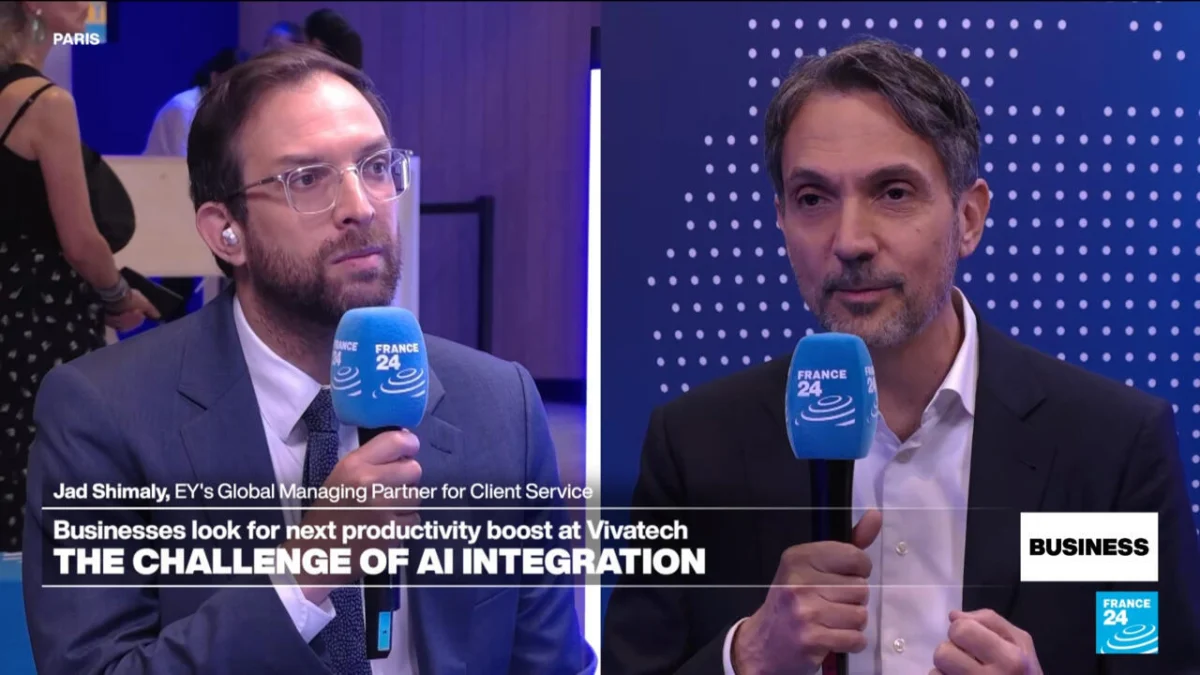
As companies across the globe grapple with the integration of AI, the focus has narrowed on tangible outcomes: boosting operational productivity, revolutionizing recruitment pipelines, and automating complex consulting workflows. In a recent exclusive interview with FRANCE 24 at VivaTech, Jad Shimaly, a key executive at EY (Ernst & Young), provided a candid assessment of how these tools are reshaping the very definition of professional labor and the future of work.
Main Facts: The AI Integration Imperative
Artificial intelligence is no longer a peripheral IT project; it is the central pillar of business transformation. Recent industry data suggests that firms integrating AI are seeing a marked improvement in output, with particular gains in data-heavy sectors like finance, legal, and human resources.
The primary drivers of this change are threefold:
- Hyper-Efficiency: Routine tasks, such as data entry, preliminary research, and document synthesis, are being offloaded to large language models, freeing up human capital for high-value strategic thinking.
- Recruitment Optimization: AI is being utilized to screen thousands of resumes in seconds, identifying candidates based on skill-matching rather than traditional keyword density, thereby reducing bias and shortening the hiring lifecycle.
- Consulting Augmentation: In the consulting world, AI tools act as "co-pilots," allowing consultants to digest massive volumes of market data to provide clients with real-time, evidence-based recommendations.
According to Shimaly, the success of these integrations depends on a company’s ability to pivot its internal culture. It is not just about installing software; it is about retraining a workforce to collaborate with algorithms.
Chronology: The Road to the AI Pivot
The timeline of this transformation has been compressed into a remarkably short period, punctuated by significant milestones that have brought us to the current state of industrial integration.
- 2022: The Catalyst. The public release of advanced generative AI models triggered a "Gold Rush" mentality across the corporate sector. CEOs began tasking their digital transformation teams with identifying immediate use cases for LLMs.
- 2023: The Proof of Concept Phase. Throughout the year, major firms like EY began launching internal AI sandboxes. These were controlled environments where employees could experiment with generative tools to automate mundane report writing and client outreach.
- 2024: The Scalability Shift. Companies moved from pilot programs to enterprise-wide adoption. This period saw the integration of AI into core legacy systems, often requiring significant cloud infrastructure upgrades.
- 2025: The Human-AI Hybrid Era. As we move through the middle of the decade, the focus has shifted toward "Agentic AI"—systems that can perform multi-step tasks independently, requiring only high-level human oversight.
- 2026: The Maturity Point. At the current juncture, as seen at the recent VivaTech conference, the industry is no longer debating the feasibility of AI. The conversation has evolved into governance, ethics, and the long-term impact on the labor market.
Supporting Data: Measuring the Impact
The economic implications of AI adoption are substantial. While skeptics initially pointed to high implementation costs, the return on investment (ROI) is becoming increasingly clear through empirical data.

Productivity Gains
Reports from major consulting firms indicate that workers equipped with AI tools see an average productivity increase of 25% to 40% in document-intensive tasks. In coding and software development, this figure is even higher, with some development cycles shortened by nearly 50%.
Recruitment Efficiency
In the HR sector, AI-powered recruitment tools have demonstrated a 30% reduction in "time-to-hire." By automating the screening process, HR departments have seen an increase in the quality of short-listed candidates, as AI tools can cross-reference global databases to verify credentials and experience levels more effectively than manual review.
The "Consulting Gap"
EY and its peers have noted that clients are now demanding AI-driven insights as a standard deliverable. A project that once required a team of ten analysts for four weeks can now be completed by a team of three in one week, with the remaining time focused on client-facing strategy and implementation.
Official Responses and Strategic Vision
Speaking from the floor of VivaTech, Jad Shimaly emphasized that the goal of AI implementation is not to replace human talent but to augment it. "The future of work is a symbiotic relationship," Shimaly stated. "We are looking at a future where the professional is a conductor of an AI-powered orchestra."
However, industry leaders are also tempering enthusiasm with caution. The consensus among executives at the conference was that AI must be "explainable" and "ethical." Shimaly noted that firms must prioritize data privacy and transparency, ensuring that algorithms do not inherit the biases inherent in historical data.
Furthermore, there is a clear strategic move toward "upskilling." Companies that fail to invest in training their employees to use these new tools risk losing their competitive edge. The narrative from leadership is clear: the employee who uses AI will likely replace the employee who refuses to.
Implications: The Future of the Workplace
As AI becomes deeply embedded in the corporate structure, the implications for the workforce and the economy at large are profound.
The Evolution of the Job Description
Entry-level roles are facing the most significant disruption. Traditionally, junior employees cut their teeth on data gathering and basic drafting—tasks that AI now handles with greater speed and accuracy. This necessitates a rethink of career progression; firms must find new ways to train junior staff when the "grunt work" has been automated.

The Shift to "Soft Skills"
As technical tasks are offloaded to machines, the value of uniquely human traits—empathy, complex negotiation, ethical judgment, and creative strategy—is skyrocketing. The professional of the future will need to be a skilled communicator and a critical thinker, capable of interpreting AI outputs and guiding them toward business-aligned objectives.
Economic and Societal Challenges
The displacement of certain administrative and technical roles remains a primary concern for policymakers. While new roles—such as prompt engineers, AI ethics auditors, and machine-learning operations managers—are being created, the transition period requires a robust social safety net and a massive commitment to vocational retraining.
Governance and Regulation
The rapid pace of development has outstripped regulatory frameworks. The next decade will likely be defined by the "tug-of-war" between technological advancement and the need for rigorous oversight. Companies that lead in responsible AI adoption will likely gain the trust of both consumers and regulators, providing them with a long-term strategic advantage.
The Global Competitive Landscape
For nations and corporations alike, the "AI race" is the new space race. Countries that provide the digital infrastructure and the talent pool necessary for AI innovation will set the global standards for the next century. As evidenced by the energy at VivaTech, the race is well underway, and the winners will be those who can most effectively harmonize human ingenuity with the limitless potential of artificial intelligence.
Conclusion
The integration of artificial intelligence is the most significant industrial shift since the advent of the internet. As Jad Shimaly and other industry leaders have highlighted, the challenge is no longer about the technology itself, but about the human and organizational capacity to adapt.
The future of work will not be defined by a choice between human or machine, but by the successful integration of both. Companies that manage this transition with a focus on productivity, ethical standards, and continuous learning will define the global market in the coming years. The "AI-enabled professional" is not a futuristic concept—it is the reality of the present. As we look ahead, the firms that flourish will be those that embrace this shift not as a threat, but as the ultimate tool for unlocking human potential.