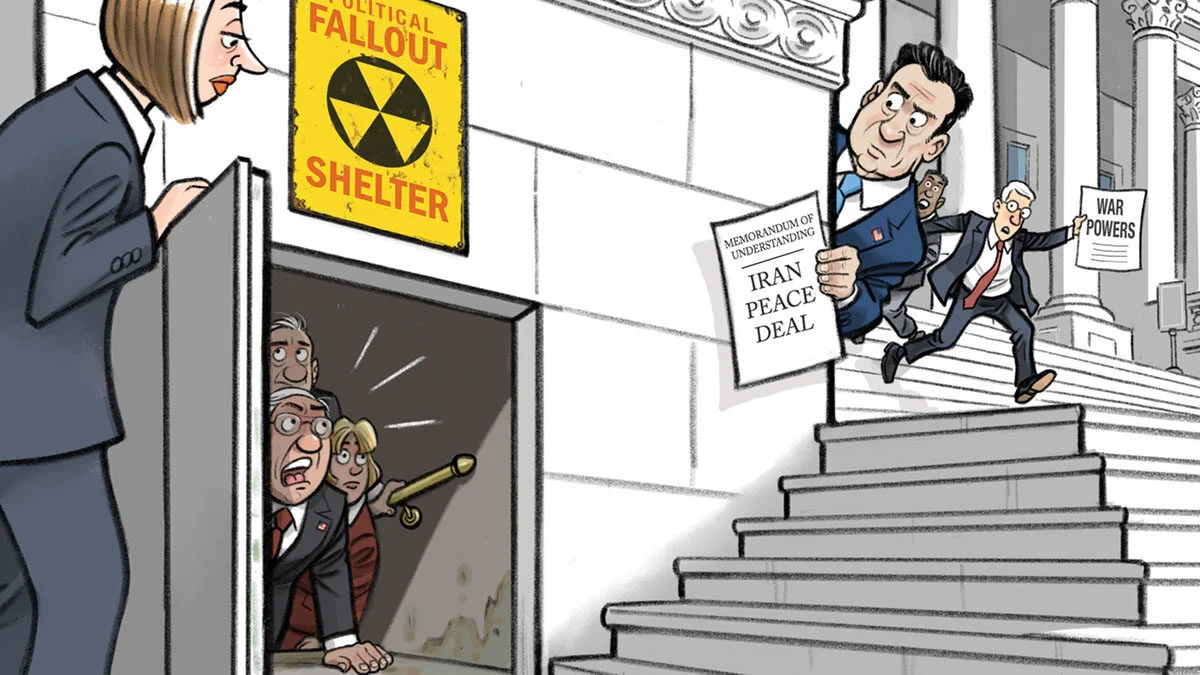
WASHINGTON, D.C. – June 18, 2026 – A new political cartoon by acclaimed artist R.J. Matson, published today by CQ Roll Call under his renowned "Capitol Ink" series, has quickly become a poignant visual commentary on the deepening partisan chasm gripping Washington. Titled "Stalemate at the Summit," the piece vividly illustrates the profound legislative paralysis that has stalled the ambitious "National Renewal Initiative," a sprawling legislative package designed to address critical infrastructure upgrades, climate resilience, and workforce development.
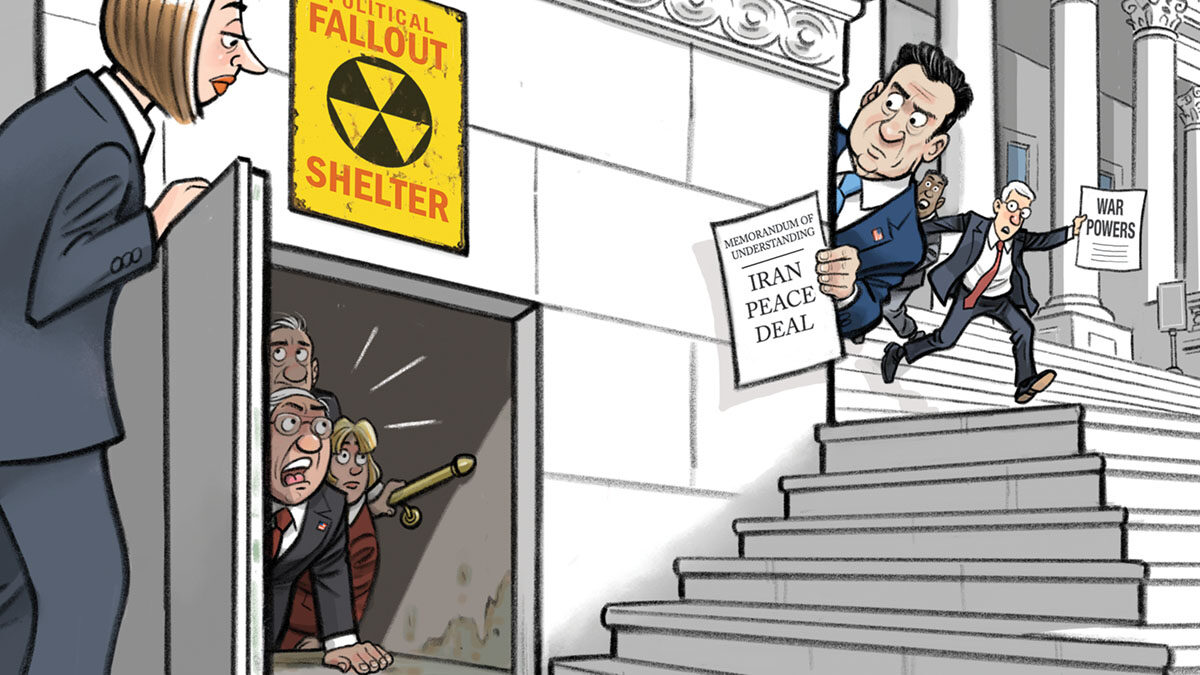
Matson’s cartoon, widely circulated online and within the Capitol, depicts two colossal figures, each representing a major political party, tugging fiercely at opposite ends of a rope. The rope, taut to the breaking point, is visibly fraying over a gaping canyon labeled "The People’s Trust." In the background, an ornate Capitol dome looms, seemingly oblivious to the dramatic standoff unfolding beneath it. The stark imagery resonates deeply with a public increasingly frustrated by congressional inaction and the relentless politicking that often overshadows pressing national concerns.
The timing of Matson’s cartoon is particularly salient, arriving as the legislative calendar inches closer to the crucial 2026 midterm elections. With just five months until voters head to the polls, the inability of Congress to advance significant legislation like the National Renewal Initiative has become a central point of contention, fueling campaign rhetoric and voter disillusionment alike. The cartoon serves not merely as a humorous jab but as a stark mirror reflecting the anxieties and exasperation felt by many across the nation as vital policy objectives remain ensnared in ideological warfare.
The National Renewal Initiative, initially heralded as a potential bipartisan triumph, has devolved into a symbol of Washington’s dysfunction. Its comprehensive scope, touching upon everything from next-generation broadband expansion and modernizing public transportation to establishing a national green energy grid and retraining programs for a rapidly evolving job market, made it a cornerstone of the current administration’s domestic agenda. Yet, what began with cautious optimism has now become a legislative quagmire, its fate hanging precariously in the balance as both parties dig in their heels, prioritizing political leverage over substantive progress. Matson’s "Capitol Ink" piece effectively encapsulates this grim reality, offering a powerful, if sardonic, snapshot of American governance in crisis.
Chronology: A Legislative Odyssey from Hope to Deadlock
The journey of the National Renewal Initiative (NRI) has been a microcosm of the challenges facing American policymaking in the mid-2020s, a narrative arc stretching from ambitious inception to its current state of legislative limbo.
Genesis of an Ambition: Post-2024 Mandate
The concept for a comprehensive national revitalization effort first gained significant traction in the aftermath of the 2024 presidential election. The incumbent administration, having secured a second term with a mandate for domestic renewal and economic stability, prioritized a broad-stroke legislative agenda aimed at future-proofing the American economy and infrastructure. Early discussions within the White House and among key congressional allies focused on synthesizing several long-standing policy goals – infrastructure repair, climate action, and workforce adaptation – into a single, cohesive package. The idea was to create a monumental bill that would not only address immediate needs but also lay the groundwork for sustained growth and resilience over the next several decades. This ambitious scope was intended to appeal to a wide array of stakeholders and demonstrate the government’s capacity for long-term strategic planning.
Early Bipartisan Hopes: A Fleeting Moment
Initial overtures from the White House and congressional leadership to the opposition party were met with a surprising, albeit cautious, degree of openness. There was a palpable desire, at least publicly, to avoid the perpetual gridlock that had characterized previous legislative sessions. Key committees in both the House and Senate held joint hearings throughout late 2024 and early 2025, bringing together experts, industry leaders, and local officials to discuss the nation’s pressing needs. Early drafts of the NRI saw significant input from members across the aisle, particularly on aspects related to traditional infrastructure – roads, bridges, and ports – areas where bipartisan consensus often proved more attainable. There were even optimistic press conferences highlighting "productive dialogue" and "good faith negotiations," leading many observers to believe that the NRI might defy the odds and emerge as a genuine bipartisan achievement. The Speaker of the House, Representative Evelyn Reed (D-NY), and Senate Minority Leader, Senator Marcus Thorne (R-TX), were frequently photographed shaking hands and issuing joint statements emphasizing the importance of national unity.
The Inevitable Divide: Ideological Fault Lines Emerge
However, as the legislative text began to solidify and specific funding mechanisms were debated, the cracks in the nascent bipartisan façade began to appear, quickly widening into insurmountable ideological chasms. The "climate resilience" components, which included substantial investments in renewable energy, carbon capture technologies, and adaptation measures for extreme weather events, became a primary battleground. Progressive Democrats pushed for aggressive timelines and stringent environmental regulations, while conservative Republicans raised concerns about the economic impact on traditional energy sectors, federal overreach, and the overall cost.
Similarly, the "workforce development" section, which proposed significant federal funding for universal pre-kindergarten, free community college tuition for certain programs, and expanded union apprenticeship initiatives, faced fierce opposition. Republicans argued these provisions were socialistic expansions of government, while Democrats championed them as essential investments in human capital and economic equity. The debate over how to pay for the estimated $3.5 trillion package also became a significant point of contention. Democrats proposed a combination of corporate tax increases and new wealth taxes, while Republicans vehemently opposed any new taxes, advocating instead for spending cuts elsewhere and a more limited, targeted approach funded by existing revenues or private-public partnerships. By late 2025, the initial spirit of cooperation had evaporated, replaced by familiar accusations of obstructionism and radical agendas.
Summer Standoff: A Battle of Wills
As June 2026 arrived, the National Renewal Initiative was firmly entrenched in a legislative standoff. After passing the House of Representatives on a largely party-line vote in April, the bill encountered an impenetrable wall in the Senate. Multiple attempts to invoke cloture and bring the bill to a final vote had failed, falling victim to filibusters by the minority party. Senate Majority Leader, Senator Lena Hanson (D-CA), had made repeated public pleas for compromise, framing the bill as a generational opportunity. However, Senate Minority Leader Thorne remained steadfast, declaring the bill "dead on arrival" in its current form, arguing it was a "Trojan horse for socialist policies" that would burden future generations with unsustainable debt.
The summer months had been characterized by a war of words, with both sides engaging in intense public relations campaigns. The White House launched "Renew America" tours, with cabinet secretaries fanning out across the country to highlight the potential benefits of the NRI. Republicans, in turn, held counter-events, warning of the dangers of "big government overreach" and "reckless spending." The legislative process had ground to a halt, with no clear path forward. This pre-midterm election climate, where every policy decision is viewed through the lens of political advantage, only exacerbated the stalemate, transforming what was once a beacon of hope into a symbol of legislative inertia. Matson’s cartoon, published on June 18, 2026, perfectly captured this moment of profound legislative paralysis and political brinkmanship.
Supporting Data and Context: The Broader Landscape of Discontent
The current legislative gridlock over the National Renewal Initiative is not an isolated incident but rather a symptom of deeper trends within American politics, amplified by public sentiment, historical precedents, and significant economic implications.
Public Sentiment and Polling: A Nation Divided and Disillusioned
Recent polling data underscores the public’s profound frustration with the state of governance. A June 2026 survey conducted by the non-partisan Pew Research Center revealed that 68% of Americans believe Congress is "mostly dysfunctional," an all-time high since tracking began in 1990. Furthermore, 75% expressed a desire for political leaders to "compromise more" to address national challenges. However, this general desire for unity masks significant partisan divides on the specifics of the NRI. For instance, while 78% of Democrats strongly support the climate resilience provisions, only 22% of Republicans share that enthusiasm, with a significant portion viewing them as economically detrimental. Conversely, Republican proposals for deregulation and tax cuts to stimulate economic growth find robust support among their base but are largely rejected by Democrats. This data highlights a paradox: Americans want compromise but remain deeply divided on the ideological foundations of potential solutions, creating fertile ground for the very gridlock they deplore. The perceived failure of the NRI only exacerbates this disillusionment, fostering a sense that elected officials are incapable of transcending their political differences for the greater good.
Historical Precedent: Echoes of Past Stalemate
The current standoff over the NRI evokes strong parallels with several historical legislative stalemates that have plagued Washington. Political historians and analysts frequently draw comparisons to the budget battles of the 1990s and 2010s, which led to government shutdowns, or the protracted and often acrimonious debates over healthcare reform in the early 21st century. Dr. Eleanor Vance, a political science professor at Georgetown University, notes, "What we’re seeing with the National Renewal Initiative isn’t entirely new. It’s a recurring pattern where broad consensus on the need for action clashes with deep ideological divides on the means of action. The higher the stakes, the more entrenched the positions become, especially in an election year." She points to the inability to pass comprehensive immigration reform for decades as another example of how complex issues can become political footballs, indefinitely stalled by partisan recalcitrance. These historical precedents suggest that breaking the current deadlock will require either a dramatic shift in political will or an external catalyst, neither of which appears imminent.
Economic Ramifications: Billions on Hold
The delay in passing the National Renewal Initiative carries substantial economic consequences. Economists estimate that every month of delay costs the U.S. economy billions in missed opportunities and delayed benefits. The American Society of Civil Engineers, in a recent report, projected that failing to upgrade critical infrastructure could lead to a $10 trillion loss in GDP by 2040 and millions of lost jobs due to inefficiencies and competitive disadvantages. The NRI’s provisions for next-generation broadband expansion, for example, are crucial for bridging the digital divide and fostering innovation in rural areas. Without it, many communities remain economically isolated. Similarly, the stalled investments in green energy projects mean delayed job creation in nascent industries and a slower transition away from fossil fuels, impacting both environmental goals and global competitiveness. Businesses reliant on improved infrastructure and a skilled workforce face uncertainty, potentially delaying investment decisions and hiring plans. The White House Council of Economic Advisers recently warned that the prolonged legislative uncertainty could shave 0.5% off projected GDP growth for the latter half of 2026.
Expert Analysis: A Crisis of Governance
Political analysts and think tank experts view the NRI’s predicament as a symptom of a deeper crisis in American governance. Dr. Robert Davies, a senior fellow at the Bipartisan Policy Center, argues, "The current political environment rewards ideological purity and tribal loyalty over pragmatic problem-solving. Leaders are often more concerned with appeasing their base and winning the next election than with forging consensus on critical national issues. The NRI, despite its merits, has become another casualty of this zero-sum political game." He suggests that the rise of social media and increasingly polarized news consumption further entrenches these divisions, making it harder for moderate voices to gain traction. This systemic challenge, experts warn, threatens not only the passage of individual bills but also the long-term health and stability of American democracy.
Official Responses and Rhetoric: A War of Words
The stalemate surrounding the National Renewal Initiative has triggered a predictable, yet intensely charged, volley of official responses, with each side meticulously crafting narratives designed to bolster their position and undermine their opponents. Matson’s cartoon, arriving amidst this rhetorical battle, only added fuel to the fire, with both parties attempting to co-opt its message or deflect its criticism.
White House Stance: Urgency and Blame
The White House has maintained a consistent message: the National Renewal Initiative is an urgent necessity for the nation’s future, and its delay is a direct result of partisan obstruction. During a recent press briefing, Presidential Press Secretary, Lena Chen, stated, "The President remains committed to delivering on the promise of a stronger, more resilient America. The National Renewal Initiative is not just a bill; it is a blueprint for prosperity, security, and global leadership. It is deeply disappointing that a vocal minority in Congress continues to prioritize political gamesmanship over the pressing needs of the American people." While avoiding direct naming, the implication was clear. The President himself, in a speech to a group of manufacturing workers, urged Congress to "put aside differences and come together for the common good," subtly framing the opposition as divisive. Administration officials frequently highlight the bipartisan elements that were initially considered, arguing that the current version of the bill represents a fair compromise, and that further concessions would dilute its effectiveness to an unacceptable degree.
Congressional Leadership – The Majority: Unwavering Resolve
In the House of Representatives, Speaker Evelyn Reed (D-NY) has been unwavering in her defense of the NRI, emphasizing the careful crafting and public input that went into its passage in the lower chamber. "This bill passed the House with a strong mandate because it addresses real problems faced by real Americans every single day," Speaker Reed declared on the House floor. "It’s about creating jobs, securing our infrastructure, and ensuring our children inherit a healthier planet. To oppose this bill outright is to oppose progress itself." In the Senate, Majority Leader Lena Hanson (D-CA) echoed these sentiments, expressing frustration with the minority’s tactics. "We have extended every possible olive branch," Senator Hanson stated in a press conference. "We’ve held countless meetings, considered dozens of amendments. Yet, what we’re met with is a rigid refusal to engage meaningfully. The American people deserve better than this calculated obstruction." Majority leaders frame their party as the champions of progress, willing to compromise but not to abandon core principles essential for national well-being.
Congressional Leadership – The Minority: Fiscal Responsibility and Overreach
On the Republican side, congressional leadership has been equally steadfast in its opposition, characterizing the National Renewal Initiative as an irresponsible expansion of government, a fiscal nightmare, and a vehicle for progressive social engineering. Senate Minority Leader Marcus Thorne (R-TX) has been the most vocal critic, stating emphatically, "This is not a ‘National Renewal Initiative’; it’s a ‘National Ruin Initiative’ designed to bankrupt our economy and empower Washington bureaucrats. We are not against infrastructure; we are against reckless spending, job-killing regulations, and a bill that attempts to fundamentally reshape our society without proper debate or fiscal accountability." House Minority Leader Kevin Reynolds (R-OH) supported this stance, arguing, "The American people elected us to be a check on excessive government. This bill is precisely what they sent us here to fight against. We stand ready to negotiate a sensible infrastructure package, but we will not be bullied into passing a partisan wish list dressed up as national renewal." The minority frames itself as the guardian of fiscal prudence and individual liberty, protecting citizens from an overreaching and ideologically driven majority.
Voices from the Ranks: The Spectrum of Sentiment
Beyond leadership, individual members of Congress reflect the diverse sentiments within their caucuses. Representative Sarah Miller (D-WA), a rising progressive voice, tweeted, "Matson’s cartoon perfectly captures the GOP’s obstruction. They’d rather see the country crumble than give the President a win. It’s despicable." Conversely, Senator Thomas Jenkins (R-AZ), a staunch conservative, posted, "Matson got it wrong. The rope is being pulled by the Majority, trying to drag us off a cliff. We’re the ones holding firm." Meanwhile, a handful of moderate members, like Senator Ben Carter (I-ME), who often caucuses with both parties, expressed exasperation. "The cartoon is funny because it’s true, and that’s the tragedy," Senator Carter told reporters. "Both sides are so invested in winning the argument that they’ve forgotten about solving the problem. The National Renewal Initiative has good elements, bad elements, and a lot of room for compromise, if only anyone was willing to actually compromise." These varied responses underscore the deep ideological chasms and political calculations that define the current legislative environment.
Implications and Outlook: The Stakes of Standoff
The ongoing deadlock over the National Renewal Initiative, so vividly portrayed by R.J. Matson’s latest "Capitol Ink" cartoon, carries profound implications that extend far beyond the immediate legislative session. Its failure, or even its continued delay, threatens to reshape the political landscape, erode public faith, and potentially undermine the nation’s long-term trajectory.
The Midterm Shadow: A Defining Election Issue
The 2026 midterm elections loom large, and the fate of the National Renewal Initiative is poised to become a defining issue on the campaign trail. For the incumbent party, the inability to pass their signature domestic policy initiative will be a significant vulnerability. Opponents will undoubtedly highlight the legislative paralysis as a failure of leadership and an inability to deliver on campaign promises. Conversely, the opposition party will campaign on their success in blocking what they term an "overreaching" and "fiscally irresponsible" bill, positioning themselves as the protectors of taxpayers and limited government. This dynamic risks transforming the midterms into a referendum on gridlock itself, with both sides blaming the other for the lack of progress. Voter turnout, particularly among disillusioned independents, could be significantly impacted by the perception that Washington is simply incapable of effective governance, potentially leading to unpredictable electoral outcomes and further shifts in the balance of power. The cartoon, "Stalemate at the Summit," will likely feature prominently in campaign ads, illustrating the very frustration voters feel.
Erosion of Public Trust: A Deepening Cynicism
Perhaps the most insidious implication of the NRI’s protracted failure is the continued erosion of public trust in governmental institutions. When critical issues like infrastructure decay, climate change, and workforce readiness are repeatedly debated but never resolved, the public’s faith in the ability of their elected representatives to address pressing national challenges inevitably diminishes. This cynicism can manifest in lower voter participation, increased political apathy, or, conversely, a gravitation towards more radical or populist political movements that promise to "fix" a broken system. The image of two factions pulling a nation apart, as depicted in Matson’s cartoon, risks reinforcing a narrative that government is inherently ineffective, thereby undermining the very foundations of democratic governance and the willingness of citizens to engage constructively with political processes.
National Progress at Stake: A Future Undermined
Beyond politics, the failure to enact the National Renewal Initiative could have tangible and detrimental effects on the nation’s future. Delayed infrastructure upgrades mean continued economic inefficiencies, safety hazards, and a competitive disadvantage on the global stage. A lack of comprehensive climate resilience strategies leaves communities vulnerable to increasingly frequent and severe weather events, incurring enormous costs in disaster relief and recovery. Furthermore, without substantial investments in workforce development and education, the U.S. risks falling behind in a rapidly evolving global economy, leading to widening income inequality and social instability. The vision of a future-proofed, competitive, and sustainable America, which the NRI aimed to realize, could remain an unfulfilled promise, leaving the nation to grapple with mounting challenges without a coherent, unified strategy.
Paths Forward (or Not): A Precarious Outlook
As of June 18, 2026, the immediate outlook for the National Renewal Initiative remains bleak. Several scenarios could unfold, though none appear easy. A last-minute, stripped-down compromise, focusing solely on the least controversial infrastructure components, is a remote possibility, but it would represent a significant climb-down for both parties and a far cry from the original ambitious vision. Alternatively, the bill could be abandoned entirely, with its various components potentially re-introduced as smaller, more manageable legislative pieces in future sessions, a process that would likely take years. Some analysts even speculate on the use of extreme legislative tactics, such as the "nuclear option" in the Senate to bypass the filibuster, though this would have profound and potentially irreparable consequences for the institution itself.
Ultimately, R.J. Matson’s "Capitol Ink" cartoon serves as a powerful, albeit disheartening, summation of the current state of American politics. It captures a moment of profound legislative paralysis, where ideological rigidity and electoral calculus appear to have eclipsed the imperative for collective action. The National Renewal Initiative, once a symbol of hope for a better future, has become a stark testament to the challenges of governing in an era of deep division, leaving the nation to wonder whether its leaders can ever truly bridge the chasm.