The U.S. equity markets closed on a divergent note this Monday as investors navigated a complex landscape defined by geopolitical instability in the Middle East, a pivotal moment in monetary policy history, and high-stakes corporate earnings. While the blue-chip Dow Jones Industrial Average managed to eke out a modest gain, broader market indicators—the S&P 500 and the tech-heavy Nasdaq Composite—succumbed to selling pressure, reflecting a cautious sentiment among institutional and retail market participants alike.
Main Facts: A Market in Transition
At the closing bell, the Dow Jones Industrial Average rose 0.3% to settle at 51,712. Conversely, the S&P 500 slipped 0.4% to 7,472, and the tech-heavy Nasdaq Composite bore the brunt of the session’s volatility, shedding 1.3% to close at 26,166.
The primary headwinds for the session were sector-specific weakness and the lingering anxiety surrounding geopolitical tensions. Communication services stocks served as the session’s primary laggard. This sector was notably weighed down by SpaceX (SPCX), which saw its shares plummet 16.4%. The decline marks a third consecutive day of losses for the aerospace giant, arriving less than two weeks after its historic initial public offering—the largest in U.S. history.
Meanwhile, energy markets reflected shifting expectations regarding supply security. West Texas Intermediate (WTI) crude oil futures fell 2.0% to $74.35 per barrel. This price action indicates a significant retracement; WTI has now clawed back roughly 86% of its dramatic spike to $119.48, recorded on March 9, when the onset of conflict in the Middle East first rattled global supply chains.
Chronology of an Era: The Passing of Alan Greenspan
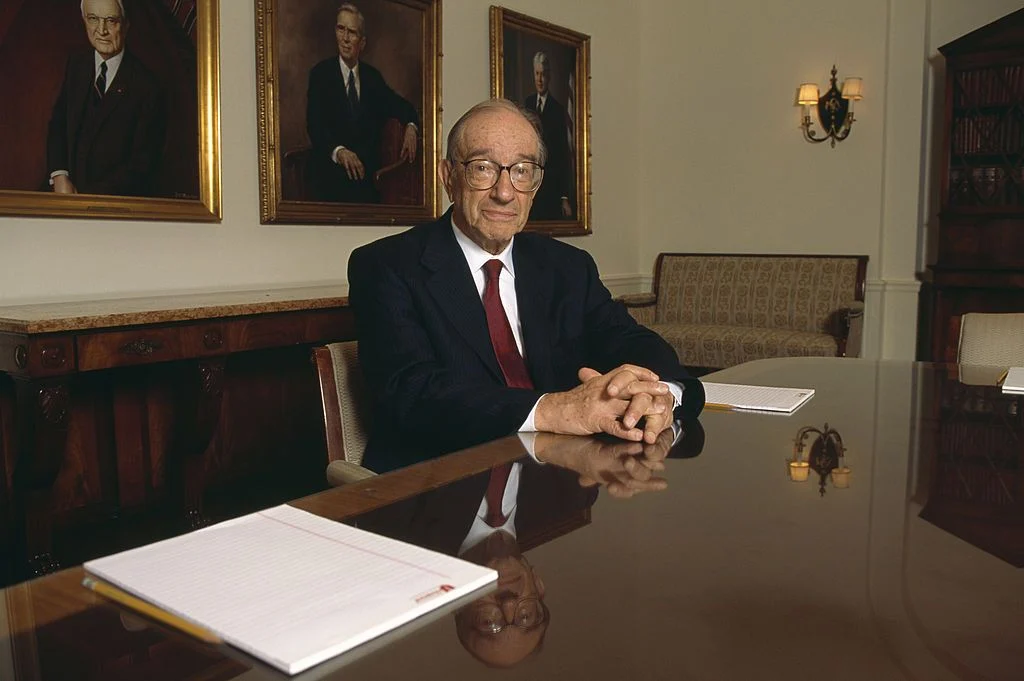
Monday was also a day of reflection for the global financial community as news broke of the passing of Alan Greenspan at the age of 100. Serving as the Chair of the Federal Reserve from 1987 to 2006, Greenspan remains perhaps the most influential central banker of the modern era.
- 1987: Nominated by President Ronald Reagan to succeed Paul Volcker, Greenspan assumed leadership on August 11. Mere months later, he steered the financial system through the "Black Monday" market crash of October 1987.
- 1990s: Greenspan oversaw an era of unprecedented economic expansion, navigating the transition into the dot-com era. It was during this time he famously coined the phrase "irrational exuberance" in December 1996, questioning the sustainability of surging asset values.
- 1999: Alongside Treasury Secretary Robert Rubin and Deputy Secretary Larry Summers, he formed the trio that Time magazine famously dubbed the "committee to save the world" in response to global financial volatility.
- 2006: After nearly 20 years at the helm, Greenspan retired, leaving behind a legacy that was later complicated by the 2007-09 Global Financial Crisis, which earned him the moniker "Mr. Bubble."
Greenspan’s tenure established the template for the modern "celebrity" Fed Chair. His ability to move markets with carefully crafted ambiguity became his hallmark. As he testified to Congress in 1987: "I have learned to mumble with great incoherence. If I seem unduly clear to you, you must have misunderstood what I said."
Supporting Data: Yields and Corporate Performance
The bond market remains a focal point for investors assessing the "higher for longer" interest rate environment. The 2-year Treasury yield fluctuated, settling at 4.232%, up from 4.179% on Thursday. This move marks another 52-week high, underscoring the market’s sensitivity to the Federal Reserve’s recent decision to hold the federal funds rate steady at a range of 3.50% to 3.75%.
While the broader indices struggled, specific corporate narratives provided a glimpse into pockets of resilience:
Micron Technology (MU)
Micron Technology shares jumped 6.8% on Monday, extending a rally that has seen the stock climb nearly 300% year-to-date. The semiconductor manufacturer is currently riding the wave of massive demand for memory and storage hardware essential to the artificial intelligence (AI) infrastructure buildout. Analysts at Susquehanna, led by Mehdi Hosseini, continue to view the stock favorably. Despite questions regarding the sustainability of gross margins above 80%, Hosseini’s models project annualized EPS reaching $160 in fiscal year 2027, maintaining a $1,750 price target for the stock.
FedEx (FDX)
FedEx shares rose 1.2% ahead of its upcoming earnings report. With a year-to-date return exceeding 40%, the industrial giant is performing in the top 10% of S&P 500 stocks. Stifel analyst J. Bruce Chan, who maintains a Buy rating and a $442 target price, notes that the focus will be on whether FedEx can maintain the momentum of its corporate restructuring and improved revenue quality in its core parcel business.
Official Responses and Market Sentiment
Market participants are currently in a "wait-and-see" pattern. The combination of uncertainty regarding Iran and the status of the Strait of Hormuz, coupled with the Federal Reserve’s cautious stance on monetary policy, has created an environment where investors are prioritizing quality and structural growth over speculative momentum.
The Federal Reserve’s recent FOMC meeting underscored that while the economy has shown durability, the central bank remains vigilant against inflationary pressures. The persistent climb in the 2-year Treasury yield suggests that bond traders are not yet convinced that the current rate environment is sufficient to curb long-term inflation or that the Fed has completed its tightening cycle.
Implications for the Investor
The current market environment offers several key takeaways for the long-term investor:
- The Shift in Leadership Influence: The passing of Alan Greenspan reminds investors that even the most formidable central bankers are subject to the tides of economic cycles. His career, marked by both the "Maestro" era and the "Mr. Bubble" critique, serves as a lesson in the limitations of policy intervention.
- Geopolitical Risk as a Market Constant: The volatility in oil prices and the ongoing monitoring of Middle Eastern trade routes suggest that energy remains a primary driver of market sentiment. Investors should continue to incorporate geopolitical risk assessments into their portfolio hedging strategies.
- The AI Infrastructure Cycle: The performance of Micron Technology demonstrates that, despite broader market weakness, thematic growth remains alive and well. However, as noted by analysts, the "normalization" of margins in fiscal 2028 serves as a reminder to maintain discipline regarding valuation.
- Operational Efficiency over Revenue Growth: The positive sentiment surrounding FedEx highlights a shift in investor preference. Markets are currently rewarding companies that have successfully navigated restructuring and demonstrated "disciplined cost execution" over those relying solely on topline expansion.
As the trading week progresses, the focus will shift from historical reflection to future guidance. With key earnings reports from the tech and industrial sectors on the horizon, the market is poised to determine whether the recent divergence in major indexes is a temporary consolidation or the beginning of a broader reassessment of equity valuations.
Investors are encouraged to remain vigilant, keep a close watch on the short-term Treasury yields, and continue to monitor the "forward commentary" provided by corporate leadership in the upcoming earnings calls. In a landscape defined by both the legacy of the past and the uncertainty of the future, a focus on balance sheet strength and sustainable competitive advantage remains the best defense against market volatility.