BUCHAREST – The political stability of Romania, a critical NATO member and European Union stakeholder, has plunged further into uncertainty after the national parliament resoundingly rejected the nomination of Adrian Vestea for prime minister on Monday. The failure of the liberal politician to secure a governing majority marks a significant escalation in the ongoing constitutional crisis, leaving the country without a functioning executive for nearly seven weeks and raising the specter of early parliamentary elections.
The rejection of Vestea, a seasoned politician and former regional leader, highlights the deep-seated polarization within the Romanian legislature. With 189 votes in favor, the candidate fell well short of the 233-vote threshold required to confirm his cabinet. The failed vote was not merely a legislative setback; it was a symptom of a systemic breakdown that has left Romania increasingly vulnerable at a time when the war in Ukraine continues to test the security architecture of Europe’s eastern flank.
The Anatomy of the Failed Vote
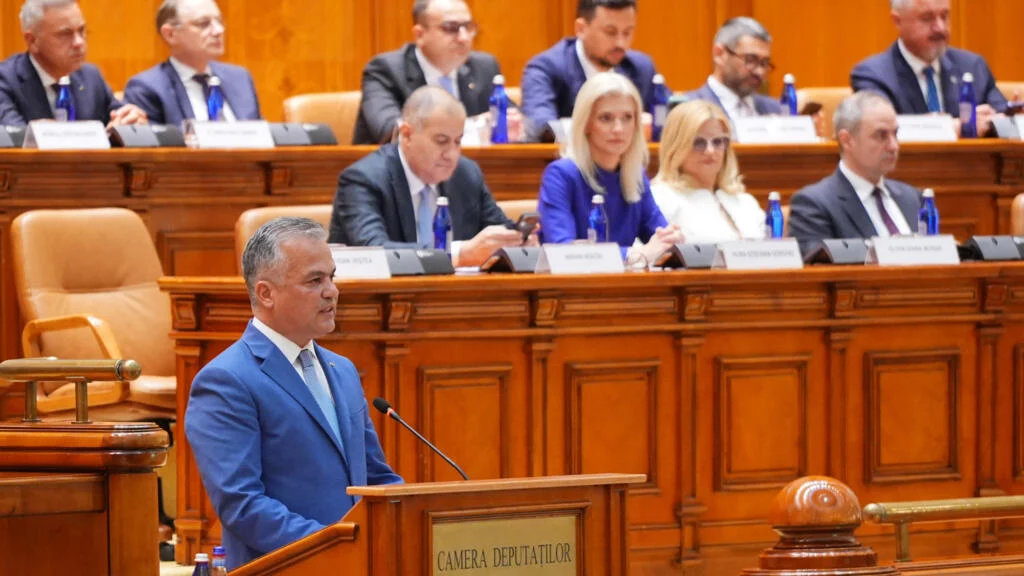
The atmosphere in the Romanian parliament on Monday was charged with tension. Following a day of heated debate regarding the proposed cabinet line-up, the proceedings took an unexpected turn when several deputies staged a walkout, leaving the chamber before the electronic voting system could even be engaged.
Adrian Vestea, a 52-year-old Liberal who previously served as national development minister and mayor, was handpicked by President Nicusor Dan on June 14. His nomination was an attempt to fill the power vacuum created by the collapse of the pro-European coalition government led by Ilie Bolojan in early May. However, Vestea faced an uphill battle from the start. Not only did he struggle to build a cross-party coalition, but he also faced open hostility from within his own party. In a display of internal discord, the Liberal Party—led by the ousted Bolojan—refused to support its own nominee, threatening Vestea with expulsion should he continue to pursue a government mandate under the current terms.
The final count of 189 votes reflected a fractured parliament. While Vestea had expressed an intention to reach across the aisle to "pro-Western democratic political parties," the arithmetic of the legislature proved insurmountable. The far-right Alliance for the Union of Romanians (AUR), which commands 90 seats, remained steadfast in its opposition, viewing the current government crisis as an opportunity to push for a total reset of the political order via snap elections.
Chronology of a Collapsing Coalition
The current turmoil did not materialize overnight. To understand the gravity of the situation, one must look at the chain of events that has eroded Romania’s governance over the past year.
- December 2024: Presidential elections are marred by widespread allegations of Russian interference, leading to a controversial annulment and a subsequent nationwide crisis of legitimacy.
- May 2025: After a prolonged period of instability, a rescheduled presidential election results in the victory of Nicusor Dan.
- June 2025: A new pro-European coalition government is formed under the leadership of Prime Minister Ilie Bolojan. The government immediately faces the daunting task of addressing a record-high budget deficit, leading to the implementation of deeply unpopular austerity measures and tax hikes.
- May 2026: The Bolojan administration falls after a successful no-confidence motion. The collapse is precipitated by the Social Democrats (PSD), the country’s largest party, which abandons the coalition to align with far-right factions in a tactical maneuver to unseat the Liberals.
- June 14, 2026: Following the failure of an initial candidate to form a government, President Dan nominates Adrian Vestea.
- June 22, 2026: Tensions peak as a sea drone explodes in the Black Sea port of Constanta, underscoring the regional security risks and the urgency of having a stable government in Bucharest.
- June 23, 2026: The Romanian parliament rejects Vestea’s cabinet, extending the political vacuum to 47 days.
Economic and Strategic Implications
The cost of this political paralysis is not merely abstract; it is tangible and severe. The 47 days without a stable government have left critical sectors of the Romanian economy in limbo. European Union funds, which are vital for infrastructure development and regional modernization, remain stalled due to the lack of an authorized executive capable of signing off on key administrative requirements.
"Forty-seven days without a government are costing us dearly in European funds, trust, and time that we will not get back," Vestea remarked in a post-mortem on Facebook. His sentiment is shared by international observers who fear that Romania’s inability to govern itself is signaling weakness to both Brussels and Moscow.

Beyond the economy, the strategic implications are profound. Romania sits on the front line of the NATO-Russia standoff. The recent explosion of a sea drone in the port of Constanta serves as a stark reminder that the war in Ukraine is not a distant conflict. An absent government means a lack of decisive leadership in military preparedness, border security, and diplomatic engagement within the EU and NATO. As Russia continues to exert pressure on the Black Sea region, a leaderless Romania is a strategic liability.
The Rise of the Far-Right and the Spectre of Snap Elections
A central player in this drama is the AUR. By positioning itself as a fierce critic of the European Union and the establishment, the party has successfully tapped into public frustration regarding the austerity measures of the last year. The AUR has explicitly stated that Vestea’s nomination was a misguided attempt to "exacerbate the current crisis," and they are actively campaigning for a snap election.
Analysts, including Remus Ioan of INSCOP Research, warn that the country is teetering on the edge of a "nuclear option." Under Romanian law, the president must now propose another candidate. Should that candidate also be rejected, the path to dissolving parliament and holding snap elections becomes a constitutional reality.
"A second rejection will trigger the nuclear option of a snap election," Ioan stated, warning that such an outcome would be "a catastrophe for the country, the economy, businesses and people’s earnings." The concern is that the current political climate favors radicalization; with the traditional center-left and center-right parties fractured, the AUR is the only entity well-positioned to capitalize on a snap vote.
Official Responses and Future Outlook
In the wake of the vote, Vestea maintained a posture of dignity, telling reporters, "I have a clear conscience. I did my duty." However, his failure leaves President Nicusor Dan in a precarious position. The president has repeatedly pledged that he will not preside over a government that includes the far-right. This creates a circular problem: to form a government, the President needs a coalition; the traditional parties are unwilling or unable to unite; and the only party willing to block the process is the AUR.
The President is now forced into a new round of consultations. He must weigh the risk of nominating a candidate who may fail again—triggering the dreaded snap elections—against the need to find a consensus figure who can hold the center together.
For the Romanian public, the message from the parliament is one of frustration. Citizens are witnessing a political class that appears more concerned with shifting alliances and electoral gains than with the fundamental challenges of inflation, energy security, and regional defense. As the summer progresses, the question remains: can the Romanian political system demonstrate the resilience required to govern itself, or will it succumb to the chaos that its opponents are waiting for?
The coming weeks will be decisive. With the nation’s economy hanging in the balance and the security of the Black Sea region under threat, Romania cannot afford another 47 days of inaction. The "responsibility over political calculations" plea made by Vestea may fall on deaf ears, but it remains the only viable path out of the current quagmire. Whether the parliament possesses the maturity to heed that call is a question that will define the trajectory of the nation for the remainder of the decade.