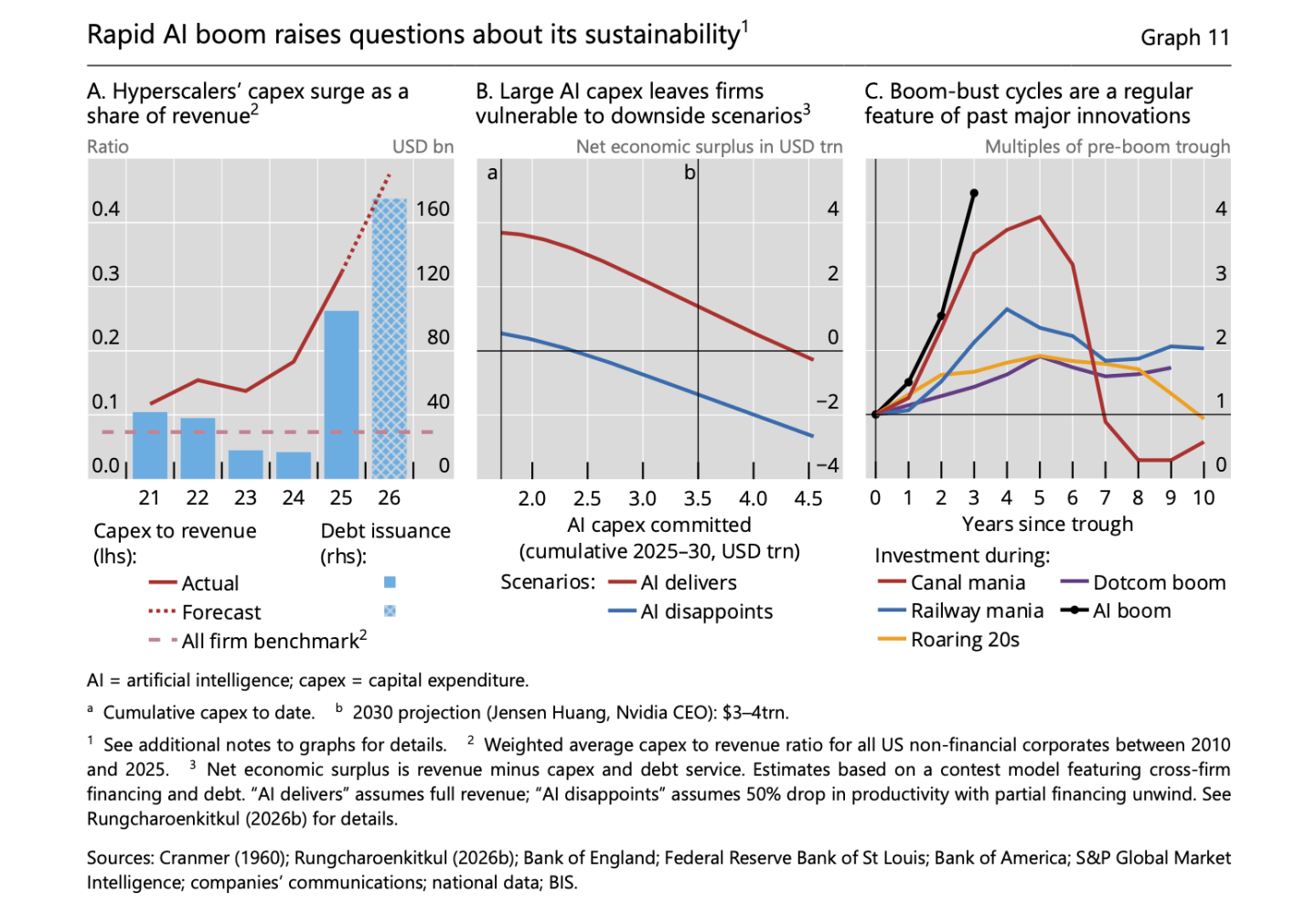
The history of capitalism is a graveyard of "genuine breakthroughs." In the 1830s, it was the canal mania that promised to stitch together the industrial world. In the 1840s, it was the British railway bubble, where thousands of miles of track were laid under the assumption of infinite growth. In the late 1990s, the dot-com boom promised a "new economy" that would defy the laws of gravity. In each instance, the underlying technology was revolutionary and permanent. Yet, in each instance, the capital rush far outstripped the immediate commercial returns, culminating in market crashes and prolonged economic contractions.
Today, the Bank for International Settlements (BIS)—the Basel-based "central bank for central banks"—sees the same dangerous patterns emerging in the $1 trillion artificial intelligence (AI) investment boom. In its Annual Economic Report 2026, released this Sunday, the global financial system’s most authoritative watchdog issued a stark warning: the scale and velocity of AI spending have moved beyond technological optimism into the realm of systemic financial risk.
Main Facts: A $1 Trillion Bet on the Brink
The BIS report paints a picture of a sector that is increasingly "outrunning its balance sheet." The five largest "hyperscalers"—the dominant cloud and technology giants—are currently on pace to spend more than $1 trillion on AI-related capital expenditure (capex) across 2025 and 2026. This level of spending is unprecedented in the history of corporate investment, and the BIS notes that it is already outpacing the firms’ collective earnings and free cash flow. To bridge this widening gap, several of these tech titans have been forced to issue massive amounts of debt, a pivot from their historically cash-rich positions.
The central concern of the BIS is not that AI is a "fraud" or a "fad." On the contrary, the report acknowledges the technology’s transformative potential, citing task-level studies that show consistent productivity gains of 20% to 50% in time-saving metrics. However, the BIS argues that a technological success can still be a financial disaster.
The report highlights a "collective overcommitment" driven by the perception that the AI market is a winner-take-all arena. Because firms believe only a handful of players will dominate the future of intelligence, they are incentivized to spend aggressively to ensure they are among the survivors, regardless of the immediate return on investment (ROI). This "contest-theory" dynamic, the BIS warns, is a recipe for a protracted investment bust if payoffs fail to materialize as quickly as the debt matures.
Chronology: From Innovation to Institutional Risk
The trajectory of the current AI boom can be traced through a series of escalating financial phases, now complicated by a 2026 geopolitical crisis.
Phase 1: The Proof of Concept (2022–2023)
The release of large language models (LLMs) triggered a global race for "compute." Early investment was focused on chip acquisition and foundational model training. During this period, the narrative was driven by the sheer novelty of generative AI and its potential to disrupt white-collar labor.
Phase 2: The Infrastructure Surge (2024–2025)
Investment shifted from software to physical infrastructure. Hyperscalers began massive expansions of data centers, leading to a surge in demand for energy, cooling systems, and specialized real estate. It was during this phase that the "circular financing" models identified by the BIS began to take root, as tech giants invested in the very AI labs that would then spend that capital on the giants’ own cloud services.
Phase 3: The 2026 Convergence of Risks
As of mid-2026, the AI boom has collided with a severe macroeconomic shock. In February 2026, the start of the Iran conflict led to the closure of the Strait of Hormuz. This geopolitical event removed over 10 million barrels of crude oil per day from the global supply—a disruption exceeding both the 1973 oil embargo and the 1979 Iranian revolution.

This energy shock has sent oil prices soaring 67% to a peak of $120 a barrel, driving global inflation upward and forcing central banks to maintain high interest rates. The BIS notes that the AI boom is now trapped between high debt-servicing costs and an energy-driven inflationary environment, creating a "perfect storm" for a capital markets correction.
Supporting Data: The Anatomy of a Fragile Boom
The BIS provides granular data to support its thesis that the AI investment landscape is structurally fragile.
The Contest Theory and Negative Surplus
Using contest-theory modeling, BIS economists analyzed the competitive pressure among tech firms. They found that as capital expenditure rises due to competition, the "net economic surplus" for the sector—calculated as total payoffs minus investment costs—declines. In several "adverse scenarios" modeled by the bank, this surplus turns negative. This means the industry, as a whole, could end up spending more on the tools of AI than the AI itself generates in profit for years to come.
The Web of Circular Financing
One of the report’s most alarming sections details the "hidden wiring" of AI financing. The BIS identifies a complex web of private arrangements where:
- Hyperscalers take equity stakes in AI startups/labs.
- AI Labs commit to multi-year purchases of computing power from their investors.
- Data Center Contractors lease facilities back to hyperscalers under long-dated contracts with "exit clauses" that could be triggered in a downturn, leaving infrastructure firms with specialized, empty buildings.
The BIS warns that the terms of these deals are "typically poorly disclosed," raising the risk that the same assets are being pledged as collateral multiple times across the supply chain.
Private Credit and Non-Bank Exposure
The risk is not contained within the tech sector. Direct lending funds—a $1.5 trillion ecosystem—have quadrupled their lending to AI and IT sectors over the last five years. These sectors now represent roughly 15% of private credit portfolios. Unlike traditional banks, these non-bank financial institutions (NBFIs) operate with significantly less regulatory oversight and are more prone to "liquidity mismatches" if investors suddenly demand their money back.
Official Responses: Warnings from the Global Guard
The BIS report has echoed through the halls of global finance, drawing reactions from both regulators and market strategists.
Zhang Tao, BIS Asia-Pacific Representative:
Speaking to the South China Morning Post, Zhang emphasized the speed of a potential collapse. "A correction could unwind much faster than previous banking crisis episodes," he warned. He pointed to the fact that financing now flows through hedge funds and private credit vehicles rather than traditional banks, meaning the "circuit breakers" of the traditional banking system may not apply.
Torsten Slok, Chief Economist at Apollo Global Management:
The BIS findings align with warnings from Wall Street. Slok recently noted that AI has "penetrated every corner of financial markets." He pointed out that AI-related firms now account for nearly half of all investment-grade bond issuance and a staggering 87% of venture capital funding. The concentration of risk is so high that any "hiccup" in AI sentiment could paralyze the broader capital markets.
The BIS Prescription for "Robustness":
The BIS avoids calling for a "halt" to AI investment but instead advocates for "robustness." The report repeatedly distinguishes between "resilience" (the ability to bounce back) and "robustness" (the ability to withstand a shock without breaking). The bank is calling for:
- Central Banks: To remain vigilant on inflation despite political pressure to lower rates to support the tech sector.
- Governments: To restore fiscal space by reducing deficits, ensuring they have the "dry powder" to intervene if a recession hits.
- Regulators: To extend prudential standards to NBFIs, specifically targeting the transparency of private credit and circular financing deals.
Implications: The Global "Wealth Effect" and Beyond
The fallout of an AI investment bust would not be localized to Silicon Valley; it would be a global macroeconomic event with profound implications for household wealth and international stability.
The Household Wealth Effect
U.S. equities now represent approximately 64% of the MSCI Global Index, a historical high. Household exposure to these stocks has more than doubled relative to income since 2010. The BIS warns that a major repricing of AI-related stocks would trigger a "sharper consumption pullback than in the past." When the "paper wealth" of the middle class evaporates in a stock market correction, consumer spending—the engine of the global economy—stalls.
The Vulnerability of the Supply Chain
The engineering and construction firms building the AI "backbone" are particularly at risk. These companies often carry weak balance sheets and operate on thin margins. If hyperscalers pause their capex deployment, these contractors face immediate revenue shortfalls. Because they are at the end of the financing chain, they have the least cushion to survive a sudden reversal in investment.
The Inflation-AI Nexus
The interaction between the AI boom and the energy crisis in the Strait of Hormuz creates a policy dilemma. If central banks raise rates to fight the 67% surge in oil prices, they increase the debt-servicing burden on the very tech firms that are currently propping up the stock market. Conversely, if they lower rates to save the AI boom, they risk letting energy-driven inflation spiral out of control.
A Protracted Investment Bust
The ultimate danger, according to the BIS, is not just a "crash" but a "protracted investment bust." If the $1 trillion already spent does not yield the promised productivity payoffs by 2027, the "sudden pullback in financing" could lead to a decade of stagnant growth, mirroring the aftermath of the railway mania or the 1920s electrification boom.
In conclusion, the BIS Annual Economic Report 2026 serves as a sobering reminder that while technology moves at the speed of light, finance is still bound by the laws of debt and return. The AI breakthrough is real, but the financial structure built upon it is increasingly fragile. As the world navigates the twin shocks of an energy crisis and a potential tech correction, the BIS’s call for "robustness" over "exuberance" has never been more urgent.