For decades, the halls of American universities have witnessed a demographic transformation. Women have not only caught up to men in college enrollment; they have significantly outpaced them, establishing a gender divide that has become a defining characteristic of modern higher education. However, this gap is no longer merely a matter of who walks through the admissions door. Today, the conversation has shifted toward a more troubling trend: young men are increasingly opting out of higher education entirely or failing to complete degrees, prompting an urgent national debate on the value, accessibility, and relevance of the modern college experience.
As institutions grapple with declining enrollment, rising costs, and the looming shadow of artificial intelligence on the labor market, the question of how to re-engage young men has moved from the periphery to the center of educational policy.
The Current Landscape: A Crisis of Confidence and Completion
The disparity in educational attainment is stark. Current data suggests a 60-to-40 split in enrollment favoring women, a trend that is fueling a crisis of confidence in the traditional four-year degree. This is not just a failure of enrollment; it is a crisis of retention. Many young men who do enter the higher education ecosystem find themselves disconnected, struggling to see the tangible "value proposition" of their studies in an economy that is increasingly rewarding technical expertise and hands-on skill acquisition.
This skepticism is backed by a growing body of research. A recent survey conducted by Cygnal, which polled 800 American men aged 18 to 30, reveals a complex psychological landscape. While 55 percent of respondents feel their lives are "on track," a significant 40 percent feel they are off track. More tellingly, nearly two-thirds—63 percent—believe the federal government should play a more active role in addressing the challenges facing young men, with inflation and housing instability cited as primary stressors.
The Symposium on Young American Men: A Call to Action
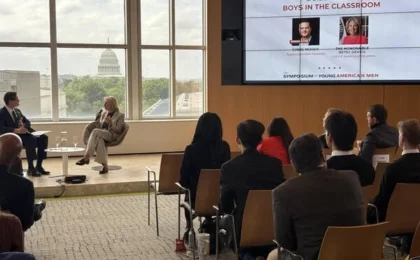
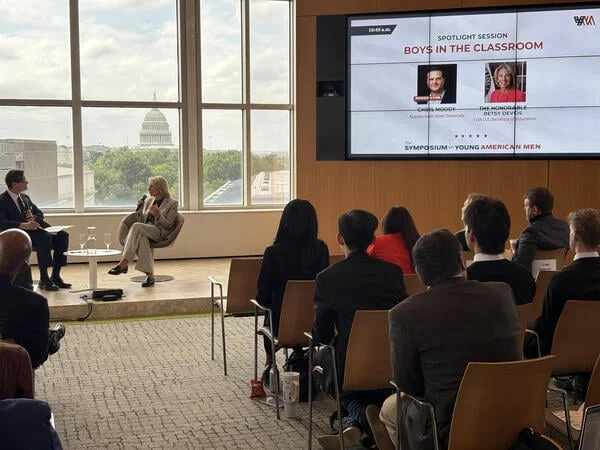
The urgency of this situation was on full display at the recent Symposium on Young American Men in Washington, D.C. The event served as a high-level summit, bringing together policymakers, academic researchers, and social advocates to dissect the structural and cultural forces shaping the lives of the next generation of men.
Former U.S. Education Secretary Betsy DeVos, a keynote speaker at the event, framed the issue as a fundamental identity crisis for colleges. "There’s no simple answer," DeVos remarked, noting that many young men are rightfully questioning whether the traditional degree path offers a sufficient return on investment compared to burgeoning apprenticeship programs and vocational pathways. Her critique was pointed: "I’m not sure that a lot of the degrees that have been granted in higher ed institutions in the last couple of decades are all that valuable for a lot of young people."
Perspectives from the Capitol: Policy and Structural Shifts
The symposium featured a high-profile panel focused specifically on the "diploma divide," featuring Senator Bill Cassidy (R-La.), chair of the Senate Health, Education, Labor and Pensions Committee; Judson Horras, CEO of the North American Interfraternity Conference; and Curtis Valentine, founding president of the Male Educator Network and Policy Institute.
Senator Cassidy’s Legislative Vision
Senator Cassidy argued that federal policy must be more surgical in its approach to educational success. He proposed a three-pronged framework for institutional leaders:
- Pathway Calibration: Institutions must distinguish whether a student is better suited for a technical, hands-on path or a traditional academic track.
- Addressing Disparities: Acknowledging the gender gap is not an indictment of any group, but a recognition that the current system is not serving all demographics equally.
- Persistence Metrics: Colleges must focus as much on keeping men enrolled as they do on recruiting them.
Cassidy highlighted the bipartisan College Transparency Act, which he is co-sponsoring with Senator Elizabeth Warren. By modernizing postsecondary data reporting, the act aims to provide students with clearer, more granular information about the actual outcomes of specific degrees, theoretically allowing young men to make better-informed decisions about their futures.

Mentorship and the Belonging Gap
If systemic policy is the "what," then mentorship is the "how." Curtis Valentine of the Male Educator Network and Policy Institute argued that the crisis of engagement is, at its core, a crisis of connection.
"There’s something about hearing from a male educator that college is possible, that you’re needed," Valentine explained. He argued that young men often lack the "permission" to see themselves as successful academics. When a young man has a mentor—a teacher or coach who believes in his potential—the academic environment transforms from an alienating institution into a place of opportunity.
The Role of Community
Judson Horras added a unique perspective by pointing to the success of fraternities and all-male societies. In an era of rising loneliness, these organizations provide what many universities lack: a "home base." Horras argued that students who participate in these groups are statistically more likely to persist to graduation because they have found a community that provides both a sense of belonging and a structure of accountability.
"As we track them, the students joining fraternities or all-male societies are the most likely to stay in school and to follow through to graduation," Horras noted. "They’re finding a place where they belong, where they’re welcome and where they can challenge their ideas."
The Future of Work: AI and the New Skill Set
The symposium also addressed the elephant in the room: the rapid rise of artificial intelligence. Panelists agreed that the traditional, static classroom model is increasingly ill-equipped for the future labor market.
Horras suggested that as AI automates routine cognitive tasks, the value of a degree will shift from rote memorization to high-level critical thinking and human influence. "With AI, it’s going to be less about what you’re learning in the classroom and more about thinking critically and influencing others to build something," he stated. He advocated for colleges to aggressively integrate experiential learning and external opportunities into their curricula, rather than clinging to the "four walls" of the classroom.
Implications for Higher Education: A New Social Contract
The findings and discussions from the symposium point to several critical implications for the future of higher education:
- The End of "One Size Fits All": Universities can no longer assume that the four-year, residential degree is the gold standard for every student. Institutions that fail to integrate apprenticeships and "earn-while-you-learn" models may find themselves increasingly irrelevant to the male demographic.
- Targeted Support Systems: The rising loneliness among college-aged men suggests that counseling and mental health services need to be gender-responsive. Addressing the specific social anxieties of first-generation men is not just a "nice-to-have" but a critical retention strategy.
- Incentivizing the Pipeline: Proposals to offer free tuition for men entering teaching or coaching fields could create a "multiplier effect," ensuring that future generations of boys have the role models they currently lack.
Conclusion: Bridging the Gap
The "diploma divide" is a complex, multifaceted issue that defies simple solutions. As Betsy DeVos noted, higher education is facing a necessary, if painful, period of "self-analysis." The challenge for universities is to prove that they are not just gatekeepers of status, but engines of genuine opportunity for all.
Whether through modernized data, more intentional mentorship programs, or a complete overhaul of the "value proposition" of a degree, the path forward requires a shift in focus. By treating young men not as a problem to be solved, but as a population to be engaged through relevant pathways and meaningful community, higher education may yet find its way back to being an attractive destination for the next generation. As the landscape of work continues to evolve, one thing is certain: the institutions that survive the coming decades will be those that prioritize connection, discernment, and the clear communication of value over the status quo.