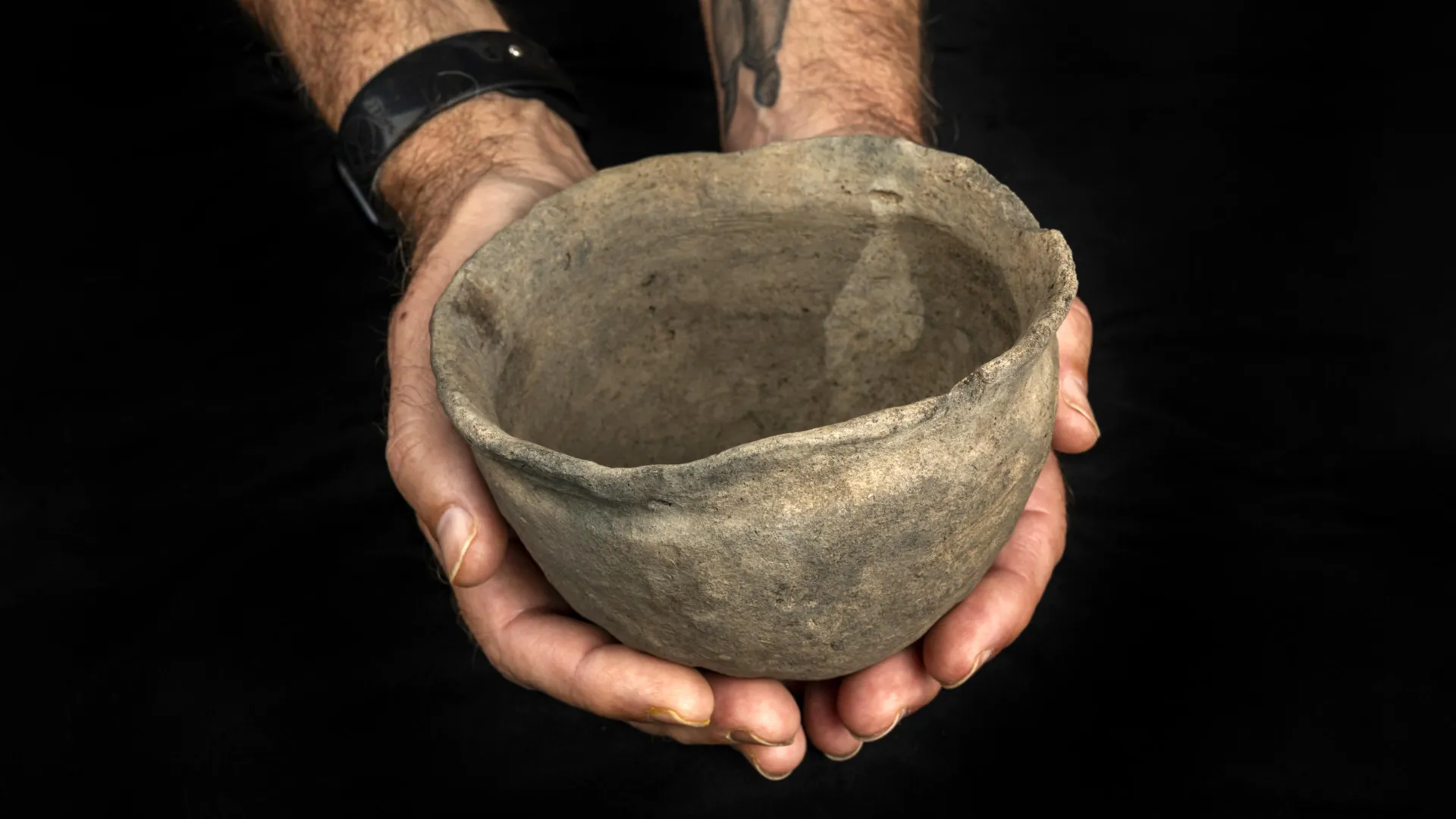
In the quiet, wooded landscape of northwest Gainesville, Florida, a team of University of Florida students recently performed an act of archaeological alchemy: they reached into the past and pulled out a vessel that had remained untouched for four centuries. The object—a small, palm-sized clay pot, smooth-surfaced and undecorated—was found perfectly intact, an anomaly in a field where archaeologists are usually tasked with piecing together the fragmented history of human endeavor.
For the researchers at the Florida Museum of Natural History, this discovery is more than a curio; it is a profound mystery. While thousands of shards of pottery have been unearthed at the site of Mission San Francisco de Potano over the last two decades, this singular vessel remains, as its excavators describe it, a "unique" window into the life of the Potano-Timucua people during the turbulent era of Spanish colonization.
A Legacy of Clay: The Main Facts
The vessel in question is a testament to the durability of indigenous craftsmanship. Hand-shaped by a member of the Potano-Timucua tribe approximately 400 years ago, the pot is deceptively simple. It lacks the intricate decorations often associated with ceremonial items and bears no obvious signs of heavy wear, such as the charred residue common to cooking vessels placed directly over open flames.
The primary puzzle for archaeologists is its state of preservation. "Typically, we find things that were broken and discarded," says Gifford Waters, the collections manager for historical archaeology at the Florida Museum of Natural History. "You don’t leave things behind that you can still use, so why was this purposefully put into a pit?"
In the context of terrestrial archaeology, intact pottery is vanishingly rare. Most ceramics buried in the ground succumb to the inexorable pressures of the earth—the slow shift of soil, the vibrations of modern construction, and the cycles of agricultural development. Finding an unbroken vessel in an open-air site, rather than a shipwreck or a protected burial vault, is a career-defining moment for any archaeologist.
Chronology: From Potano Village to Spanish Mission
To understand the significance of this pot, one must look at the timeline of the site itself. The Potano people, a subgroup of the Timucua, were forced into a state of relocation by encroaching Spanish colonial forces in 1585. Originally inhabiting the region between modern-day Payne’s Prairie and Orange Lake, the tribe migrated, eventually establishing themselves in the area that would become the mission site.
By 1606, the Spanish colonial administration had solidified its influence, sending a friar to the village to establish a mission. This was part of a broader, aggressive campaign by the Spanish Crown to establish more than 100 Catholic missions across Florida to maintain geopolitical control. Mission San Francisco de Potano became a nexus of this cultural collision.
The site functioned as a mission for exactly one century. By 1706, it had been abandoned, and the structures were reclaimed by the forest. For over two centuries, the mission’s existence was largely obscured, existing only in fragments of memory and fading records until, in the 1950s, physical evidence began to emerge from the dirt.
Beneath the Trowel: Supporting Data and Methodology
The excavation is led by Gifford Waters and Charles Cobb, a curator of historical archaeology at the museum. Their method is meticulous, relying on a grid of 1-by-1 meter excavation squares that allow students to document the precise location of every find.
Since 2006, the team has recovered more than 7,000 artifacts from the site. This dataset paints a detailed, if complex, picture of daily life. The population was predominantly Potano-Timucua, with a single European resident—the friar—living among several hundred indigenous people. Consequently, the vast majority of the recovered items are indigenous in origin, though the presence of glass beads, iron nails, and European-style musket hardware underscores the uneasy synthesis of cultures.
"What tells us the most is not just the artifacts but the evidence of activities," Waters explains. By mapping the distribution of animal bones—remains of meals featuring turtle, freshwater fish, and turkey—researchers have successfully identified specific cooking areas and refuse pits. This spatial data is what transforms a random collection of objects into a coherent narrative of human survival and adaptation.
Official Responses and Scientific Inquiry
The discovery occurred within a mysterious, yet-to-be-identified Spanish structure. The presence of military-grade items, such as a gun’s rear sight and a musket side plate nearby, has led researchers to hypothesize that the building may have functioned as a barracks, particularly during the early 1700s when the mission faced increasing pressure from British-led raids.
However, the pot itself remains an outlier. Because it lacks the characteristic carbon buildup of a pot used for stewing or boiling, researchers believe it may have served a different purpose. Perhaps it was used for storing small, dry goods, or perhaps it was placed near the periphery of a fire to keep food warm. The absence of trauma to the vessel suggests it was deposited with care, rather than tossed into the refuse as trash.
This discovery has prompted a re-evaluation of the site’s stratigraphy. Archaeologists are currently cross-referencing the soil density and depth at which the pot was found to better understand the timeline of the mission’s final, desperate years.
The Broader Implications: Trade, Migration, and Change
Perhaps the most telling aspect of the recent excavation is the discovery of a second vessel fragment found shortly after the intact pot. This second piece was significantly larger and featured a rough, coarse texture that did not match local Potano pottery styles.
This contrast is highly significant. It suggests that the mission was not an isolated enclave, but rather a hub in a vast, interconnected network of trade and movement. The second vessel may have originated in St. Augustine or present-day Jacksonville, brought to the site by merchants or through the migration of new residents who carried their own ceramic traditions with them.
"During the later years of this mission, folks from different parts of Florida and Native Americans from different areas moved into and around the site," says Waters. "It’s really neat to see these differences and connections in the artifacts. It shows both the persistence and change of traditions over time."
The presence of these two vessels—one local, refined, and unbroken; the other foreign, rugged, and fragmentary—mirrors the history of the site itself. It was a place of deep-seated indigenous traditions attempting to persist under the weight of foreign colonial influence.
Conclusion: A Story Still Being Written
The work at Mission San Francisco de Potano is far from finished. As students continue to sift through the earth, square by square, they are uncovering more than just clay and bone. They are documenting the resilience of the Timucua people and the shifting sands of a colonial landscape that would eventually reshape the entire continent.
The small, unbroken pot sits now in a laboratory, a silent witness to a century of history. It serves as a reminder that even when the records of a people are destroyed or abandoned, the physical objects they left behind—the tools of their daily lives—can survive the centuries to tell their story. For the archaeologists at the University of Florida, each trowel of dirt removed is a step closer to understanding not just the mission, but the human beings who lived, ate, worked, and eventually left this spot in the Florida woods. The mission may have been abandoned in 1706, but in the hands of modern scholars, its story is finally being read.