The dream of a World Cup title for France has come to a brutal, abrupt end. In a semi-final that was expected to be a clash of titans, the French side—touted by pundits and analysts alike as the tournament favorites—was systematically dismantled by a tactical masterclass from Spain. The 2-0 defeat in Dallas was not merely a loss; it was a total tactical surrender, a performance so listless that it invited immediate comparisons to the opening hour of the 2022 World Cup final against Argentina, but with one critical difference: this time, there was no comeback.
The Anatomy of a Tactical Failure
From the opening whistle, the "French Armada" appeared to be sailing into a storm they were entirely unprepared for. Spain, under the guidance of a sophisticated coaching setup, did not simply play better; they played a different game entirely. While France looked to rely on individual moments of brilliance from their star-studded forward line, Spain operated as a singular, cohesive organism.
The disparity in tactical preparation was evident in the midfield. France, playing with a double pivot of Adrien Rabiot and Aurélien Tchouaméni, was intended to provide a bedrock of stability. Instead, they were routinely bypassed. Rabiot, hampered by an early yellow card that forced him to temper his aggressive pressing, lost the physical battle. Tchouaméni, returning from a hamstring injury that had sidelined him for two matches, looked visibly lacking in both rhythm and stamina. The result was a midfield vacuum that Spain’s orchestrator-in-chief, Rodri, exploited with surgical precision.
Chronology of the Collapse
The match unfolded as a slow, agonizing realization for French supporters that their team had arrived at the stadium in body, but not in spirit.
- 0-15 Minutes: Spain immediately asserted control, moving the ball with a tempo that unsettled the French backline. France attempted to counter-press, but the timing was consistently off.
- 22nd Minute (The Turning Point): A defensive lapse triggered the inevitable. Mikel Oyarzabal, displaying clinical composure, stepped up to convert a penalty after a defensive error, handing Spain the lead. The atmosphere in the stadium shifted instantly; the French nerves became palpable.
- 30-45 Minutes: France attempted to find an equalizer through long balls to Kylian Mbappé, but the Spanish defensive structure held firm. The reliance on individual talent over collective movement became the team’s undoing.
- 58th Minute (The Death Knell): Any hope of a second-half resurgence was extinguished when Pedro Porro found the back of the net. The goal, coming shortly after the break, effectively broke the French spirit.
- 75-90 Minutes: The final quarter was characterized by a lack of coherent strategy from Didier Deschamps’ men. substitutions, including the introduction of Rayan Cherki and Desiré Doué, failed to inject the necessary energy, and the team seemed to accept their fate long before the final whistle.
The Humbled Star: The Case of Michael Olise
Perhaps the most symbolic illustration of France’s failure was the performance of Michael Olise. Hailed throughout the tournament as the "old-school playmaker" capable of unlocking any defense, Olise was expected to be the protagonist of this semi-final. Instead, he was invisible.

The data surrounding his performance is damning. Losing possession 20 times and failing to complete a single successful dribble, Olise was effectively neutralized by the Spanish defensive block. He looked lost, seemingly paralyzed by the pressure of the occasion. When he did find the ball, his options were closed off by a well-drilled Spanish unit, leading to frustrated, aimless passes that only served to fuel Spain’s transition game. The "Ballon d’Or candidate" narrative that had accompanied him into the match evaporated under the heat of the Dallas afternoon, leaving him looking like a player overwhelmed by the magnitude of the stage.
Supporting Data and The Midfield Vacuum
A closer look at the statistics reveals just how thoroughly France was outplayed. Spain controlled the possession metrics for over 65% of the match, but more importantly, they controlled the verticality of the play.
While France’s forward line—including Ousmane Dembélé, Bradley Barcola, and Kylian Mbappé—was expected to provide a constant threat, they were effectively starved of service. Dembélé, typically a spark for the French, posed almost zero threat to the Spanish full-backs. The lack of connection between the midfield and the attack meant that France’s transitions were easily snuffed out by a disciplined Spanish defensive line.
The contrast between the two sides was best summarized by the efficiency of their offensive phases. Spain needed few clear-cut chances to secure their two goals, whereas France’s efforts, largely speculative and disjointed, failed to register a single high-probability goal-scoring opportunity.
Official Responses and Internal Reflections
Following the match, the post-game atmosphere in the French dressing room was reportedly one of stunned silence. Manager Didier Deschamps, ever the realist, did not shy away from the gravity of the defeat.

"The players are devastated, but we have to be clear-headed," Deschamps told reporters in the post-match press conference. "Technically, we were second best. That is on us. We knew their main strength was their ability to play at a false tempo, to slow the game down and lull you into a state of complacency. At times, we should have done the same, but we were too reactive rather than proactive. It was more difficult than we expected, and credit must go to Spain for executing their plan perfectly."
Rayan Cherki, reflecting on the team’s inability to adapt, noted, "We knew what to expect. We studied them. But knowing and executing are two different things. They forced us into a rhythm that suited them, and we never found a way to break that cycle."
Implications for the Future
The implications for French football are significant. For a team that has been consistently positioned at the top of the FIFA rankings and considered the favorites for every major tournament since 2018, this exit signals a potential need for a systemic rethink.
- The End of a Cycle: There is a growing sense that the current iteration of the French national team has reached its ceiling. While the talent pool remains the envy of the world, the tactical rigidity and the reliance on individual brilliance may have become a crutch.
- Leadership Questions: While Deschamps has brought unprecedented stability to the squad, critics are beginning to question whether a change in philosophy is required to maximize the next generation of French talent.
- The "Mbappé Factor": Kylian Mbappé’s inability to influence the biggest moments in this tournament will undoubtedly be the subject of intense media scrutiny. As the captain and the face of the team, his failure to drag his side back into the game in the final 30 minutes will haunt the French headlines for months.
A Lesson in Humility
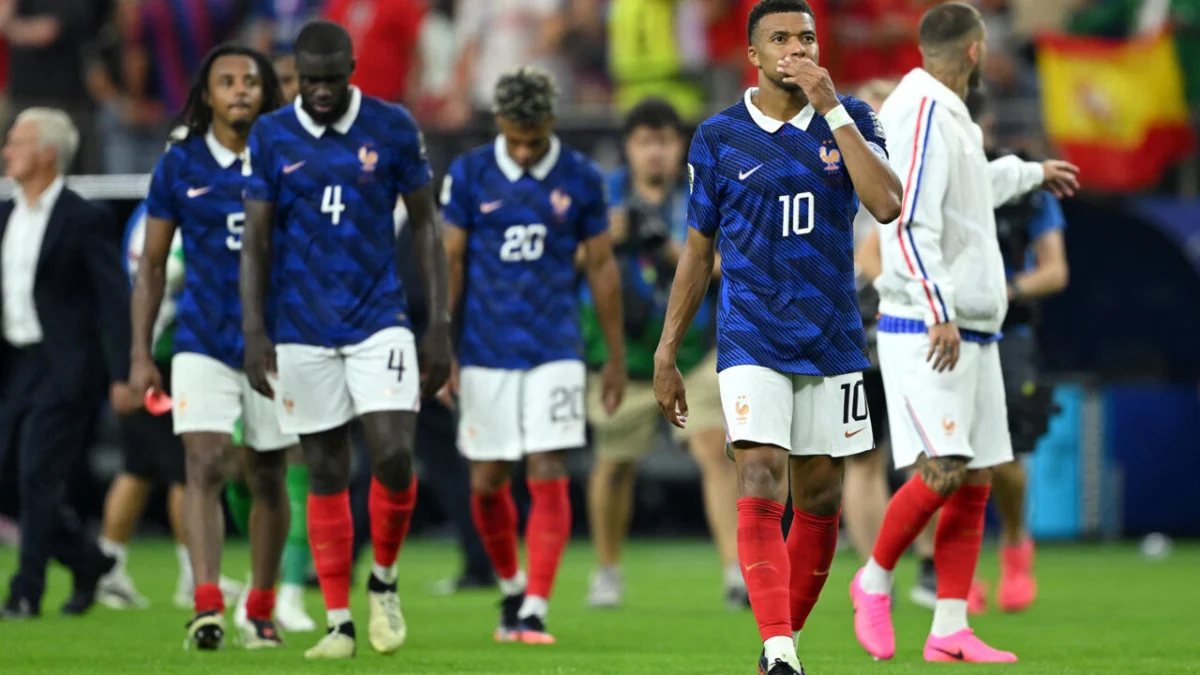
As the final whistle blew, the imagery told the story: Kylian Mbappé standing alone in the center circle, a solitary figure amidst the celebration of his opponents. His teammates, scattered across the pitch, were broken—some on their knees, others shielding their faces from the cameras.
For France, the 2026 World Cup campaign will be remembered as a missed opportunity. They arrived with the swagger of champions but left with the heavy realization that at the highest level of international football, reputation counts for nothing. Spain, meanwhile, moves on to the final, having reminded the world that in football, the most dangerous team is not the one with the biggest names, but the one with the most unified purpose. The French Armada, once thought unsinkable, has been grounded by a masterclass in tactical discipline.