Introduction
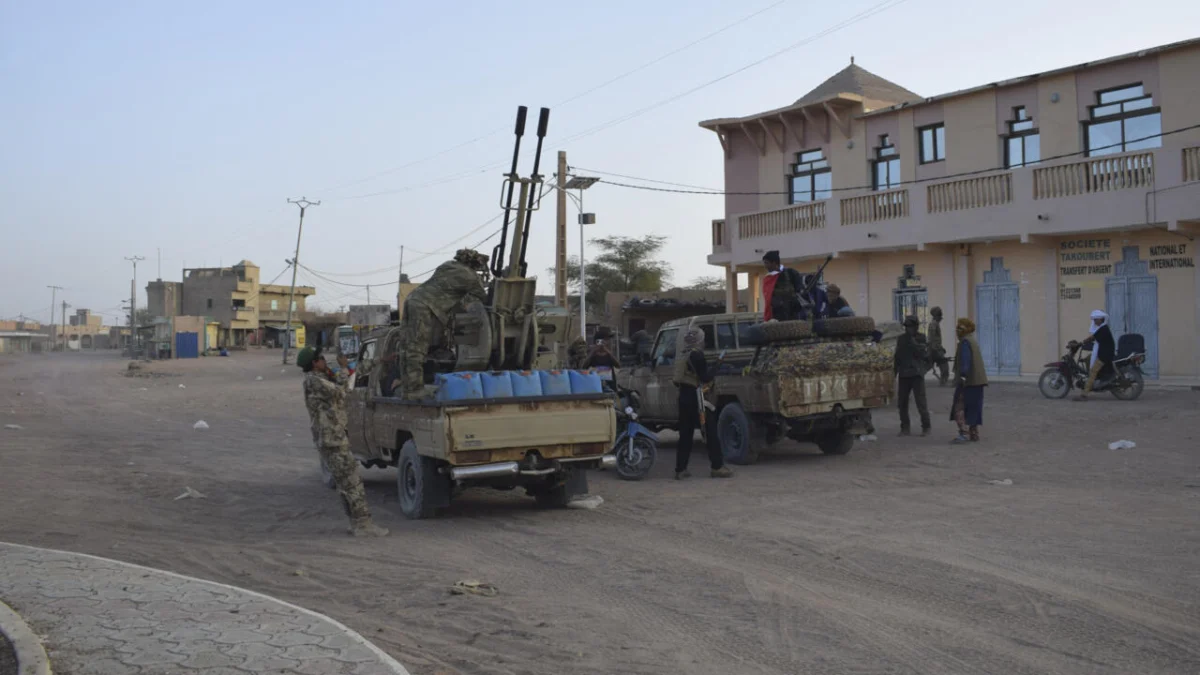
The volatile security landscape of Northern Mali has deteriorated sharply this week, as a coordinated insurgent offensive pushes the nation’s military junta and its Russian paramilitary allies into a desperate defensive struggle. On Thursday morning, a major reinforcement convoy tasked with resupplying a beleaguered military outpost in the town of Anefis was ambushed by a coalition of Tuareg separatists and Al-Qaeda-linked militants.
This latest engagement marks a critical escalation in a long-standing territorial dispute. As the Malian government—supported by Russia’s "Africa Corps"—attempts to reassert central authority over the restive north, it finds itself pitted against an unlikely and fragile alliance of convenience between the Azawad Liberation Front (FLA) and the Group for the Support of Islam and Muslims (JNIM). The battle for Anefis, a strategic gateway to the separatist stronghold of Kidal, has become the focal point of a war that threatens the stability of the entire Sahel region.
The Strategic Context: Why Anefis Matters
To understand the ferocity of the current fighting, one must look at the geography of Northern Mali. Anefis is not merely a desert town; it serves as a logistical "chokepoint." Situated approximately 100 kilometers from Kidal, the provincial capital and the primary power base for Tuareg separatists, Anefis is the proverbial key to the door.
For the Malian military government, holding Anefis is a prerequisite for any future attempt to reclaim Kidal, which was lost to rebels in a major offensive just two months ago. Conversely, for the FLA and their jihadist counterparts, preventing the consolidation of government forces in Anefis is an existential necessity. By maintaining control of this corridor, the rebel alliance effectively cages the Malian army and its Russian mercenaries in isolated pockets, preventing them from projecting power further into the northern territories.
Chronology of the Conflict: A Week of Fire
The current hostilities are the result of a week-long degradation of security, defined by a series of precise and coordinated strikes:
- Saturday, July 4th: The FLA and JNIM launched a series of synchronized attacks across northern towns, successfully seizing control of Anefis. This move effectively cut off supply lines for the military camp stationed there, which is currently manned by a mix of Malian soldiers and Russian mercenaries.
- Sunday, July 5th: Recognizing the vulnerability of the forces trapped in Anefis, the Malian military command dispatched an initial reinforcement convoy from the regional hub of Gao. This convoy was intercepted and ambushed by insurgents, forcing a retreat and underscoring the rebels’ sophisticated intelligence and mobility.
- Thursday, July 9th: Determined to break the siege, a second, much larger convoy—described by security sources as consisting of "dozens of vehicles" backed by air cover—attempted the transit toward Anefis. The column was intercepted near the town of Tabankort, leading to an hours-long, high-intensity firefight that continued well into the afternoon.
Mohamed Elmaouloud Ramadane, the spokesperson for the FLA, confirmed the engagement to international media, noting with grim precision: "Our troops engaged in combat this Thursday near Tabankort against the reinforcement force, which is composed 90 percent of Russian mercenaries and Malian soldiers."
The Combatants: A Shifting Alliance
The conflict in Mali has become increasingly complex due to the shifting allegiances of the factions involved.
The Government and the Africa Corps
Since pivoting away from traditional Western security partners, the Malian military government—led by Colonel Assimi Goïta—has leaned heavily into a security pact with Moscow. The "Africa Corps," the successor to the Wagner Group’s operations in Africa, has become the backbone of the government’s counter-insurgency strategy. These paramilitaries are tasked not only with direct combat but also with training and logistical support for the Malian Armed Forces (FAMa).
The Rebel-Jihadist "Fragile Alliance"
Perhaps the most alarming development for international observers is the tactical cooperation between the Azawad Liberation Front (FLA) and JNIM. Historically, these two groups have often been at odds: the FLA represents nationalist Tuareg aspirations for autonomy or independence, while JNIM seeks to impose a fundamentalist, transnational caliphate.
However, as explored in recent reports, the two groups have adopted a "common enemy, but not a common project" framework. By pooling their resources—the FLA providing local knowledge and regional legitimacy, and JNIM providing ideological fervor and tactical, asymmetric warfare experience—they have managed to stymie a state military that is better equipped but geographically overextended.
Supporting Data: The Cost of the Sahel War
The human cost of this conflict continues to climb, with tens of thousands of lives lost across the "Alliance of Sahel States" (AES), which comprises Mali, Burkina Faso, and Niger.
- Casualty Figures: While exact numbers for the current fighting remain difficult to verify, the scale of the engagements—involving heavy artillery, vehicle-borne IEDs, and sophisticated ambush tactics—suggests that losses on both sides are mounting.
- Military Assets: The presence of "dozens of vehicles" in the convoy demonstrates the Malian government’s willingness to commit significant resources to the Anefis theater. The loss or degradation of such a convoy represents a significant blow to the military’s operational capacity.
- Russian Economic Interests: Moscow’s engagement is not strictly altruistic. As the AES countries move deeper into the Russian orbit, Moscow is actively seeking to expand its footprint in the mining and energy sectors. The instability in the north directly threatens these long-term economic ambitions, making the Kremlin’s commitment to the junta’s survival increasingly entrenched.
Official Responses and Tactical Implications
The Malian government has remained characteristically tight-lipped regarding specific tactical failures, focusing instead on a narrative of national sovereignty and the fight against "terrorist incursions." However, the inability to move a heavily armored convoy through a corridor they supposedly control is a significant blow to the government’s image of strength.
The View from the Rebels
For the FLA, every day that the Anefis camp remains isolated is a victory. Their spokesperson’s public acknowledgment of the combat suggests a high level of confidence in their ability to dictate the pace of the conflict. By documenting their successes with videos of heavy gunfire in the desert, they are engaging in a sophisticated information war designed to undermine morale within the Malian military.
The International Perspective
International observers, including the United Nations and regional bodies like ECOWAS, have expressed mounting concern over the deepening violence. The collapse of the 2015 Algiers Peace Agreement has left a vacuum in northern governance that neither the state nor the rebels have been able to fill, leading to a "perpetual war" state.
Broader Implications: A Regional Crisis
The fighting in Anefis is a microcosm of a larger regional contagion. The Alliance of Sahel States (AES) is attempting to present a united front against jihadist insurgency, but the reality on the ground is that the state is struggling to secure its own territory.
- The Failure of Militarization: The heavy reliance on Russian mercenaries highlights a preference for kinetic military solutions over political dialogue. Critics argue that this approach ignores the underlying grievances of the Tuareg population, which have been ignored for decades.
- Resource Competition: As the conflict intensifies, the northern regions risk becoming a permanent theater of proxy warfare, where the local population is squeezed between the state’s desire for central control and the rebel alliance’s desire for autonomy.
- Future Outlook: If the Malian military fails to break the siege of Anefis, they may be forced to abandon the north entirely, effectively ceding the territory to a loose coalition of rebels and jihadists. This would likely trigger a massive refugee crisis and further destabilize the border regions of Niger and Burkina Faso.
Conclusion
As the sun sets over the desert of northern Mali, the situation remains fluid and perilous. The firefight near Tabankort is more than just a tactical engagement; it is a manifestation of a fundamental struggle for the future of the nation. With Russian-backed forces pinned down and a determined insurgent coalition holding the high ground, the path to peace appears increasingly narrow.
The events of this week serve as a sobering reminder that without a credible political process to address the legitimate grievances of the northern populations, the cycle of ambushes, counter-offensives, and regional instability is likely to persist. For now, all eyes remain on the dusty outskirts of Anefis, where the outcome of this clash will dictate the next, perhaps final, chapter of the current northern campaign.