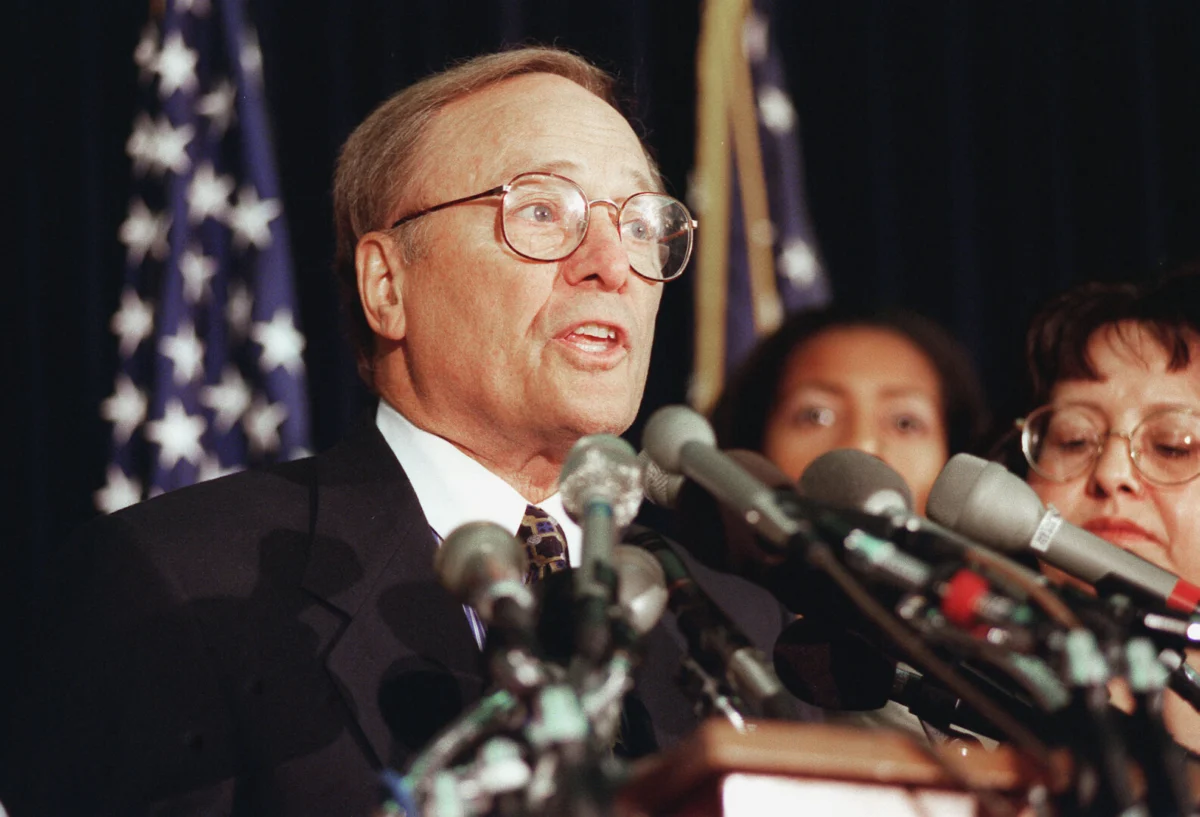
STANLEY, Va. – William "Bill" Archer Jr., a towering figure in American fiscal policy and a former Republican Congressman from Texas who chaired the powerful House Ways and Means Committee during a pivotal era, passed away Saturday at his farm in Stanley, Virginia. He was 98.
Archer, whose distinguished career spanned three decades representing West Houston in Washington, D.C., was a relentless champion for tax cuts and a principal architect of significant reforms to the nation’s tax code and welfare programs. His tenure as chairman of the House Ways and Means Committee from 1995 to 2001, following the historic Republican takeover of the House, solidified his legacy as a conservative trailblazer whose policies continue to reverberate through American economic life. Among his most notable legislative achievements were the establishment of the $500-per-child tax credit and substantial reductions in the estate tax, cornerstones of the Republican pro-growth agenda.
His passing marks the end of an era, recalling a period of intense legislative activity and partisan realignment in Congress. Archer’s journey from local Texas politics to the highest echelons of federal power, including succeeding former President George H. W. Bush in his House seat, reflects a profound dedication to public service and a deep-seated belief in fiscally conservative principles.
A Life Dedicated to Public Service: Main Facts
Bill Archer’s remarkable journey through American politics began long before his arrival in Washington. Born in Houston, Texas, in 1928, he cultivated a reputation for diligence and a keen understanding of economic policy from his earliest days. After serving in the U.S. Army, Archer earned his bachelor’s degree from Princeton University and later a law degree from the University of Texas School of Law. These foundational experiences instilled in him a rigorous analytical approach that would define his legislative career.
His political career was characterized by a steady ascent and a principled commitment to conservative ideals, even as his party affiliation evolved. He first entered the political arena at the local level, serving as a county commissioner, before his election to the Texas House of Representatives. It was during his two terms in the state legislature that Archer made a significant ideological shift, initially serving as a Democrat before recognizing his alignment with the burgeoning Republican Party. This pivot reflected a broader realignment in Southern politics and foreshadowed his future role in shaping the GOP agenda.
Upon arriving in Washington in 1971, filling the seat vacated by George H. W. Bush who was then appointed U.S. Ambassador to the United Nations, Archer quickly established himself as a serious legislator focused on economic matters. He became a fixture on the House Ways and Means Committee, an assignment that would ultimately define his national impact. For decades, even as a member of the minority party, he advocated tirelessly for reduced government spending, lower taxes, and welfare reform.
The culmination of his congressional career arrived with the "Republican Revolution" of 1994, which ended 40 years of Democratic control of the House. This seismic shift propelled Archer into the chairmanship of the Ways and Means Committee, granting him an unprecedented platform to enact the conservative tax and fiscal policies he had championed for so long. Under his leadership, the committee became a legislative engine for the GOP’s “Contract with America” and subsequent efforts to reshape the American economic landscape.
Archer’s influence extended beyond specific legislation. He was known for his calm demeanor, his meticulous approach to policy, and his commitment to fostering collegiality, even amidst heated partisan battles. His enduring legacy is not just in the laws he helped pass, but also in the model of principled public service he embodied.
Chronology: A Distinguished Career in Detail
Early Life and Local Beginnings (1928-1966)
William "Bill" Archer Jr. was born on March 22, 1928, in Houston, Texas, a city whose growth and economic dynamism he would later represent in Congress. His early life was marked by a strong sense of civic duty and intellectual curiosity. After graduating from St. John’s School in Houston, Archer attended Princeton University, where he earned his Bachelor of Arts degree in 1950. His education was briefly interrupted by service in the United States Army during the Korean War, an experience that deepened his understanding of national service and sacrifice. Following his military service, he pursued a legal education, earning his Bachelor of Laws (LL.B.) from the University of Texas School of Law in 1957.
Upon returning to Houston, Archer began his professional career as a lawyer and soon gravitated towards public service. His entry into politics came at the local level, a common proving ground for aspiring leaders. He served as a county commissioner in Harris County, Texas, from 1962 to 1966, gaining practical experience in governance and an intimate understanding of the needs of his community. These early roles allowed him to connect directly with constituents and hone his skills in public administration, laying the groundwork for his future legislative endeavors.
Texas Legislature and a Pivotal Party Switch (1966-1970)
In 1966, Archer successfully ran for a seat in the Texas House of Representatives, where he served two terms. This period was crucial in shaping his political identity. Initially elected as a Democrat, Archer found his fiscal and philosophical convictions increasingly at odds with the national Democratic Party’s trajectory. Texas, like many Southern states, was undergoing a profound political transformation, with many conservative Democrats beginning to shift their allegiance to the Republican Party. Recognizing this ideological alignment, Archer made the consequential decision to switch parties and join the GOP.
This party switch was not merely a tactical move but a reflection of his deepening commitment to principles of limited government, lower taxes, and individual economic liberty. His time in the Texas legislature allowed him to articulate these views, establishing himself as a rising star within the nascent Republican movement in Texas. It also prepared him for the complex legislative processes he would encounter on the national stage.
Succeeding a Future President: Arrival in Washington (1971)
The opportunity to serve at the federal level arose in 1970 when George H. W. Bush, then the incumbent U.S. Representative for Texas’s 7th congressional district, decided to run for the U.S. Senate. Bush’s decision opened a seat that Archer was well-positioned to contest. Running as a Republican, Archer successfully campaigned on a platform of fiscal conservatism and effective representation for West Houston. His victory in 1970 was significant, marking his entry into the U.S. House of Representatives in January 1971.
His arrival in Washington coincided with a period of entrenched Democratic control in Congress. Republicans were largely in the minority, and legislative power was concentrated among long-serving Democratic committee chairmen. Despite this landscape, Archer quickly sought out assignments that would allow him to focus on economic policy, eventually securing a coveted seat on the House Ways and Means Committee, the powerful panel responsible for all tax, tariff, and revenue-related legislation.
The Years in the Minority: A Voice for Fiscal Conservatism (1971-1994)
For over two decades, Archer served in the minority on the Ways and Means Committee, honing his expertise in tax policy and consistently advocating for his conservative principles. During these years, he became a recognized authority on the federal budget, taxation, and entitlement programs. He was a vocal proponent of tax cuts as a means to stimulate economic growth and repeatedly challenged what he viewed as excessive government spending.
Even without the gavel, Archer played a critical role in shaping Republican responses to major legislative initiatives of the time, including the landmark tax reforms of the 1980s. He developed a reputation for meticulous attention to detail, a deep understanding of complex financial instruments, and an unwavering commitment to his fiscal philosophy. These years in the minority were essential training, preparing him for the immense responsibilities he would later assume.
The Republican Revolution and the Ways and Means Gavel (1995-2001)
The political landscape dramatically shifted in 1994 with the "Republican Revolution." For the first time in 40 years, Republicans gained control of the U.S. House of Representatives, a historic victory that fundamentally altered the balance of power in Washington. With the change in party control, Bill Archer, as the most senior Republican on the Ways and Means Committee, ascended to the chairmanship. This was a momentous occasion, as he became the first Republican chairman of this powerful committee in four decades.
The Ways and Means Committee holds jurisdiction over all taxation, tariffs, and other revenue-raising measures, as well as critical programs like Social Security, Medicare, and welfare. As chairman, Archer wielded immense influence, becoming a central figure in the GOP’s efforts to implement its “Contract with America” and fundamentally reshape federal fiscal policy.
Defining the GOP Tax Agenda: Landmark Legislation (1995-2001)
Under Archer’s chairmanship, the Ways and Means Committee became the engine for a series of transformative legislative initiatives. He was instrumental in passing fiscally conservative tax policies that aimed to return more money to American taxpayers and stimulate economic growth.
Perhaps his most enduring legacy in tax policy is his role in establishing the $500-per-child tax credit. Introduced as part of the Taxpayer Relief Act of 1997, this credit was designed to provide financial relief to working families and was a key component of the GOP’s family-friendly economic agenda. This policy has since been expanded and remains a cornerstone of the U.S. tax code, benefiting millions of families annually.
Archer also spearheaded efforts to decrease the estate tax, often dubbed the "death tax" by its critics. He argued that the tax penalized farmers and small business owners, hindering intergenerational wealth transfer and economic vitality. While full repeal proved elusive during his tenure, he achieved significant reductions, setting the stage for later legislative battles over its future.
Beyond tax cuts, Archer was a leading advocate for welfare reform. Working with the Clinton administration, he played a crucial role in drafting and passing the Personal Responsibility and Work Opportunity Act of 1996, which fundamentally overhauled the nation’s welfare system by emphasizing work requirements and time limits for benefits. This bipartisan achievement was a landmark piece of legislation that reflected a shared desire to reform social safety nets.
Navigating Political Crosscurrents and Bipartisan Efforts (1995-2001)
Archer’s chairmanship was not without its challenges. While he enjoyed the support of his Republican conference, he often found himself navigating complex political terrain. He faced significant pushback from Democrats, who often opposed his tax-cutting agenda and efforts to reform entitlement programs.
Intra-party dynamics also presented complexities. At times, Speaker Newt Gingrich and other GOP leaders would seize the reins on certain tax and trade policy matters, employing pressure tactics against Democrats. While Archer, with his more measured approach, sometimes found himself sidelined in these high-stakes political maneuvers, he consistently worked to build consensus where possible.
A testament to his collegial nature was the informal "Archer Rule" among the Texas congressional delegation: that members should not speak poorly of each other. This unwritten code reflected his belief in mutual respect and the importance of finding common ground. His pragmatic approach was also evident in his willingness to work with the Clinton White House on crucial issues, such as efforts to preserve and strengthen Medicare, demonstrating his capacity to prioritize national interest over strict partisan lines.
A Principled Departure (2000)
As the 106th Congress drew to a close, Bill Archer faced a GOP conference requirement to relinquish his Ways and Means chairmanship due to term limits imposed on committee chairs. Although he briefly entertained the idea of running for Speaker of the House at the end of the 105th Congress, he ultimately chose to retain his gavel for one final term, seeing through key legislative priorities.
In 2000, after 30 years of distinguished service in the House of Representatives, Archer decided not to seek re-election. His departure was a deliberate choice, allowing him to leave Congress on his own terms and pursue other avenues of public service.
A Legacy Beyond Legislation: The Archer Center (2001-Present)
Even after leaving Capitol Hill, Archer’s commitment to public service remained undimmed. He established the D.C.-based Archer Center, which serves as the Washington campus for the University of Texas System. The program, which welcomed its inaugural class of students in 2001, provides Texas university students with the opportunity to live, learn, and intern in Washington, D.C., gaining firsthand experience in government and public policy.
With over 2,200 participants since its inception, the Archer Center stands as a living testament to his vision. It aims to inspire and equip future generations of public servants, reflecting Archer’s profound belief in the power of individual citizens to make a difference. His son, William "Reyn" Archer III, articulated this sentiment, stating, "My dad would often tell me that while it was rewarding to pass major legislation, he felt his greatest accomplishment was in helping individual people. He cared deeply for the power of one person achieving their best. Through the Archer Center, he leaves a lasting legacy of that desire for Texas and Texans."
Supporting Data and Context
The House Ways and Means Committee: A Historical Nexus of Power
The House Ways and Means Committee is not merely a congressional committee; it is arguably the most powerful and historically significant legislative body in the U.S. House of Representatives. Established in 1789, it holds exclusive jurisdiction over all taxation, tariffs, and revenue-generating measures, as mandated by the U.S. Constitution, which requires all bills for raising revenue to originate in the House. Beyond taxes, its purview extends to vital social programs like Social Security, Medicare, and various welfare initiatives.
Serving as chairman of this committee means holding the keys to the nation’s purse strings and wielding immense influence over economic policy. For Bill Archer to become the first Republican chairman in 40 years underscored the profound shift in American politics and granted him an unparalleled platform to implement a conservative fiscal agenda that had been decades in the making. His deep understanding of tax law and his unwavering commitment to his principles made him a formidable and effective leader of this crucial committee.
The "Republican Revolution" of 1994: Shifting Tides
The 1994 midterm elections represented a seismic shift in American politics. For the first time since 1954, Republicans gained control of both the House and the Senate, ending four decades of Democratic dominance in the House. This "Republican Revolution," largely driven by Speaker-designate Newt Gingrich’s "Contract with America," promised a fundamental reorientation of federal policy towards fiscal conservatism, smaller government, and individual responsibility.
This historical moment was critical for Bill Archer. It transformed him from a respected but often outmaneuvered minority voice into a powerful legislative leader. The Republican majority, united behind a common agenda, provided him with the necessary political capital to push through the tax cuts and welfare reforms he had long championed. His chairmanship was a direct and powerful consequence of this revolutionary election, allowing the GOP to translate its electoral mandate into concrete legislative action.
Key Legislative Impact: The Child Tax Credit and Beyond
Archer’s impact on American economic policy is perhaps best exemplified by the legislation he championed. The Child Tax Credit, initially set at $500 per child, was not just a tax break; it was a philosophical statement about supporting families and incentivizing work. It acknowledged the financial burdens of raising children and aimed to provide tangible relief, aligning with conservative principles of strengthening families and promoting individual economic autonomy. Its enduring presence and subsequent expansions demonstrate the foresight and lasting impact of this policy.
Similarly, his efforts to reduce the estate tax were rooted in a belief that the government should not penalize wealth accumulation and intergenerational transfers, particularly for family-owned farms and businesses. While the debate over the estate tax continues, Archer’s work laid the groundwork for future legislative changes and solidified its place as a perennial issue in tax policy discussions.
His leadership in welfare reform was equally significant. The Personal Responsibility and Work Opportunity Act of 1996, a bipartisan achievement, fundamentally altered the structure of federal welfare programs, shifting from an entitlement to a block grant system for states and imposing work requirements and time limits. This reform reflected a broader societal consensus that welfare programs needed to encourage self-sufficiency, a principle Archer had advocated for throughout his career.
The "Archer Rule": A Bipartisan Ethos in Practice
The informal "Archer Rule" – the understanding that members of the Texas congressional delegation would refrain from publicly criticizing one another – speaks volumes about Bill Archer’s character and his approach to politics. In an era often characterized by fierce partisan infighting, this rule fostered a degree of collegiality and mutual respect that transcended party lines within his home state’s delegation.
This ethos extended to his broader legislative efforts. His willingness to collaborate with the Clinton administration on preserving Medicare, despite significant policy differences, highlighted his pragmatic streak and his ability to seek common ground on issues of national importance. He understood that effective governance often required compromise and that good ideas could indeed come from anywhere, regardless of party affiliation. These instances underscore his reputation as a thoughtful legislator who prioritized results over rigid ideology.
Official Responses and Tributes
News of Bill Archer’s passing has drawn tributes from across the political spectrum, with current and former colleagues reflecting on his profound impact and dedicated service. The statements emphasize not only his legislative achievements but also his character and commitment to principled governance.
Statements from Colleagues and Successors
Ways and Means Chairman Jason Smith (R-Mo.), Archer’s successor in the leadership of the pivotal committee, issued a heartfelt statement on social media, underscoring Archer’s pivotal role in shaping modern Republican fiscal policy. "Serving as the first Republican chairman after Republicans took back the House in 1994, he was instrumental in passing fiscally conservative tax policies that returned Americans more of their hard-earned dollars," Smith remarked. He specifically highlighted the enduring nature of Archer’s work: "His legacy lives on today in policies like the Child Tax Credit, which he helped create, and in our enduring commitment to a pro-growth tax code that will benefit American families for years to come." Smith’s words paint a picture of Archer as a foundational figure whose vision continues to guide the Republican Party’s economic agenda.
Echoing this sentiment of respect, but from across the aisle, Ways and Means ranking member Richard E. Neal (D-Mass.) offered a tribute that spoke to Archer’s bipartisan spirit. "I’ll always remember how he approached every issue on its merits, recognizing that good ideas could come from anywhere, regardless of party," Neal stated. This acknowledgment from a Democratic leader is a powerful testament to Archer’s ability to earn respect and foster cooperation, even amidst the most contentious policy debates. It highlights a quality that is increasingly valued, and often missed, in contemporary political discourse.
These tributes collectively portray Archer as a legislator of deep conviction who was also capable of pragmatism. They recognize his instrumental role in shaping the tax code and welfare system, while also celebrating his dedication to fair-minded debate and a collaborative approach to governance.
Family Reflections and Lasting Impact
The most personal reflections came from Archer’s family, who emphasized his deep-seated belief in empowering individuals. William "Reyn" Archer III, his eldest son, shared a poignant insight into his father’s motivations and priorities. In a statement released by the Archer Center, Reyn Archer said, "My dad would often tell me that while it was rewarding to pass major legislation, he felt his greatest accomplishment was in helping individual people. He cared deeply for the power of one person achieving their best. Through the Archer Center, he leaves a lasting legacy of that desire for Texas and Texans."
This statement provides a crucial lens through which to view Bill Archer’s entire career. It reveals that beyond the grand legislative victories and the intricacies of tax policy, his ultimate goal was to improve the lives of ordinary Americans. The Archer Center, a program designed to inspire future public servants, stands as a tangible embodiment of this philosophy, nurturing the next generation of leaders with the same commitment to individual empowerment that defined his own life. The family’s words underscore that his legacy is not just etched in law books, but also in the lives he touched and the opportunities he created for countless students.
Implications and Legacy
Bill Archer’s passing prompts reflection on the enduring impact of his legislative career and the lessons his approach to public service offers for today. His influence stretched far beyond the specific bills he championed, shaping the philosophical underpinnings of conservative fiscal policy and demonstrating a capacity for principled leadership.
Enduring Influence on Tax Policy
The most immediate and tangible implication of Archer’s work is its lasting mark on the U.S. tax code. The Child Tax Credit, which he helped establish, has evolved into a vital component of family economic policy, undergoing various expansions and becoming a focal point in debates over child poverty and family support. Its continued relevance underscores Archer’s foresight in recognizing the importance of direct financial relief for families. Similarly, the ongoing national debate over estate taxes frequently references the arguments and efforts he spearheaded to reduce what he viewed as an unfair burden on intergenerational wealth and family businesses. His policies laid the groundwork for discussions that continue to shape the American tax landscape.
A Model of Public Service
Archer’s long and distinguished career provides a compelling model of dedicated public service. From his early days in local Texas politics to his pivotal role on Capitol Hill, he exemplified a commitment to understanding complex issues, advocating for his beliefs, and working diligently for his constituents. His transition from Democrat to Republican, driven by evolving ideological convictions, also reflects a principled journey rather than mere political opportunism, offering a testament to intellectual honesty in public life. His reputation for integrity and diligence set a high standard for legislative conduct.
The Archer Center: Cultivating Future Leaders
Perhaps one of the most profound and forward-looking aspects of his legacy is the Archer Center. By establishing a program that brings university students to Washington, D.C., to immerse themselves in public service, Archer ensured that his commitment to civic engagement would continue to inspire generations long after his time in Congress. The Center, which has served over 2,200 participants, is not just an academic program; it is a living monument to his belief in the power of education and experience to shape future leaders. It embodies his personal philosophy that helping individual people achieve their best is a truly great accomplishment.
A Bridge Across Divides
In an era increasingly defined by sharp partisan divisions, Archer’s ability to navigate political crosscurrents and foster collegiality stands out as a particularly valuable aspect of his legacy. The "Archer Rule" and his willingness to work with a Democratic administration on critical issues like Medicare demonstrate a pragmatic approach that prioritized solutions over rigid ideological battles. This capacity to build bridges, find common ground, and approach issues on their merits, regardless of party, offers a powerful lesson for contemporary politics. He proved that strong convictions need not preclude productive cooperation.
In conclusion, Bill Archer leaves behind a legacy of transformative legislative achievements, a profound commitment to public service, and an enduring institution designed to inspire future leaders. His passing marks the end of a remarkable life, but his influence on American fiscal policy and his ethos of principled governance will continue to resonate for years to come.