The landscape of American higher education is currently defined by a volatile intersection of labor activism, constitutional legal challenges, and deep-seated fiscal instability. As universities grapple with shrinking enrollments and historic budget deficits, the traditional model of shared governance is being tested by administrative efforts to curtail union power. From St. John’s University’s attempt to bypass state oversight by citing religious freedom, to the widespread layoffs at Portland State and The New School, the sector is experiencing a summer of profound professional anxiety.
The St. John’s University Impasse: A Constitutional Clash
The most significant development in this wave of labor strife is the legal escalation between St. John’s University (SJU) and the New York Public Employment Relations Board (PERB). In early June 2026, the university initiated a lawsuit aimed at blocking the state agency from processing an unfair labor practice charge filed by its faculty unions in April.
This legal maneuver follows a seismic decision by SJU President Brian Shanley in March 2026, when the institution formally announced it would no longer recognize its two long-standing faculty unions. The university’s argument hinges on a bold interpretation of the First Amendment: SJU contends that its status as a religious institution grants it an exemption from state labor oversight.
The "Ministry and Mission" Defense
The university’s legal complaint explicitly frames the faculty’s collective bargaining rights as a direct threat to its religious identity. "At St. John’s, ministry and mission are inseparable—and faculty are entrusted with the sacred responsibility of guiding students in the Catholic and Vincentian educational and intellectual traditions," the filing reads.
The administration argues that under the previous collective bargaining agreement, faculty committees held excessive control over hiring, tenure, promotion, and curriculum—decisions that the university now asserts are exclusively within the purview of its religious mission. By seeking a permanent injunction against the PERB, St. John’s is effectively attempting to insulate its internal labor relations from state-level legal scrutiny.
Union Pushback
Sophie Bell, acting president of the St. John’s University AAUP chapter, characterized the lawsuit as an abandonment of the university’s foundational values. "This is another out-of-touch, misguided attempt by the administration to attack our faculty and bust a union that has existed for over 56 years," Bell stated. She emphasized that the union believes state labor laws and the institution’s own history of cooperation remain legally binding, regardless of the administration’s new stance.

Chronology of the 2026 Labor Friction
The current climate is the result of months of mounting tensions across various institutions.
- March 2026: St. John’s University President Brian Shanley announces the end of recognition for the university’s two faculty unions.
- April 2026: Faculty unions file an unfair labor practice charge against SJU with the New York Public Employment Relations Board.
- May 2026: PSU President Ann Cudd announces a proposal to lay off 52 unionized faculty members to mitigate a $35 million budget shortfall.
- Early June 2026: St. John’s University files a lawsuit to block the state labor board from investigating the April charges.
- June 3, 2026: Faculty, students, and community members rally at Portland State University to protest the proposed layoffs.
- June 16, 2026: The PSU Board of Trustees approves a preliminary budget that facilitates, but does not yet finalize, the controversial faculty reductions.
- Late June 2026: Contract wins are finalized at the Community College of Baltimore County and Clatsop Community College, providing a stark contrast to the strife at larger research universities.
Supporting Data: The Precedent of Religious Exemptions
The legal struggle at St. John’s exists within a complex historical framework. For decades, the jurisdiction of the National Labor Relations Board (NLRB) over religious colleges has shifted with the political winds of the federal government.
In 2015, an Obama-era precedent established that faculty at religious institutions who do not perform specifically religious duties could unionize. However, in 2020, the Trump-appointed NLRB reversed this, ruling that religious institutions are categorically exempt from its jurisdiction. While St. John’s has voluntarily bargained with its unions since 1970, the administration is now leveraging the current climate of regulatory uncertainty to argue that it can unilaterally withdraw that recognition.
Legal Victories: The Rutgers Case
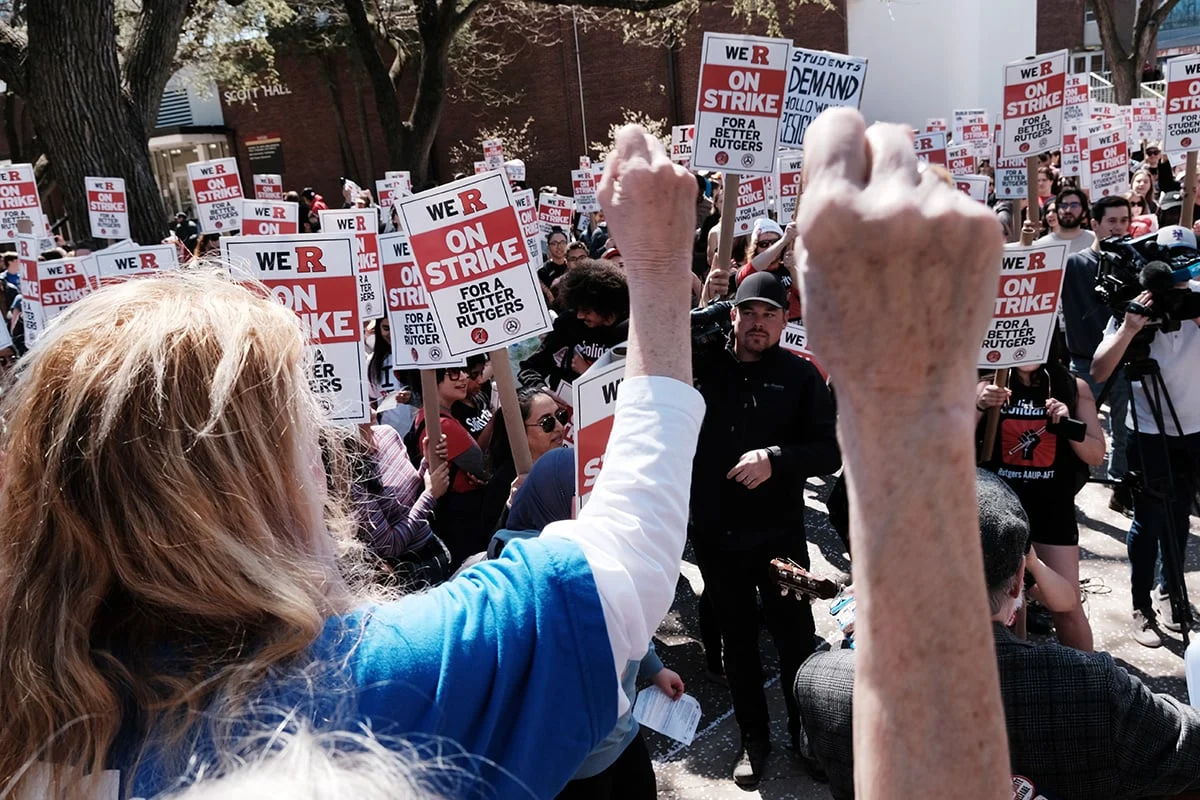
While St. John’s fights to curtail its union, other institutions have faced failures in their attempts to hold labor groups legally liable for strike actions. A significant win for organized labor occurred in late June 2026, when Middlesex County Superior Court Judge Ana C. Viscomi dismissed a 2024 lawsuit against Rutgers University unions.
The lawsuit, brought by former student Jeremy Li, alleged that the unions’ 2023 strike deprived students of a week of education. Judge Viscomi dismissed the case with prejudice, noting that because students received full course credit for the semester, there was no demonstrable legal harm.
"Our students’ learning conditions can only be as good as the working conditions of the faculty and staff who support their education," said Heather Pierce, president of the Rutgers Adjunct Faculty Union, following the ruling. The decision is being viewed by legal experts as a significant precedent, protecting future union-led walkouts from individual student litigation regarding "lost instruction time."

Fiscal Crisis and Retrenchment: PSU and The New School
Beyond the legal maneuvering, a brutal reality of budget-driven retrenchment is reshaping the workforce at institutions like Portland State University (PSU) and The New School.
Portland State University
At PSU, the administration is citing a $35 million deficit as the primary justification for the proposed termination of 52 faculty members, including twelve tenured professors. Despite vocal protests and a rally on June 3, the administration maintains that the cuts are a necessary component of a broader fiscal restructuring. While the Board of Trustees has approved a "preliminary budget," the uncertainty continues to demoralize the campus community. As student Isabelle Amezcua noted, the sense of institutional pride is eroding as faculty—and by extension, the quality of student support—are pushed out.
The New School
In New York, The New School is facing intense backlash for the dismissal of 19 faculty and 68 staff members. The AAUP chapter there has launched a campaign demanding that the administration provide transparency regarding the "criteria for termination" and the financial justification for these cuts. National AAUP president Todd Wolfson has publicly criticized the move, labeling it a "profound betrayal" of the university’s legacy as a sanctuary for critical social thought.
Implications for the Future of Higher Education
The convergence of these events suggests that the "business model" of higher education is entering a period of forced evolution. Several key implications emerge:
- The Erosion of Shared Governance: As universities like St. John’s attempt to bypass unions by citing religious mission, the traditional model of faculty participation in institutional decision-making faces an existential threat.
- Increased Legalization of Labor Relations: Universities are increasingly turning to the judiciary to resolve what were historically solved through collective bargaining. This shifts power away from the faculty and toward university legal counsels.
- The "Precarity Trap": The trend of using budget deficits to justify the mass termination of tenured and unionized faculty signals a shift toward a more gig-based, precarious labor model in higher education.
- A Counter-Movement of Success: Despite the challenges, unions in smaller or more localized environments—such as the Community College of Baltimore County and Clatsop Community College—have successfully secured multi-year contracts, salary increases, and academic freedom protections. This suggests that the struggle for labor rights in higher education is far from a uniform defeat.
As the summer progresses, the outcomes of the St. John’s lawsuit and the finalization of the budget cuts at PSU and The New School will likely set the tone for the 2026-2027 academic year. For many, these battles are not merely about wages or contracts; they are about the fundamental role of the professor in the modern university and whether that role can survive the pressures of financial austerity and administrative overreach.