For over a century, the scientific community has held a quiet, unspoken assumption: that the capacity for "insight"—the ability to solve a brand-new problem without prior trial-and-error training—was the exclusive domain of large-brained, highly intelligent vertebrates. From Wolfgang Köhler’s famous 1920s experiments with chimpanzees stacking boxes to reach bananas, to the sophisticated tool-use observed in crows and dolphins, cognitive flexibility has long been viewed as a luxury of complex nervous systems.
However, a groundbreaking study published on June 4, 2026, in the journal Science has fundamentally dismantled this hierarchy. Researchers from the University of Oulu, the University of Helsinki, and the University of Turku have demonstrated that bumble bees (Bombus terrestris)—creatures with brains the size of a pinhead—possess the cognitive capacity to solve complex, novel challenges through spontaneous, goal-directed behavior.
The "Insect Box-and-Banana" Challenge
The research, led by a multi-institutional Finnish team, centered on a problem-solving task that required the bees to manipulate their environment in a way they had never encountered before.
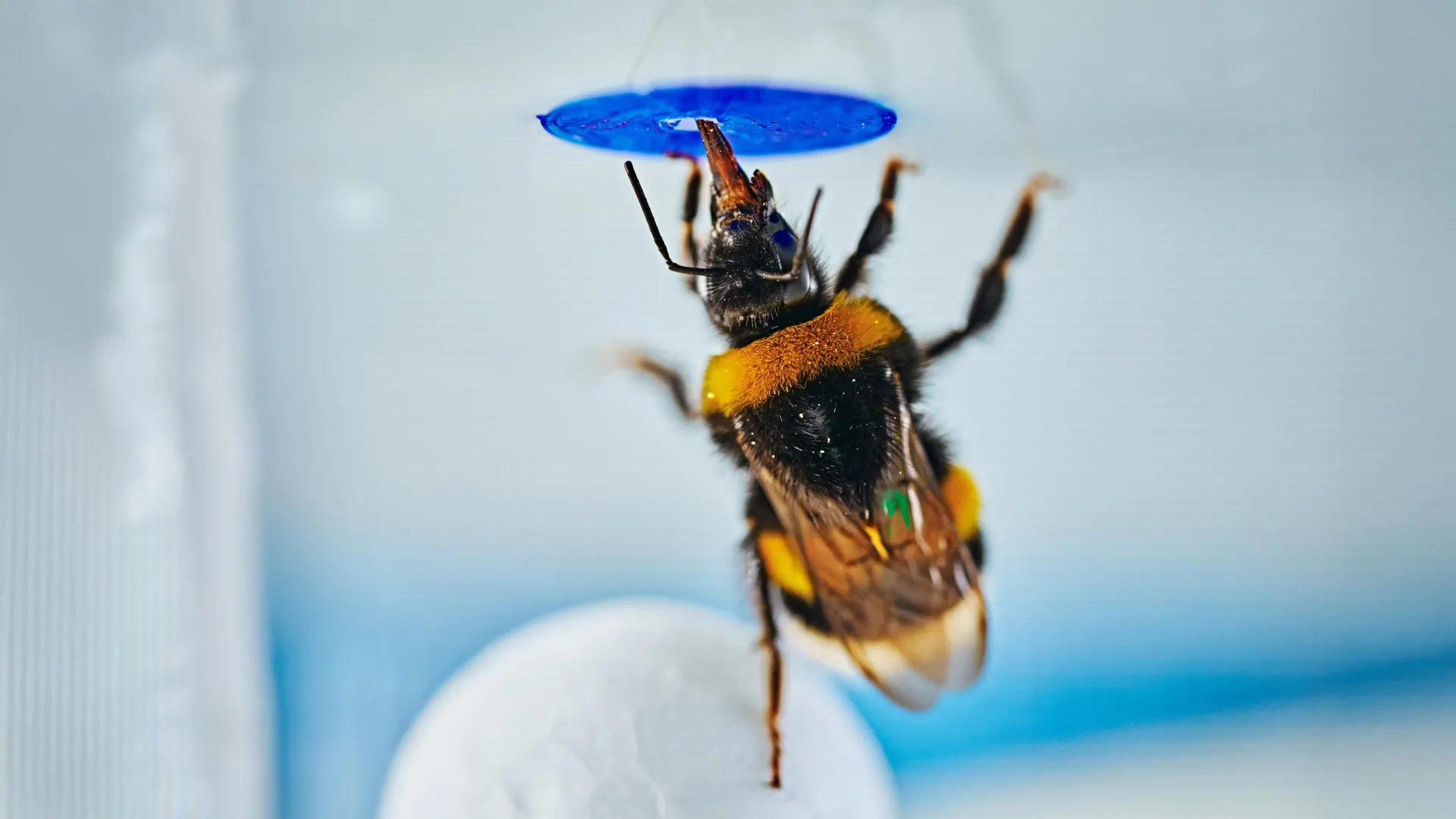
The experimental setup was deceptively simple yet ingeniously designed. Researchers first trained the bees to associate a blue artificial flower with a sugar reward. Once the bees were familiar with the reward, the scientists placed the blue flower on the ceiling of a transparent, enclosed arena. The reward was placed beyond the bees’ natural reach, creating a spatial barrier that required a mechanical solution.
Within the same arena, the researchers placed a small, movable ball. The bees had not been trained to use the ball, nor had they ever seen it interact with the flower. To reach the reward, the bees needed to display a flash of insight: they had to understand that the ball could be repositioned and used as a platform to bridge the distance between the floor and the ceiling-mounted flower.
"This is essentially an insect version of the classic ‘box-and-banana’ problem," explains Dr. Olli Loukola, the study’s senior author and a docent at the University of Oulu. "The animal must realize that an object can be repositioned and then used as a tool to reach an otherwise inaccessible goal. What stands out about the result is that this kind of spontaneous problem-solving is now demonstrated in an insect."
Chronology of the Discovery: A Step-by-Step Breakdown
The study followed a rigorous, multi-phase methodology to ensure that the results were not merely the product of accidental behavior or instinctual foraging patterns.
- Phase 1: Association. The bees were conditioned to understand that blue surfaces contained a nectar-like reward.
- Phase 2: Introduction of the Tool. The bees were exposed to the ball as an object, confirming they understood it was inert and harmless, but without any instruction on how to utilize it for a goal.
- Phase 3: The Novel Challenge. The reward was moved to the ceiling, rendering it unreachable. The bees were then released into the arena to see if they could bridge the gap.
- Phase 4: Observation of Insight. Researchers observed as the bees, initially confused, began to experiment. Successful individuals specifically pushed the ball beneath the flower, climbed onto it, and reached the reward.
- Phase 5: Stringent Controls. To rule out alternative explanations, researchers conducted "blind" tests where the flower was obscured, preventing the bees from relying solely on visual guidance. Even in these conditions, the bees successfully navigated the ball to the location of the hidden reward.
Rigorous Validation: Ruling Out "Luck"
A common criticism in animal intelligence studies is that behaviors may be the result of "trial-and-error" rather than true cognitive insight. To address this, the research team implemented several sophisticated control experiments.
Lead author Akshaye Bhambore noted that the bees were "fully naive" at the start of the experiment. "In many previous studies of insight-like problem-solving, the animals have had extensive experience with objects, test environments, or other problem-solving tasks," Bhambore explains. "Here, the bees had never been trained to use the ball to reach the flower, and they had no previous experience with this kind of solution."
By monitoring the bees’ movement patterns, the team demonstrated that the successful individuals were not moving the ball randomly. Instead, their movements were highly directed and purposeful. When the flower was hidden, the bees did not simply wander; they continued to push the ball toward the specific, albeit invisible, goal location, suggesting they were mentally representing the spatial relationship between the ball and the flower.
"By analyzing the bees’ behavior across unusually stringent control experiments, we could show that they were not simply reacting to visual stimuli or moving the ball randomly," Bhambore added. "Their behavior appeared goal-directed, with successful individuals showing more directed movement patterns."
The Complexity of the Miniature Brain
The implications of this study are profound, particularly regarding the architecture of cognition. For decades, it was theorized that high-level intelligence requires a large, complex brain (the "encephalization quotient"). However, the bumble bee’s brain, which contains roughly one million neurons compared to the billions found in humans, is demonstrating a level of flexibility that challenges the need for massive computational power.
Co-author Ece Nur Akmeşe of the University of Helsinki described the experience of observing the bees as transformative. "One moment the animal is exploring seemingly without direction, and the next it performs a highly efficient sequence of actions leading directly to the solution. Watching the bees solving the task was genuinely fascinating."
The study adds to a growing body of literature suggesting that bees are far more than "robotic" foragers. Previous research has already shown that bees can learn tool-use from peers, solve complex puzzles, and adapt their social cooperation to meet changing environmental pressures.
Official Responses and Scientific Implications
The study has sent shockwaves through the fields of ethology and neurobiology. While the authors are careful to avoid anthropomorphizing the insects—they explicitly state that this does not imply bees have human-like consciousness or complex language—the research nonetheless forces a re-evaluation of what "intelligence" means in the animal kingdom.
"We are not claiming that bees think like humans," Dr. Loukola stated. "But our findings show that miniature brains can generate flexible solutions to novel problems in ways we are only beginning to understand."
The research highlights the concept of "cognitive convergence," where different evolutionary lineages—in this case, insects and vertebrates—arrive at similar problem-solving capabilities independently. This suggests that the biological "hardware" required for basic insight may be more common and more compact than previously hypothesized.
Moving Forward: The Future of Cognitive Research
As the scientific community digests these findings, the focus will likely shift toward how these miniature brains process information to achieve such results. Is there a specific neurological circuit that facilitates this type of planning, or is it an emergent property of the entire neural network?
For the researchers at the University of Oulu, this is only the beginning. The study, titled "Spontaneous problem-solving in bumble bees," serves as a landmark paper that challenges the long-standing "vertebrate bias" in intelligence studies. By including insects in the conversation, the team has opened a new window into the evolution of cognition.
If a creature as small as a bumble bee can display the kind of insight once reserved for chimpanzees, it invites us to reconsider the intellectual potential of countless other species. The "box-and-banana" experiment, once the hallmark of primate brilliance, has become the new benchmark for the surprising, flexible, and deeply complex world of the insect mind. As we continue to probe the limits of animal intelligence, one thing is clear: we must stop underestimating the inhabitants of our gardens. The tiny brain, it seems, is far more capable than we ever dared to imagine.