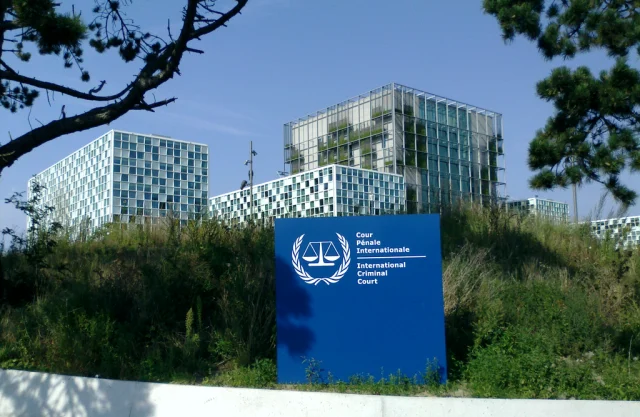
In a legal escalation that pits the foundational principles of international justice against the executive authority of the United States, three sitting judges of the International Criminal Court (ICC) have filed a federal lawsuit against President Donald Trump. The suit, initiated by Judges Kimberly Prost (Canada), Solomy Bossa (Uganda), and Reine Alapini-Gansou (Benin), challenges the constitutionality of a February 2025 executive order that imposed sweeping sanctions on court officials. This litigation represents a significant shift in the battle over global accountability, marking the first time that members of the ICC judiciary have directly challenged the US government in a domestic court.
The Core Conflict: Executive Reach vs. Judicial Immunity
The lawsuit, filed in the US District Court for the Southern District of New York, serves as a direct rebuttal to the administration’s characterization of the ICC as a rogue entity. The plaintiffs argue that President Trump’s executive order—which declared a national emergency to justify punitive measures—exceeds his statutory authority under the International Emergency Economic Powers Act (IEEPA) and the National Emergencies Act.
At the heart of the judges’ complaint is the assertion that the executive order is not merely a policy disagreement but a violation of the US Constitution. The plaintiffs contend that the sanctions, which include travel bans, asset freezes, and the termination of access to essential financial and technological services, violate the Fifth Amendment’s guarantee of due process. By targeting individuals for their judicial decisions, the judges argue the administration is engaging in an arbitrary and capricious exercise of power that undermines the rule of law.
A Chronology of Escalation: From Afghanistan to Netanyahu
To understand the current impasse, one must look at the historical friction between Washington and the Hague.
- 2002: The Rome Statute establishes the ICC. The United States, under the George W. Bush administration, formally signals it will not join the court, citing concerns over the potential prosecution of US service members.
- 2020–2021: The ICC prosecutor launches an investigation into alleged war crimes in Afghanistan, including those potentially committed by US personnel. This triggers the first major wave of friction, leading the Trump administration to issue initial executive orders targeting court staff.
- 2024: The ICC prosecutor seeks and subsequently receives an arrest warrant for Israeli Prime Minister Benjamin Netanyahu regarding actions in Gaza. This move reignites the ire of the US executive branch.
- February 2025: President Trump issues the current executive order, declaring a "national emergency." The order explicitly sanctions any ICC official involved in the investigations of US troops in Afghanistan or the issuance of warrants for Israeli leadership.
- Mid-2025: The sanctions take a severe toll on court operations. Judges find their personal bank accounts frozen and their ability to travel to international forums restricted.
- Present Day: Judges Prost, Bossa, and Alapini-Gansou file their suit, marking the sixth legal challenge to the administration’s order but the first brought by the bench itself.
Supporting Data and the Mechanics of the Sanctions
The sanctions imposed by the Trump administration are not symbolic; they are designed to functionally paralyze the ability of these jurists to perform their duties. The impact on the three plaintiffs is profound:
- Financial Exclusion: The Treasury Department’s Office of Foreign Assets Control (OFAC) has effectively barred these judges from the US financial system. This prevents them from utilizing international banking infrastructure, complicating their ability to manage personal affairs and professional travel expenses.
- Digital Isolation: The restriction on tech platforms has hampered the judges’ ability to participate in virtual international conferences or access secure cloud-based systems used for case management, creating a digital "chilling effect" on judicial deliberation.
- Travel Restrictions: By placing the judges on the Specially Designated Nationals (SDN) list, the US has effectively rendered them personae non gratae, preventing them from visiting the US for legal conferences, UN meetings, or personal travel.
Legal scholars analyzing the complaint point out that the administration’s reliance on the "national emergency" justification is particularly thin. Under the IEEPA, such emergencies are typically reserved for threats to the US economy or national security posed by foreign adversaries or terrorist organizations. The plaintiffs argue that judicial conduct in an international court does not constitute an "unusual and extraordinary threat" to the United States.
Official Responses and Political Rhetoric
The Trump administration has maintained a defiant posture. In statements released alongside the February 2025 executive order, the White House characterized the ICC’s actions as an "infringement on US sovereignty." President Trump has repeatedly labeled the ICC as a "maligned" institution that ignores the fact that neither the United States nor Israel are signatories to the Rome Statute.
"We do not recognize the jurisdiction of a court that lacks the consent of the governed," a White House spokesperson stated. "The President has a duty to protect American citizens and our allies from the overreach of unelected bureaucrats in the Hague who seek to undermine our national security interests."
Conversely, the international legal community has mobilized in defense of the judges. James A. Goldston, Executive Director of the Open Society Justice Initiative, issued a blistering critique of the administration’s stance: "Targeting international judges for carrying out their judicial duties is an unprecedented attack on judicial independence and the rule of law. If the United States, a nation that has historically championed global human rights, abandons these principles to shield political allies, it sets a dangerous precedent for authoritarian regimes worldwide."
Human rights organizations, including Amnesty International and Human Rights Watch, have filed multiple amicus briefs in support of the judges, arguing that the sanctions are a clear attempt to intimidate the judiciary and force the abandonment of legitimate investigations into war crimes.
The Implications: A Crisis for International Law
The implications of this lawsuit extend far beyond the personal grievances of the three judges. The case forces a confrontation between domestic administrative law and the long-term viability of the international justice system.
1. The Erosion of Judicial Independence
If an executive branch is permitted to sanction judges for the content of their rulings, the very concept of judicial independence—a pillar of modern democracy—is at risk. Legal experts warn that if the US succeeds in this campaign, other nations could adopt similar tactics, using economic sanctions to "punish" judges who rule against their interests.
2. The Future of the Rome Statute
The US stance creates a bifurcated legal world. By declaring the ICC’s actions to be a "national emergency," the administration is essentially attempting to carve out an exemption from international law. This threatens to delegitimize the Rome Statute in the eyes of emerging nations, who may view the court as ineffective if it cannot protect its own personnel from the reach of a superpower.
3. Domestic Legal Precedent
The US District Court for the Southern District of New York faces a delicate task. It must determine whether the President’s power to declare a national emergency is reviewable by the judiciary when that power is allegedly used to target individual judges for exercising their professional mandates. A ruling in favor of the ICC judges would be a significant check on executive power, while a ruling in favor of the administration could permanently alter the interpretation of the Administrative Procedure Act.
Conclusion
The suit filed by Judges Prost, Bossa, and Alapini-Gansou is more than a legal filing; it is a desperate appeal to the integrity of the American legal system. By seeking a judicial remedy, the plaintiffs are effectively asking the US courts to decide whether the executive branch’s political agendas can override the basic protections afforded to international legal actors. As the case proceeds, the eyes of the global community will remain fixed on New York, where the fate of the international rule of law may be decided in the chambers of a domestic court.
The standoff continues to isolate the US from its traditional allies in the international legal arena, raising the question of whether the cost of maintaining these sanctions—in terms of diplomatic credibility and legal integrity—is ultimately worth the political victory the administration seeks. Regardless of the outcome, the lawsuit has successfully elevated the conflict from a geopolitical spat to a defining constitutional crisis of the 21st century.