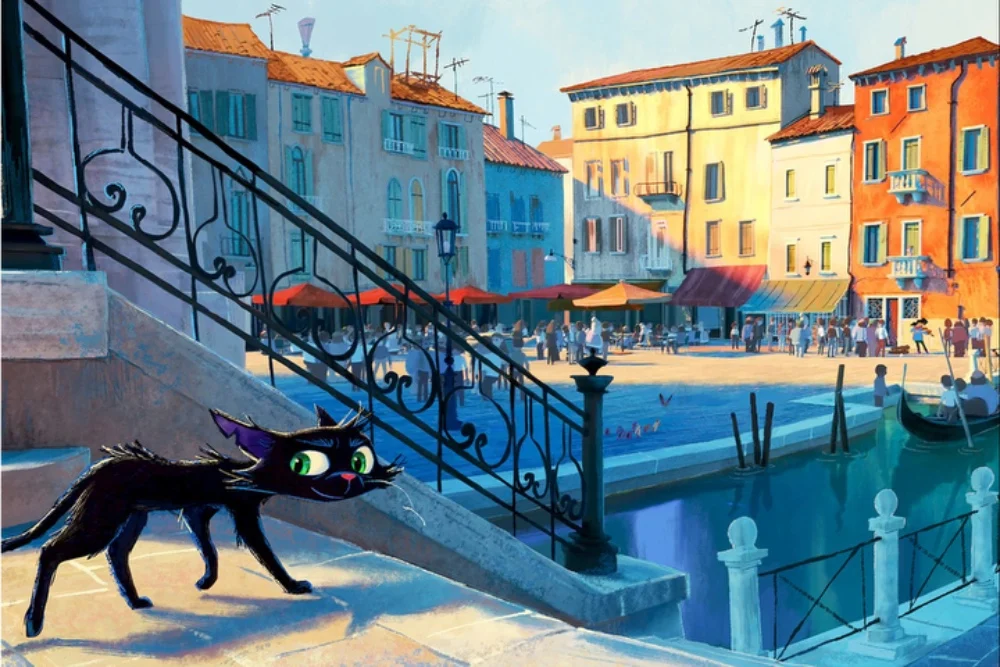
The animation world turned its collective gaze toward the prestigious Annecy International Animation Film Festival this week, as Pixar Animation Studios took the stage to pull back the curtain on its latest slate of projects. Among the revelations were two distinct shorts that highlight the studio’s ongoing commitment to emotional storytelling, experimental aesthetics, and character-driven narratives: the whimsical, aquatic "Loving Dory" and the gritty, painterly Venetian noir "Gatto."
As Pixar continues to evolve its visual language, these projects serve as a testament to the studio’s dual focus: honoring its most iconic intellectual properties while simultaneously pushing the boundaries of what computer-generated imagery can achieve.
The Return of an Icon: "Loving Dory"
The announcement that Nemo and Dory would be returning to the screen in a new theatrical short, "Loving Dory," sent ripples of excitement through the Annecy audience. While the 2016 feature Finding Dory explored the blue tang’s past and family history, "Loving Dory" aims to shift the tone toward something lighter, stranger, and arguably more eccentric.
Director Lou Hamou-Lhadj noted that the short represents a new chapter for the character, one defined by autonomy and humor. "It’s a new chapter in Dory’s story, because she allows us to have fun," Hamou-Lhadj remarked during the presentation. In a departure from the high-stakes ocean exploration of previous films, this narrative centers on a peculiar, surreal romantic entanglement: Dory falls in love with a piece of discarded plastic.
This choice of subject matter is being viewed by industry analysts as a clever meta-commentary on environmentalism and the nature of perception. By placing a beloved character in a situation that is inherently absurd—and potentially poignant—Pixar is signaling a return to the "short-form" storytelling roots that allow the studio to experiment with tone in ways that feature-length films sometimes cannot.
"Gatto": A Painterly Descent into Venetian Noir
While "Loving Dory" provided a familiar anchor, the true star of the presentation was the reveal of "Gatto." Directed by Enrico Casarosa—the visionary behind the acclaimed film Luca—this project marks a significant stylistic departure for Pixar.
Set against the evocative, labyrinthine backdrop of Venice, Gatto tells the story of Nero, a stray black cat navigating the dangers of a city teeming with feline hierarchies and human superstitions. Casarosa, whose affinity for Italian culture has become a hallmark of his work, spoke passionately about the aesthetic evolution of this project.
The Artistic Vision: Walking into a Painting
"We are back in Italy," Casarosa told the crowd, presenting the first finished sequences. "Venice is our setting. We have a new, very immersive, painterly look. We like the idea of walking into a painting. Imagine walking into a Van Gogh painting."
This artistic direction represents a departure from the "hyper-realistic" trend that has dominated animation for the last decade. Instead, the team at Pixar is prioritizing texture and brushstroke-like rendering to create what they call a "heightened version of Venice." By leaning into an impressionistic style, the studio is attempting to capture the emotional essence of the city rather than merely its architectural dimensions.
Chronology of a Heist: The Plot of "Gatto"
The narrative structure of Gatto is framed as a classic crime caper, filtered through the lens of animal behavior. Nero, already an outcast due to his coat color and his inability to swim, finds himself under the thumb of Rocco, a formidable cat mob boss who rules the city’s feline underbelly.
- The Inciting Incident: Nero, struggling to survive on his own in the alleyways of Venice, is coerced into service by Rocco.
- The Conflict: Rocco, a connoisseur of "cat art," forces Nero to act as his primary thief. The stakes escalate when Nero realizes he wants out of the criminal life.
- The Final Task: Rocco agrees to grant Nero his freedom, but only on one condition: he must steal a specific, valuable violin.
- The Complication: While attempting the heist, Nero encounters Maya, a talented street musician. He also meets Saverio, a pigeon who claims to be a passionate advocate for the "union of pigeon rights."
- The Climax: As Nero and Maya grow closer, their bond threatens the success of the mission, forcing Nero to choose between his loyalty to a crime boss and a genuine connection with a human.
Supporting Data and Production Details
The production of Gatto is as ambitious as its plot. The film features a star-studded voice cast, including Mark Ruffalo and Laurence Fishburne, bringing a gravitas to the feline characters that elevates the material from a simple animal story to a complex character drama. In a delightful twist, director Enrico Casarosa himself provides the voice for Saverio, the eccentric, union-obsessed pigeon.
The technical team emphasized that "Gatto" required an entirely new workflow to achieve its "handcrafted" aesthetic. By prioritizing "emotional immersiveness" over raw photorealism, the studio has utilized advanced lighting shaders that mimic the way light interacts with oil paint on canvas. This ensures that even in the dark, dangerous corners of the Venetian underworld, the frame remains vibrant and alive.
Official Responses and Creative Philosophy
The reception at Annecy highlights a significant shift in how Pixar is positioning its short-film department. Rather than serving as mere "trailers" or supplemental material for feature films, these shorts are increasingly being treated as autonomous laboratories for new talent and new technologies.
"We created an expressive Venice, both in an emotional way and immersive," the team stated during the Q&A session. "It’s very textured. We look for that handcrafted feel."
For Casarosa, the choice to focus on cats was born out of personal observation. "In Venice, there used to be tons of cats around the streets. They seemed to rule the place. We loved the idea of showing the secret life of cats of Venice." By grounding the fantasy in the historical reality of the city’s feline population, the film achieves a grounded, authentic tone that distinguishes it from other anthropomorphic animal features.
Implications: The Future of Pixar’s Visual Language
The unveiling of these projects has broader implications for the animation industry. Firstly, it confirms that Pixar is not content to rest on the laurels of its established franchises. By pairing the return of Dory with the experimental, moody atmosphere of Gatto, the studio is demonstrating a balanced portfolio.
Secondly, the emphasis on "painterly" looks suggests that we may be seeing the end of the "glossy CGI" era. If Gatto proves successful, it could pave the way for a more diverse range of artistic styles in major studio productions. The industry is currently witnessing a renaissance in stylized animation—pioneered by films like Spider-Man: Into the Spider-Verse and Puss in Boots: The Last Wish—and Pixar’s move to embrace this in Gatto signals that the studio is ready to compete on the front of visual innovation once again.
Furthermore, the narrative risks being taken in Gatto—specifically the "crime noir" genre—are notable. By exploring themes of redemption, class struggle (the "underbelly" of the cat world), and the moral conflict between duty and personal desire, Pixar is aiming at a more sophisticated, perhaps older, audience.
Conclusion
As the Annecy festival concludes, the buzz surrounding "Loving Dory" and "Gatto" serves as a reminder that animation remains one of the most versatile mediums for storytelling. Whether through the surreal, lighthearted lens of Dory’s aquatic romance or the moody, artistic streets of Venice in Gatto, Pixar continues to seek out new ways to challenge its animators and captivate its global audience.
With the technical prowess of the studio meeting the creative ambition of directors like Lou Hamou-Lhadj and Enrico Casarosa, the upcoming releases promise to be a highlight of the next few years in cinema. For fans, the message is clear: the studio is evolving, the canvases are getting larger, and the stories are becoming more intimate than ever before.