

By Editorial Staff, Spotlight
Published: June 23, 2026
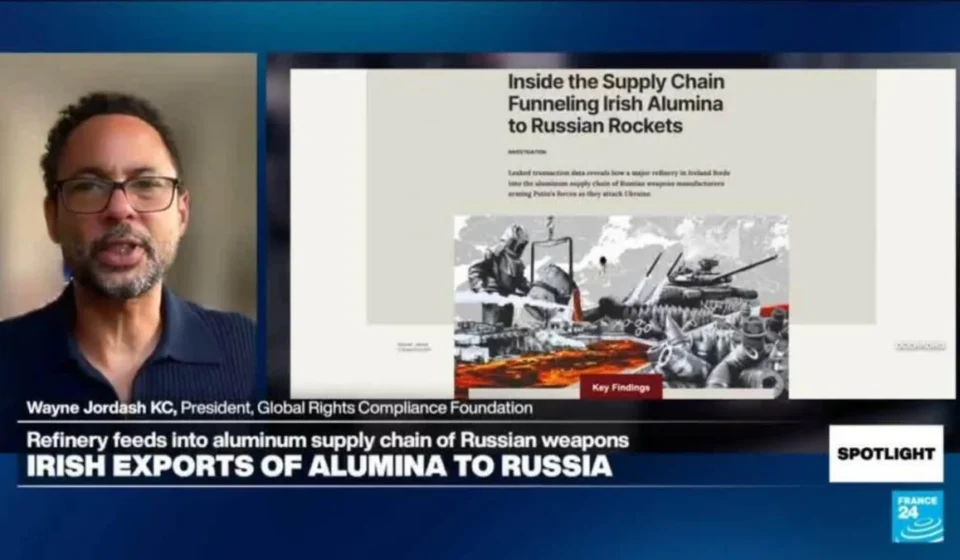
In an era where economic warfare has become as decisive as battlefield maneuvers, the European Union finds itself ensnared in a troubling paradox. While Brussels has implemented successive rounds of sweeping sanctions intended to cripple the Russian military-industrial complex, critics argue that a glaring oversight in the regulation of strategic raw materials—specifically alumina—is undermining these efforts. A recent investigation, highlighted on France 24’s Spotlight, suggests that an Irish-based company has been instrumental in supplying the essential component for aluminum production to Russia, raising profound questions about corporate complicity, legal accountability, and the effectiveness of Western sanctions.
The Core Contradiction: Sanctions vs. Reality
The conflict centers on the export of alumina, a refined mineral powder that serves as the critical precursor to aluminum—a metal vital for the construction of aircraft, armored vehicles, and missiles. While the EU has moved to ban a vast array of high-tech goods, luxury items, and energy products, the continued flow of raw industrial materials like alumina through European channels has created what experts call a "deadly contradiction."
Wayne Jordash, President of the Global Rights Compliance Foundation, posits that European authorities are trapped in a cycle of regulatory failure. By focusing heavily on the end-user status of Russian military entities, the EU has neglected the "upstream" reality: if the raw materials required to produce the aluminum for a Russian fighter jet originate or pass through European supply chains, the sanctions lose their intended bite.
"The issue is not merely one of formal compliance with existing laws," Jordash explained during his appearance on Spotlight. "It is a matter of functional dependence. When European companies continue to facilitate the movement of these materials into the Russian market, they are essentially providing the building blocks for the Russian war machine, regardless of the fine print in their shipping manifests."
A Chronology of Oversight and Evasion
The timeline of this issue reveals a pattern of shifting corporate structures and regulatory loopholes that have allowed trade to persist despite the geopolitical firestorm in Ukraine.
- Early 2022: Following the full-scale invasion of Ukraine, the EU introduces the first wave of sanctions targeting Russian oligarchs and specific industrial sectors.
- Late 2022 – 2023: As sanctions tighten, various logistics and commodity trading firms begin to reorganize their operations to ensure "compliance." Critics allege that during this period, several entities utilized Irish holding structures to maintain trade links with Russian aluminum giant Rusal, formerly associated with Oleg Deripaska.
- 2024: Investigative reports begin to surface regarding the volume of alumina exports originating from European ports, destined for Russian refineries.
- Mid-2025: Increased scrutiny from international NGOs highlights the "gray zone" of commodity trading. Calls for a total ban on industrial raw materials increase.
- June 2026: The current crisis peaks as revelations emerge that an Irish-based firm may have been systematically supplying alumina to Russian interests, providing the raw material for production lines that directly support the Russian Ministry of Defence.
The "Oligarch Factor" and Economic Influence
A major point of contention in this controversy is the role of Russian oligarch Oleg Deripaska. While European regulators often look for direct ownership stakes to trigger sanctions, Jordash argues that this is a "technocratic trap."

Even if an entity can prove it is not formally owned by a sanctioned individual, the scale of its commercial ties to the Russian economy often creates a "de facto influence." When an Irish company acts as a vital link for a Russian-linked aluminum conglomerate, it creates a dependency that effectively ties the company’s success to the stability of the Russian industrial sector.
"We need to stop looking at ownership papers and start looking at the flow of value," Jordash contends. "When your primary business model is predicated on moving thousands of tons of material into a country that is currently committing war crimes, the question of whether an oligarch owns 51% or 0% of the firm is secondary to the fact that you are providing the fuel for that war."
Supporting Data: The Strategic Value of Alumina
To understand why this is a high-stakes issue, one must look at the industrial math. Aluminum is one of the most strategic resources in modern warfare. It is the backbone of aerospace engineering; it is found in the fuselage of Su-35 fighter jets, the chassis of infantry fighting vehicles, and the guidance systems of cruise missiles.
Russia, while rich in mineral resources, requires high-grade alumina to process into aluminum at scale. By sourcing this from international markets—including via companies that leverage European trade networks—the Russian military-industrial complex circumvents the supply chain bottlenecks that sanctions were designed to create. Data suggests that the volume of trade has remained remarkably resilient despite the geopolitical shift, suggesting that the "sanctions wall" has significant gaps that allow for the continued replenishment of Russian stocks.
Official Responses and the Defensive Posture
The response from the entities involved has been, as expected, rooted in legalistic defense. Many firms maintain that their activities are "fully compliant with current EU regulations." They argue that if the European Commission has not explicitly banned the export of alumina, then their actions remain legal and within the bounds of international trade norms.
However, this defense is precisely what triggers the outrage of international law experts. The argument is that "legality" under current, potentially flawed, sanctions regimes is not a moral or ethical defense.
The European Commission has been under immense pressure to tighten the "dual-use" goods list. A spokesperson for the Commission recently noted that the EU is "continuously reviewing" its sanctions lists to address circumvention. However, critics argue that the pace of bureaucratic adjustment is nowhere near the speed of the conflict on the ground. By the time a specific raw material is added to a prohibited list, the damage—in the form of thousands of tons of material already delivered—has been done.

The Broader Implications: Redefining Corporate Responsibility
The implications of this situation extend far beyond the immediate case of an Irish company and the Russian war effort. It signals a fundamental shift in how we must view corporate accountability in the 21st century.
1. From "Direct Link" to "Foreseeable Risk"
Jordash’s argument suggests that the legal standard for corporate complicity needs to evolve. Currently, authorities often require proof of a "direct link" between a specific shipment and a specific weapon system. This is an impossibly high bar in a globalized economy. The new standard, he suggests, should be "foreseeable risk." If a company is shipping vast quantities of strategic raw materials to a country currently engaged in an illegal war, it is "foreseeable" that those materials will assist in that war effort.
2. Supply Chain Transparency
The case highlights the dangerous opacity of modern supply chains. Through the use of shell companies, holding firms, and complex logistics networks, it is becoming increasingly difficult for the public—and even for regulators—to track who is ultimately profiting from the war.
3. The Duty of Due Diligence
Corporate boards can no longer hide behind the excuse that they are merely "logistics providers." The ethical responsibility to perform rigorous due diligence on the end-use of their commodities is now a matter of international security. Failing to do so should, in the eyes of many legal scholars, open these companies up to liability for aiding and abetting international crimes.
Conclusion: A Turning Point for Sanctions Policy
As the war in Ukraine drags on, the international community is forced to confront the uncomfortable reality that some European commercial activities are inadvertently sustaining the very adversary they seek to defeat. The case of the alumina exports is a wake-up call. It demands a more robust, proactive approach to sanctions that looks beyond the surface of legal compliance and addresses the underlying realities of war-time economics.
Unless the EU and other Western powers move to close the loopholes surrounding strategic raw materials, they risk becoming passive participants in the conflict. The moral and strategic imperative is clear: trade cannot be decoupled from the human cost of the war it supports. Moving forward, the standard for European businesses must be not just "is this legal?" but "is this facilitating the destruction of a sovereign nation?"
The "deadly contradiction" identified by Wayne Jordash is a test of the West’s resolve. Passing that test will require more than just rhetoric; it will require the courage to disrupt global trade flows in favor of the foundational principles of international law and human security.