In a move that signals a seismic shift in how enterprises interact with generative AI, Anthropic has unveiled "Claude Tag," a sophisticated new feature currently entering research preview. Designed to act as an "always-on" AI teammate within Slack, Claude Tag moves beyond the transient nature of traditional chatbots. It offers a persistent, memory-backed intelligence layer that lives directly within workplace communication channels, effectively bridging the gap between static software tools and collaborative human workflows.
Available initially for Claude Enterprise and Claude Team customers, this development marks a significant evolution in Anthropic’s product roadmap, transforming its AI from a reactive assistant into an active participant in organizational life.
The Evolution of the AI Teammate: From DM to Dynamic Participant
The introduction of Claude Tag is not an isolated experiment but the culmination of a deliberate strategy to integrate AI into the fabric of daily work. For months, users have been able to interact with Claude through direct messages or by tagging the bot in specific Slack channels for on-demand assistance. More recently, the rollout of "Claude Code" in Slack enabled the AI to handle complex engineering tasks, routing coding prompts to full web-based sessions and posting updates back into the thread.
However, these previous iterations were largely transactional. Each interaction acted as a fresh start, often requiring users to re-contextualize the AI before it could provide meaningful output. Claude Tag changes this dynamic entirely by introducing a layer of persistent memory and contextual awareness.
According to internal statements from Anthropic, as Claude "follows along" within a channel, it continuously accrues knowledge about the specific projects, stakeholders, and nuances of the team’s work. Furthermore, if granted the appropriate permissions, Claude can cross-reference data from other channels within the organization, allowing it to synthesize information that would otherwise remain siloed.
How Claude Tag Operates: A Collaborative Framework
At the core of Claude Tag is the concept of a shared identity. Unlike individual user-based AI sessions, a Claude Tag identity is channel-specific. This means that every team member in a Slack channel is engaging with the same "version" of the AI.
Persistent Context and Memory
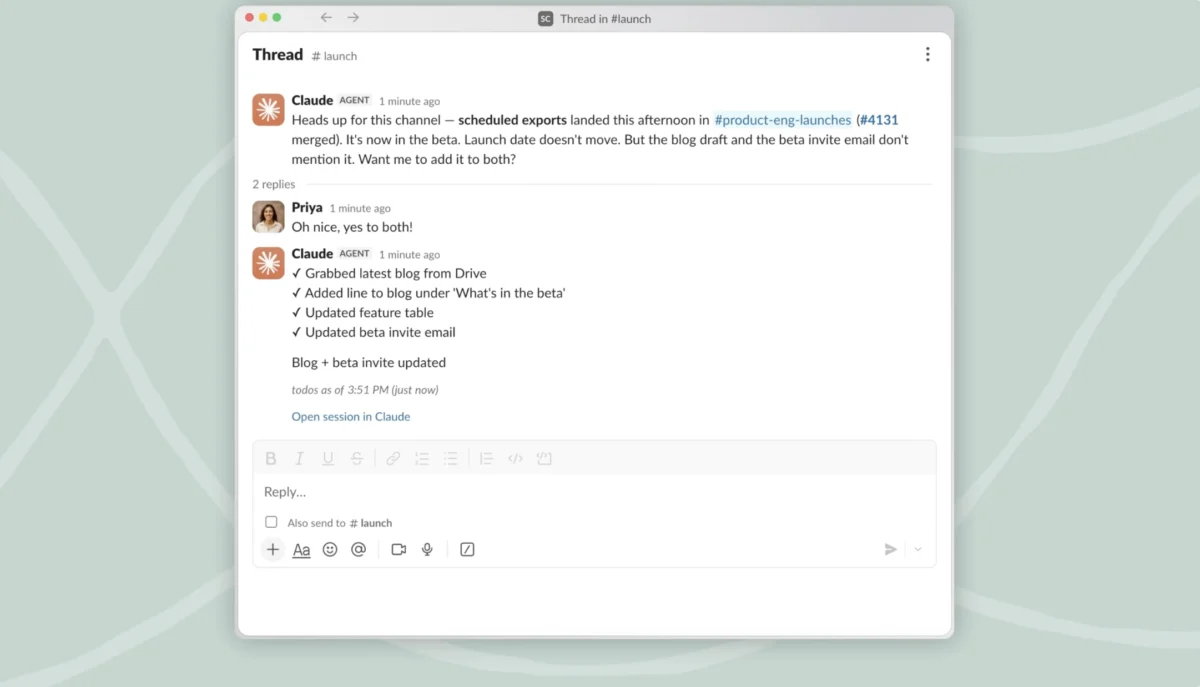
When a team member enters a channel, they can see exactly what Claude has been working on, allowing them to pick up a project mid-stream without repeating instructions or re-uploading documents. This "ambient" state means the AI is no longer waiting for a prompt; it is actively observing the flow of work.
Administrative Scoping and Security
Security remains a primary concern for enterprise deployment. Anthropic has implemented a robust administrative control layer. System administrators have full authority to define which tools, data repositories, and channels the AI can access. This ensures strict logical boundaries: a Claude identity configured to support a legal team will never accidentally "leak" information or attempt to access data from an engineering channel. By compartmentalizing these identities, Anthropic is addressing the "hallucination" and data-privacy risks that have historically hampered enterprise-wide AI adoption.
Task Management and Proactive Engagement
Claude Tag does not just sit in the background; it acts as a project manager. When assigned a task, the AI decomposes the objective into granular stages. It then executes these steps using its authorized tools and posts the results back into the thread.
Perhaps most intriguingly, the feature includes an "ambient mode." In this state, Claude can proactively interject in a conversation to:
- Flag potential blockers based on organizational data.
- Provide updates on long-running tasks.
- Follow up on forgotten threads or abandoned action items.
By producing work in a public channel, Claude creates a transparent audit trail, effectively functioning as a digital colleague that contributes to the collective intelligence of the team.
The Broader Landscape: The Enterprise AI Land Grab
Anthropic’s push into persistent, context-aware agents arrives at a pivotal moment in the tech industry. As the initial excitement around "chatbots" wanes, the focus has shifted toward "agentic workflows"—the ability for AI to perform multi-step tasks across disparate applications.
The Competition for Context
Anthropic is by no means operating in a vacuum. The race to become the "intelligence layer" of the enterprise is arguably the most lucrative theater in the current AI war.
- Microsoft: Through its "Graph" technology—expressed via Copilot and Work IQ—Microsoft is leveraging its massive footprint in the Office 365 ecosystem. By understanding the relationships between documents, emails, and calendar events, Microsoft aims to make Copilot the definitive interface for corporate data.
- Data Infrastructure Giants: Companies like Snowflake and Databricks are pivoting their value proposition. No longer just storage or analytics platforms, they are positioning themselves as the "tacit knowledge" reservoirs that AI agents must query to produce accurate, company-specific outputs.
- The Intelligence Layer: Startups like Glean are building sophisticated middleware that sits between the AI model and the underlying enterprise data. Glean’s approach emphasizes search-and-retrieval accuracy, ensuring that when an agent acts, it does so with the most current information available in the company’s internal ecosystem.
Anthropic’s strategy, by contrast, is to focus on the interface. By embedding directly into Slack, they are betting that the future of work is not a dedicated AI app, but rather an AI presence within the tools that employees already use for 90% of their daily communication.
Implications for the Future of Work
The shift toward persistent AI teammates like Claude Tag brings with it significant implications for organizational culture and operational efficiency.
Enhanced Transparency and Collaboration
When AI is integrated into a public Slack channel, the entire team gains visibility into the AI’s decision-making process. This prevents the "black box" problem where one employee uses an AI to generate a report, but the rest of the team cannot understand how that conclusion was reached. By working in public view, Claude becomes an accountable member of the team.
Shifting Roles for Knowledge Workers
If an AI can "remember" project history, flag blockers, and handle cross-channel research, the role of the human employee naturally shifts. "Middle management" tasks—tracking project status, reminding teammates of deadlines, and synthesizing updates—are increasingly being automated. This allows human workers to pivot toward higher-order strategy, creative problem-solving, and emotional intelligence-driven leadership.
The Risk of "Context Overload"
However, there are potential pitfalls. As AI agents become more proactive and "ambient," there is a risk of notification fatigue. If an AI is constantly chiming in with updates, suggestions, and reminders, it could disrupt human-to-human communication. Anthropic will need to balance the AI’s "proactiveness" with the necessity of a calm, focused working environment.
Conclusion: The Path Forward
The research preview of Claude Tag represents a critical milestone in the maturation of generative AI. By solving the problem of context-loss, Anthropic is moving the needle from "AI as a tool" to "AI as a teammate."
As this technology scales, the success of Claude Tag will likely depend on how well it navigates the friction between helpfulness and intrusion. For now, the enterprise market is watching closely. If Anthropic can prove that a persistent AI can handle complex, sensitive workflows while remaining securely scoped and genuinely helpful, it may well define the standard for the next decade of digital collaboration.
As businesses continue to grapple with the complexities of managing hybrid workforces and vast amounts of internal data, the promise of a "digital colleague" that never forgets a task and always knows the context of a project is a compelling—and potentially revolutionary—value proposition. Whether Claude Tag becomes the definitive solution for this challenge remains to be seen, but the trajectory of the industry is clear: the AI of the future is not a destination you visit; it is a presence that joins you at your desk.