
Echoes from the Pleistocene: A Million-Year-Old Fossil Cache Rewrites New Zealand’s Ecological History

Deep within the subterranean labyrinth of a cave system near Waitomo, on New Zealand’s North Island, scientists have unearthed a geological "time capsule" that is fundamentally altering our understanding of the country’s prehistoric evolution. A collaborative team of paleontologists and volcanologists from Australia and New Zealand has discovered a treasure trove of vertebrate fossils dating back approximately one million years. This unprecedented find provides a vivid, high-definition snapshot of a lost ecosystem, challenging long-held assumptions that New Zealand’s biodiversity remained static until the arrival of humans less than a millennium ago.
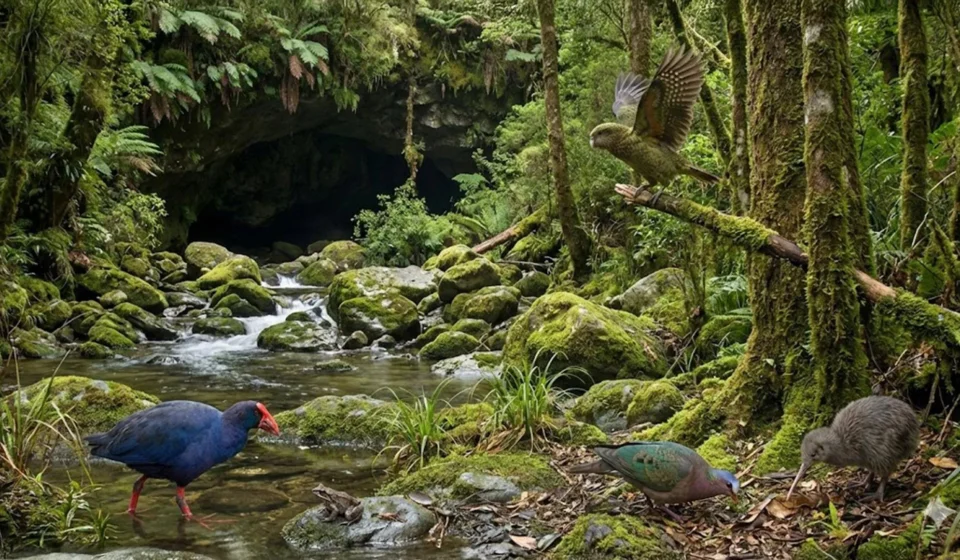
The discovery, recently detailed in the journal Alcheringa: An Australasian Journal of Palaeontology, features the remains of 12 bird species and four frog species, many of which are ancestral to the wildlife iconic to Aotearoa today. By filling a critical "missing volume" in the nation’s fossil record, researchers are now mapping a dynamic history defined not by human interference, but by the raw, cataclysmic power of the Earth itself.
The Discovery: A Rare Glimpse into the Pleistocene
For decades, the study of New Zealand’s ancient wildlife has been hampered by significant gaps in the fossil record. While sites like St Bathans in Central Otago have provided researchers with a glimpse of life between 20 and 16 million years ago, the subsequent 15-million-year stretch remained an enigma—a vast, dark void in the natural history of the islands.
"This wasn’t just a missing chapter; it was a missing volume," explains Dr. Paul Scofield, Senior Curator of Natural History at the Canterbury Museum and a co-author of the study. The Waitomo discovery acts as a bridge, connecting the deep past to the modern era. The cave, which holds the distinction of being the oldest known cave on the North Island, served as a natural trap and repository for bones, preserving them beneath layers of volcanic ash that acted as a temporal bookmark.
The collection of vertebrate remains recovered is the first of its kind for this specific period in New Zealand’s history. It documents an avifauna—a community of bird species—that was vastly different from the one that greeted the first Polynesian settlers. According to the research team, between 33% and 50% of the species present in this cave ecosystem vanished during the million-year interval between the formation of these fossil layers and the arrival of humans.
Chronology: The Geological "Sandwich"
The ability to date these fossils with such precision is perhaps the most significant aspect of the find. The specimens were found encased between two distinct layers of volcanic ash, or tephra. The lower layer originated from a cataclysmic eruption approximately 1.55 million years ago, while the upper layer was deposited by a massive volcanic event roughly 1 million years ago.
This "geological sandwich" provides a reliable chronological frame, allowing scientists to confirm exactly when these creatures roamed the forests of the North Island. The younger ash layer, in particular, was so voluminous that it likely smothered much of the island in meters of volcanic debris. While wind, water, and erosion have since scrubbed most of this evidence from the landscape, the sheltered environment of the Waitomo cave acted as a vault, protecting the skeletal remains of birds and amphibians that were otherwise erased from the surface world.
The Ancestry of Icons: Enter Strigops insulaborealis
Among the most sensational findings is the identification of a previously unknown parrot species, Strigops insulaborealis. This bird is an ancient relative of the kākāpō, one of the most charismatic and endangered birds in the world today.
The modern kākāpō is a unique evolutionary marvel: it is the world’s only flightless parrot, a heavy, nocturnal bird that relies on its powerful, muscular legs to navigate the forest floor. However, the bones of its ancestor, Strigops insulaborealis, tell a different story. Analysis reveals that this ancient relative possessed significantly weaker leg structures compared to its modern-day successor.
"This suggests that the ancestral bird may not have been the terrestrial climber we see today," says Associate Professor Trevor Worthy of Flinders University, the lead author of the study. "It raises the compelling possibility that this species retained the ability to fly, marking a significant divergence in the evolutionary trajectory of the lineage." While further skeletal analysis is required to confirm the flight capabilities of S. insulaborealis, the discovery underscores the fluid nature of evolution in the face of shifting environmental pressures.
Beyond the parrot, the cave also yielded the remains of an extinct ancestor of the takahē—a large, flightless swamphen—and a previously unknown species of pigeon, closely related to the bronzewing pigeons of Australia. These findings indicate that the North Island’s forests were once a laboratory of experimentation, where species arrived, adapted, and were periodically wiped out by the island’s volatile geological nature.
Environmental Drivers: Volcanoes and Climate Change
The research team is clear: the extinctions observed in the fossil record were not the result of human impact, but the consequence of "natural upheaval." During the Pleistocene, New Zealand was subjected to rapid, intense climate shifts and repeated volcanic activity that fundamentally rearranged the landscape.
"These extinctions were driven by relatively rapid climate shifts and cataclysmic volcanic eruptions," Dr. Scofield notes. As the climate fluctuated, the mosaic of forest and shrubland habitats across the North Island changed dramatically. This forced the extinction of specialized species and created evolutionary vacuums that allowed new, hardier populations to emerge.
This cyclical process of destruction and renewal is a fundamental theme of New Zealand’s ecological history. The study suggests that the "unique identity" of modern New Zealand wildlife is not an ancient, unchanging relic, but the result of a "reset" triggered by these environmental pressures over the last million years. The shifting forest types forced bird populations to adapt or perish, acting as a major driver for the diversification of the fauna we recognize today.
Implications: A New Baseline for Conservation
The implications of this study extend far beyond the field of paleontology. For decades, the narrative of New Zealand’s environmental history has been heavily centered on the arrival of humans approximately 750 years ago. This anthropogenic focus often framed the loss of species—such as the moa or the haast eagle—as a singular event in the nation’s history.
Associate Professor Worthy argues that this new research provides a "critical, missing baseline." By demonstrating that mass extinctions and major ecological shifts were occurring long before the first human footprint touched the shore, the study challenges the notion that New Zealand’s ecosystems were inherently stable or unchanging prior to human settlement.
"For decades, the extinction of New Zealand’s birds was viewed primarily through the lens of human arrival," Worthy explains. "This study proves that natural forces like super-volcanoes and dramatic climate shifts were already sculpting the unique identity of our wildlife over a million years ago."
Looking Ahead
The discovery at Waitomo serves as a stark reminder of the Earth’s volatility and the resilience—or fragility—of life within it. As researchers continue to analyze the remaining material from the cave, they hope to unlock more secrets regarding the specific timing of these extinctions and the precise ways in which the climate shifts influenced the development of the kākāpō lineage and other endemic species.
For the scientific community, the Waitomo cave is now a primary site of interest. It is a portal into a "missing volume" of history, a place where the bones of forgotten birds and frogs wait to tell the story of a land defined by fire and change. As we look toward the future of conservation, this deeper understanding of the "natural" rate of extinction and evolutionary flux will be vital in helping scientists distinguish between the background noise of natural history and the anthropogenic impacts of the modern age.
In the quiet, darkened chambers of a cave that has sat undisturbed for a million years, the history of New Zealand is being rewritten—one bone at a time. The discovery reminds us that the land of the long white cloud has always been a place of profound transformation, where life is constantly engaged in a rhythmic dance with the earth beneath its feet.