
The Great Barrier: Why the American Dream of Homeownership Has Become a Financial Mirage

For millions of Americans, the traditional milestone of purchasing a home—once the bedrock of middle-class stability—has shifted from a tangible goal into a distant, often unattainable, pipe dream. As of mid-2026, the U.S. housing market remains trapped in a state of profound imbalance. Monthly housing payments continue to hover near record highs, sustained by a stubborn combination of elevated mortgage rates and chronically high home prices.
According to the latest data from Redfin, the typical homebuyer is now forced to commit nearly 40% of their monthly income to housing costs—a figure that drastically exceeds the long-standing financial recommendation that housing should consume no more than 30% of a household’s budget. This fiscal strain is reshaping the American social fabric, forcing a generation of would-be buyers to lean on family for down payment assistance, pivot to long-term renting, or abandon the prospect of homeownership entirely.
The Geography of Exclusion: America’s Most Expensive Markets
The crisis of affordability is not distributed equally. It is most acute along the nation’s coastal corridors, where limited geography, restrictive zoning, and intense demand have created a "lockout" effect for all but the highest earners.
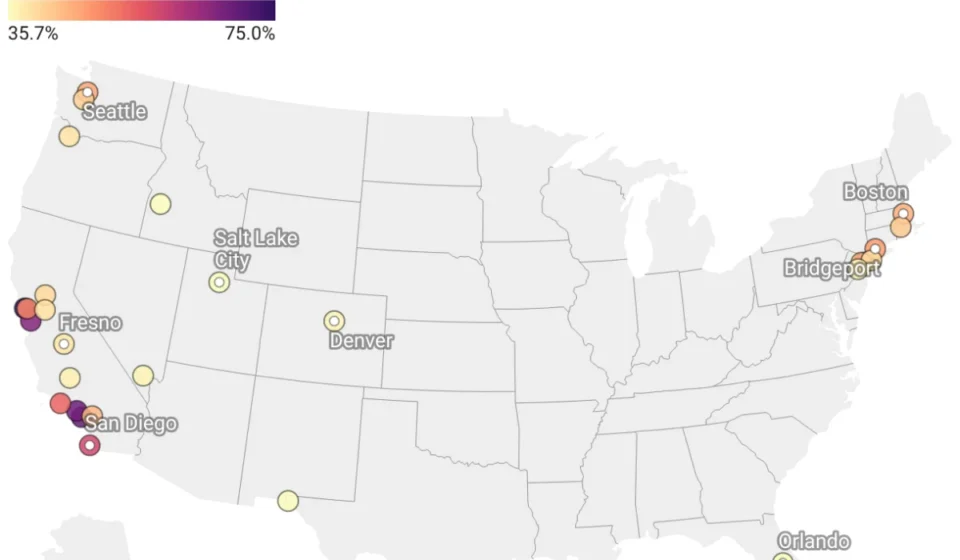
San Francisco, CA, stands at the epicenter of this crisis. In a city where the median home price has climbed to $1,725,000, a typical resident must dedicate a staggering 75% of their monthly income to housing expenses. This figure highlights a stark reality: in many of America’s primary economic engines, median-income earners are effectively priced out of the market.
Top 10 Most Expensive U.S. Housing Markets (2026)
| City | Share of Income for Housing | Median Household Income | Median Sale Price |
|---|---|---|---|
| San Francisco, CA | 75.0% | $162,118 | $1,725,000 |
| Anaheim, CA | 69.4% | $126,178 | $1,249,500 |
| Los Angeles, CA | 68.0% | $97,775 | $930,000 |
| San Jose, CA | 66.2% | $176,401 | $1,650,000 |
| New York, NY | 61.6% | $98,287 | $790,000 |
| San Diego, CA | 57.7% | $115,304 | $930,000 |
| Miami, FL | 54.6% | $77,854 | $575,000 |
| Oxnard, CA | 53.6% | $119,133 | $892,000 |
| Oakland, CA | 49.6% | $139,407 | $945,000 |
| Bridgeport, CT | 47.0% | $127,489 | $690,000 |
While these ten cities represent the most extreme cases, they are by no means the only areas facing stress. An additional 26 major metropolitan areas—including Columbus, OH (30.1%), Washington, D.C. (31.9%), and Nashville, TN (34.1%)—hover in the "technically unaffordable" range, requiring over 30% of household income.
A Chronology of the Crisis: From Pandemic Boom to Market Reset
To understand the current state of the market, one must look back at the catalyst of the post-2020 era. Before the pandemic, housing costs, while rising, remained tethered to a semblance of historical normalcy.
The 2020–2022 Frenzy: As COVID-19 spurred a mass migration and a shift toward remote work, the housing market experienced an unprecedented surge in demand. Fueled by historically low interest rates, homebuyers engaged in aggressive bidding wars, often paying thousands of dollars above the asking price. This period effectively accelerated a decade’s worth of price appreciation into a mere 24-month window.
The Late 2022 Pivot: The Federal Reserve’s move to curb inflation by raising interest rates acted as a sudden brake on the market. While this successfully cooled the frenzied pace of home sales, it created a "lock-in effect." Existing homeowners, who had secured sub-3% mortgage rates, were unwilling to sell and trade their low rates for the new, much higher market rates. This drastically reduced the number of homes for sale, keeping prices elevated despite the drop in buyer demand.
The 2025–2026 "Slow Reset": We are currently in a period of painful recalibration. The market is beginning to stabilize, but the transition is glacial. As Redfin Chief Economist Daryl Fairweather notes, "Housing markets across the country are undergoing a long, slow reset. Homebuyers in 2020–2022 were hungry to take advantage of low-rate mortgages… That trend reversed as prices and rates skyrocketed in late 2022, but now the market is balancing out."
Economic Drivers and Emerging Trends
Why, despite the cooling of demand, do prices remain so stubbornly high? Experts point to three structural pillars that continue to prop up the market:
- The Inventory Deficit: The United States faces a chronic shortage of housing units. Years of under-building following the Great Recession, combined with pandemic-era labor and supply chain disruptions, have created a massive gap between the number of households and the available inventory.
- Restrictive Zoning and Land Use: In major coastal hubs, the "Not In My Backyard" (NIMBY) movement and stringent zoning laws have made it difficult for developers to increase housing density. When supply cannot expand, prices are forced upward by default.
- Wealth Concentration: In markets like San Francisco and San Jose, the influx of high-salaried workers in the technology and AI sectors has pushed median home prices to heights that bear little relation to the broader national economy. This creates a hyper-competitive sub-market that can sustain record-high prices even when the rest of the country feels the pinch.
Signs of Easing?
Despite the gloom, there are glimmers of hope. Affordability is beginning to show signs of improvement in areas where inventory is finally ticking upward. Cities like San Jose (-6.7 percentage points in income share), Chicago (-6.1), and Seattle (-4.6) have seen outsized gains in affordability. This is largely because sellers, tired of waiting for a market peak that may never return, are listing their homes, thereby providing buyers with more options and negotiating leverage.
Implications for the American Future
The societal implications of this housing crisis are profound and far-reaching.
- The Wealth Gap: Homeownership has historically been the primary vehicle for intergenerational wealth transfer in America. If a large segment of the population remains locked out of the market, the wealth gap between current homeowners and renters will continue to widen, creating a permanent class divide.
- Economic Mobility: When workers must spend nearly half their income on rent or mortgages, their ability to save, invest in education, or start small businesses is severely restricted. This "housing tax" drains the economy of the capital that would otherwise drive growth and innovation.
- The "Family Subsidy": A growing trend of younger buyers relying on family wealth for down payments is introducing a new form of inequality, where access to homeownership is increasingly dependent on familial inheritance rather than individual merit or career success.
Conclusion: The Long Road to Normalization
Returning to a "normal" housing market—where the average family can afford a median home with 25% or 30% of their income—will likely take years, if not a decade. It requires a multi-pronged approach: the expansion of housing inventory through zoning reform, a sustained cooling of price growth, and potentially a recalibration of interest rates that makes the cost of borrowing sustainable for the average worker.
For now, the market remains a landscape of high barriers. While the "frenzy" of the pandemic era has subsided, the "affordability crisis" has taken its place as the defining economic challenge of the decade. Prospective buyers should remain cautious, keep a close watch on local inventory levels, and understand that in this current environment, patience and flexibility are the most valuable assets a buyer can possess.
Methodology Note: This report utilizes data from the May 2026 Redfin analysis of 96 of the largest U.S. metropolitan areas. Affordability is defined by the share of income a median-income resident must spend to afford a typical home, assuming a 20% down payment, prevailing interest rates, and a 30-year mortgage. "Unaffordable" is defined as a monthly payment exceeding 35% of median monthly earnings.