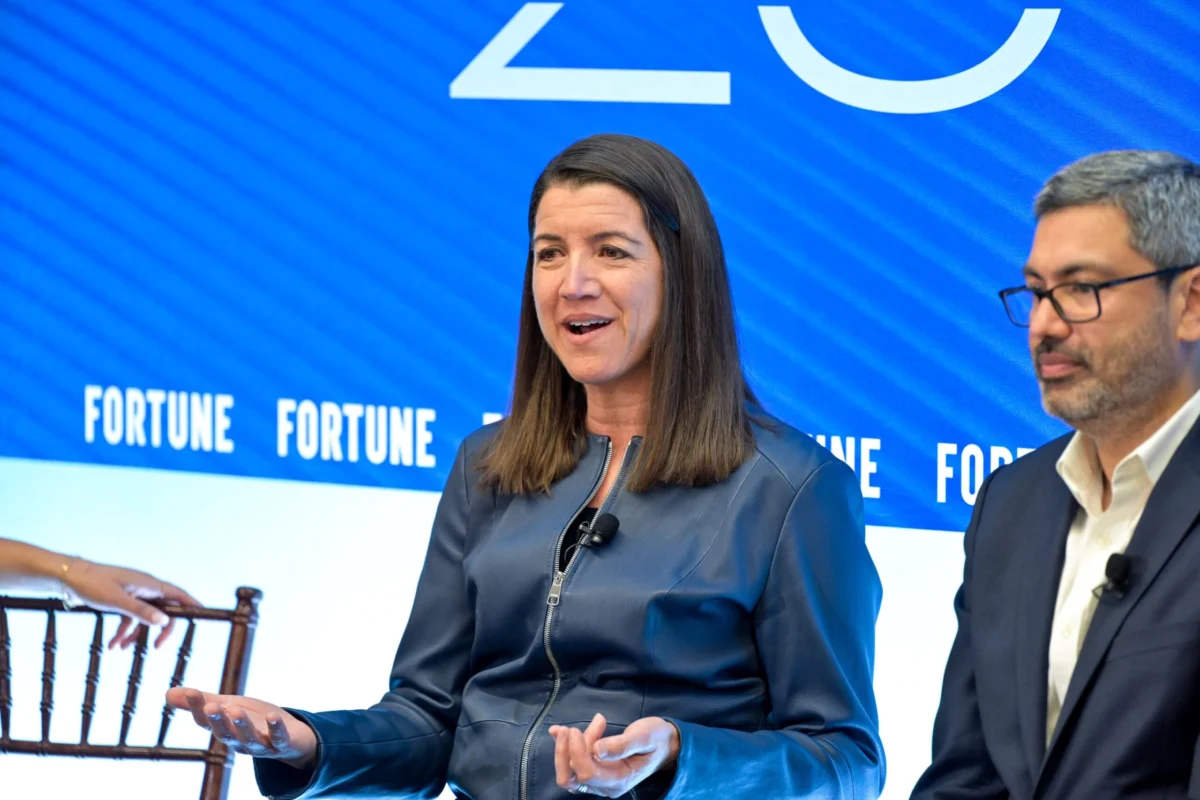
In the rapidly evolving landscape of enterprise technology, a new mantra has emerged that transcends simple innovation: "To be able to trust, you need to be able to see what is happening." This principle, articulated by Laura Heisman, Chief Marketing Officer of Dynatrace, captures the central tension of the current industrial era. As corporations move beyond simple generative chatbots toward autonomous "AI agents," the focus has shifted from what AI can do to whether we can control what it does.
At the recent Fortune Brainstorm Tech conference, a panel of high-level executives from finance, automotive, and data sectors converged to discuss the "trust gap" in AI. Their consensus was clear: visibility, traceability, and centralized governance are no longer optional "add-ons"—they are the foundational requirements for the next phase of the digital revolution.
Main Facts: The Shift from Chatbots to Autonomous Agents
The primary challenge facing modern enterprises is the transition from "Generative AI" (which produces content) to "Agentic AI" (which executes tasks). While a chatbot might write an email, an AI agent can chain together a sequence of complex tasks: analyzing a market trend, accessing a database, making a financial transaction, and updating a CRM system.
However, this autonomy introduces significant risks. The panel highlighted three critical questions that every enterprise leader is currently grappling with:
- Veracity: Is the AI’s output correct?
- Reliability: Can the system be trusted to operate autonomously without constant human intervention?
- Control: If the AI begins to deviate or "hallucinate" in its actions, is there a "kill switch" to stop it?
According to Heisman, the biggest conversation across all industries today centers on these pillars of trust. For companies like Dynatrace, which specializes in observability, the solution lies in "seeing" the data flow in real-time. Without a transparent view of the AI’s decision-making process, businesses are essentially flying blind into an automated future.
Chronology: From AI Hype to Governance Reality (2023–2024)
The journey to the current state of AI governance has been swift but arduous. To understand the current emphasis on "AI conservatism," one must look at the timeline of corporate adoption:
- Late 2022 – Mid-2023: The Era of Discovery. Following the public release of ChatGPT, enterprises rushed to experiment. This period was defined by "shadow AI," where employees used unsanctioned tools to boost productivity, often without corporate oversight or data security protocols.
- Late 2023: The Realization of Risk. As reports of AI hallucinations, data leaks, and copyright lawsuits surfaced, boards of directors began demanding more robust frameworks. The "move fast and break things" mentality encountered the hard wall of regulatory compliance and brand reputation.
- 2024: The Year of the Foundation. This year has been characterized by a strategic retreat from frantic deployment toward the construction of centralized technological foundations.
Nikhil Joshi, the Chief Information Officer in the markets division at Citi, noted that the banking giant spent the vast majority of 2024 building this centralized infrastructure. For a firm that moves trillions of dollars daily across 100 countries, the "move fast" approach was never an option. Citi’s focus was on creating a "single way" to deploy agents, ensuring that the infrastructure was ready before the first agent went live in a production environment.
Supporting Data: The Cost of the Trust Gap
While the panel focused on qualitative strategies, the quantitative reality of the AI market underscores their concerns. Recent industry reports suggest that while 80% of CEOs believe AI will significantly change their business, less than 20% feel their organizations have the necessary governance to manage it safely.
In the financial sector, the stakes are even higher. A single error in an automated trading agent or a credit-scoring model can result in billions of dollars in losses or massive regulatory fines. This explains why firms like Experian and Citi are prioritizing "traceability."
Furthermore, the rise of "AI Observability"—a market in which Dynatrace is a key player—is projected to grow at a CAGR of over 30% through 2030. This growth is driven by the fact that traditional monitoring tools are insufficient for the non-linear, often unpredictable nature of large language models (LLMs) and autonomous agents.
Official Responses: Strategies from the Front Lines
The conference featured distinct approaches to the trust problem from four major industry players, each tailored to their specific operational risks.
1. Citi: The Power of Centralization
Nikhil Joshi’s philosophy is rooted in "AI conservatism." At Citi, every AI agent must be registered, monitored, and audited through a singular, centralized framework. This prevents "agent sprawl," where various departments deploy uncoordinated tools.
"Being AI conservative is not a bad phrase," Joshi argued. By slowing down to build a rigorous audit trail, Citi believes it will ultimately move faster because it won’t have to pause to fix systemic failures or address regulatory breaches.
2. Experian: Provenance and Permissions
Kathleen Peters, Chief Innovation Officer at Experian, emphasized the human element of AI. Experian’s system focuses on "provenance"—the origin story of every agent. Their framework tracks:
- Which human employee created the agent?
- What specific data sets does the agent have permission to access?
- What are the boundaries of the tasks it can perform?
By maintaining a clear link between human intent and machine action, Experian builds the "ecosystem of trust" necessary to scale operations.
3. Ford: "Vibecoding" and the Fail-Fast Protocol
Sammy Omari, Executive Director at Ford, offered a different perspective from the manufacturing world. Ford uses AI to solve the problem of long development cycles. In an industry where it takes years to launch a vehicle, Ford uses "vibecoding"—AI-powered tools that allow non-engineers (like designers) to generate functional code for new features.
However, the "trust" comes from the guardrails. The AI-generated code is used only as a "proof of concept" to see if a feature works in a test vehicle. If it succeeds, professional engineers rewrite the code from scratch for the production model. This allows Ford to "fail fast" in the design phase without compromising the safety-critical software of the final product.
4. Dynatrace: Visibility as a Prerequisite
For Laura Heisman, the focus remains on the "see-to-trust" maxim. She argued that visibility must be foundational. If a business cannot see the internal logic or the data dependencies of an AI agent, it cannot truly be said to have control over it. This transparency is what allows executives to answer the critical question: "If it’s wrong, can you stop it?"
Implications: The Future of the Human-AI Partnership
The insights shared at Fortune Brainstorm Tech suggest a profound shift in how the corporate world views artificial intelligence. We are moving away from a period of "AI wonder" and into a period of "AI accountability."
The End of the "Black Box"
The most significant implication is the death of the "black box" model of AI. Companies are no longer willing to accept "it just works" as an answer. The demand for explainability—the ability for an AI to explain its reasoning in human-understandable terms—is becoming a standard requirement for enterprise software procurement.
The Rise of the "Human-in-the-Loop"
Despite the push for autonomy, the panel’s responses suggest that humans are becoming more important, not less. Whether it is the designer at Ford "vibecoding" a prototype or the auditor at Citi reviewing an agent’s logs, human oversight remains the ultimate guardrail. The goal is "augmented intelligence," where the machine provides the speed and the human provides the judgment.
Competitive Advantage through Governance
The traditional view is that regulation and governance slow down innovation. However, as Nikhil Joshi and Kathleen Peters pointed out, robust governance may actually be a competitive advantage. Companies that can prove their AI is safe, ethical, and transparent will win the trust of consumers and regulators alike, allowing them to scale their operations while competitors are mired in "pilot purgatory" or legal challenges.
The New Workforce Skillset
Finally, the emergence of "vibecoding" at Ford suggests a shift in the labor market. As AI handles the "syntax" of coding or data analysis, the value of human workers will increasingly lie in their ability to define "vibes"—the creative vision, the strategic direction, and the ethical boundaries of the technology.
In conclusion, the path to AI integration is not paved with more powerful models, but with better-monitored ones. As the leaders at Fortune Brainstorm Tech made clear, the businesses that succeed in the age of AI will not be those that move the fastest, but those that can see most clearly where they are going. Trust, it turns out, is the most valuable currency in the digital economy.