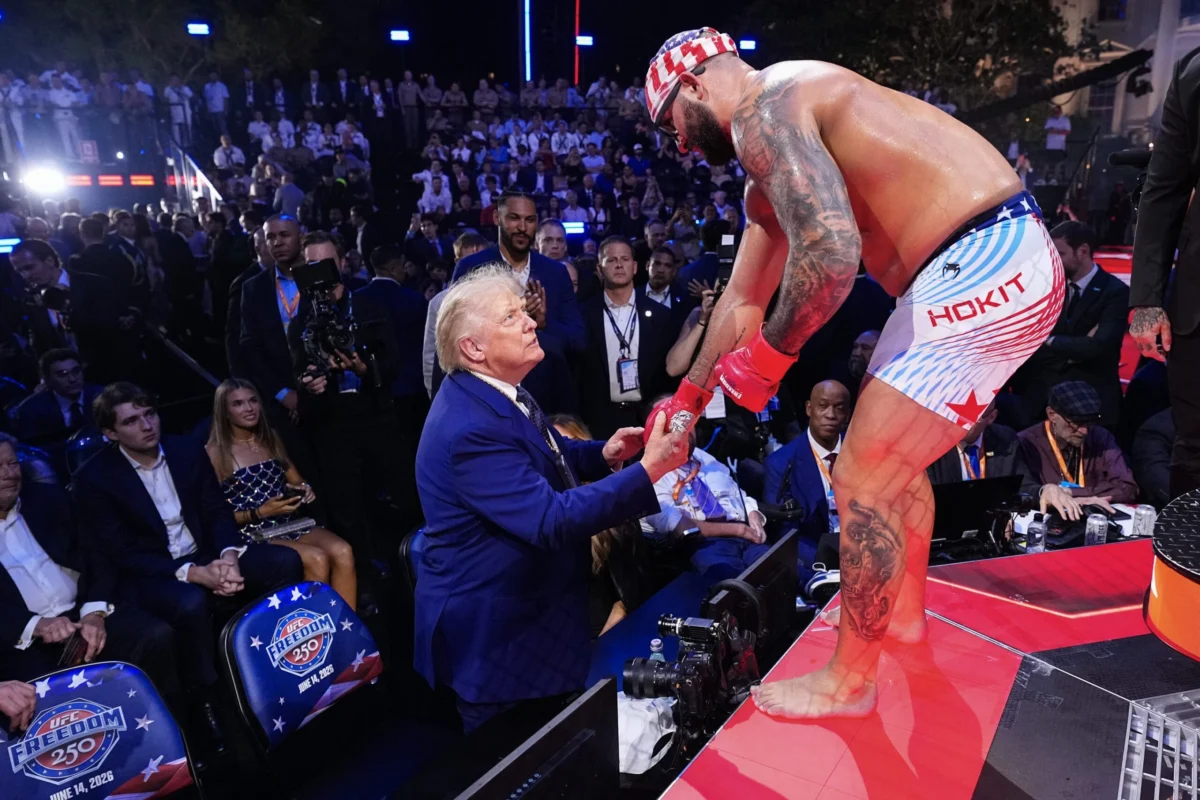
The intersection of professional sports, high-stakes finance, and the American presidency reached an unprecedented peak this week as the South Lawn of the White House was transformed into a combat sports arena. The "UFC Freedom 250" spectacle, headlined by some of the biggest names in mixed martial arts, was not merely a display of athletic prowess; it served as the backdrop for a significant financial maneuver involving the President’s private business interests.
While the event drew record viewership, it has simultaneously ignited a firestorm of ethical debate. At the center of the controversy is the revelation that winning fighters were not paid in traditional U.S. currency, but rather in "USD1"—a synthetic stablecoin issued by World Liberty Financial, a cryptocurrency venture founded and owned by the family of President Donald Trump. This move, which effectively turns the White House into a promotional platform for a private financial product, has raised profound questions regarding the blurring lines between public office and private profit.
Main Facts: A New Frontier for Presidential Business
The UFC Freedom 250 event was marked by several historical firsts. It was the first time a full-scale professional fighting event was hosted on the grounds of the White House, and it saw the introduction of record-breaking performance bonuses. However, the mechanism of these payments has overshadowed the results of the fights themselves.
The USD1 Stablecoin
Unlike standard prize money, which is typically distributed via wire transfer or check in U.S. dollars, the UFC winners received USD1. USD1 is a "stablecoin"—a digital asset designed to maintain a 1:1 peg with the U.S. dollar. It is the flagship product of World Liberty Financial (WLF), a decentralized finance (DeFi) project launched by the Trump family and their close associates.
The Financial Connection
The connection between the President and the currency is direct. World Liberty Financial was established in 2024, with the President’s sons—Donald Jr., Eric, and Barron Trump—taking prominent roles. While President Trump officially stepped back from formal governance of the company upon taking office, he remains a primary beneficiary of its success. According to recent financial disclosures, the President has already realized over $57 million in profits from the sale of the company’s governance tokens.
The Ethical Conflict
Legal experts have pointed out that the use of a Trump-linked currency for an event hosted on federal property creates a unique ethical scenario. Richard Painter, who served as the chief White House ethics lawyer during the George W. Bush administration, noted that if any other executive branch official—such as the Secretary of the Treasury—were to promote a private financial interest in this manner, it would likely constitute a federal crime. However, the President remains legally shielded by long-standing exemptions in federal conflict-of-interest statutes.
Chronology: From DeFi Vision to White House Reality
The journey to the UFC Freedom 250 event began long before the Octagon was assembled on the South Lawn. The timeline of World Liberty Financial’s rise reflects a rapid integration of the Trump brand with the burgeoning cryptocurrency sector.
- September 2024: World Liberty Financial is officially unveiled. The project is marketed as a way to "bank the unbanked" and challenge the traditional financial establishment. The "Gold Paper"—the project’s white paper—lists Donald Trump as the "Chief Crypto Advocate" and his sons as executives.
- Late 2024: The venture faces early skepticism from the crypto community regarding its centralized nature and the timing of its launch. Despite this, the company successfully launches its governance token, WLFI.
- January 2025: Donald Trump is inaugurated. Following standard protocol, he is removed from the listed team of World Liberty Financial to avoid direct management conflicts, though he maintains his ownership interest. Steve Witkoff, a real estate mogul and Trump’s Middle East special envoy, also steps back from formal roles.
- March 2025: World Liberty Financial launches USD1, its proprietary stablecoin. The coin is backed by a mix of cash, U.S. Treasury bills, and other cash equivalents. Within weeks, the coin sees massive adoption, fueled in part by the President’s public endorsements of "crypto-freedom."
- May 2025: UFC President Dana White, a longtime ally of Donald Trump, announces "Freedom 250." The event is billed as a celebration of American resilience and a showcase for the "new digital economy."
- The Event: During the Freedom 250 broadcast, it is revealed that the $250,000 "Performance of the Night" bonuses will be paid out exclusively in USD1, directly into the fighters’ digital wallets.
Supporting Data: The Economics of USD1
To understand why the use of USD1 is so lucrative for the Trump family, one must look at the mechanics of stablecoin issuance. Stablecoins are not merely digital chips; they are sophisticated financial instruments that generate significant "float."
Revenue from Reserves
When an entity like World Liberty Financial issues $1 billion worth of USD1, it takes in $1 billion in real-world assets (cash and Treasuries) to back those tokens. While the token holder has a digital asset worth $1, the issuer (WLF) holds the underlying collateral. By investing that collateral in interest-bearing U.S. Treasuries, the issuer earns the yield. With interest rates remaining elevated, a stablecoin with a circulation of several billion dollars can generate tens, if not hundreds, of millions of dollars in annual revenue for the issuer.
Trump’s Financial Disclosure
According to a financial disclosure released on the Saturday following the UFC event, the President’s financial stake in the venture is substantial:
- Governance Token Sales: $57.3 million in revenue from WLFI sales.
- USD1 Circulation: The stablecoin currently has several billion dollars in circulation.
- Projected Yield: Based on current Treasury rates, World Liberty Financial is estimated to be generating significant annual interest income, a portion of which is tied to the Trump family’s equity in the parent company.
The Scale of the Event
UFC Freedom 250 was one of the most-watched pay-per-view events in the organization’s history. By integrating USD1 into the broadcast, World Liberty Financial received what marketing experts estimate to be tens of millions of dollars in equivalent advertising value, all while utilizing the prestige of the White House.
Official Responses: Silence and Legal Justification
Despite the high profile of the event, official responses regarding the potential conflicts of interest have been sparse.
The UFC and Dana White
The UFC has not responded to specific inquiries regarding the logistics of the USD1 payouts. It remains unclear if fighters were given the option to opt out of the crypto payment or if they were required to set up accounts with World Liberty Financial-affiliated platforms to receive their bonuses. Dana White has historically defended his relationship with Trump, stating that the President has been a supporter of the UFC since its early days when other venues shunned the sport.
The White House
The White House press office has not issued a formal statement regarding the evaluation of potential conflicts of interest. When asked if the Office of Government Ethics (OGE) was consulted about the use of the South Lawn for a commercial promotion involving a Trump-linked currency, officials declined to comment.
Legal Perspectives
Richard Painter’s critique centers on 18 U.S.C. § 208, a federal criminal statute that prohibits executive branch employees from participating in matters in which they have a financial interest.
"The law is very clear for the Cabinet and sub-Cabinet levels," Painter told Fortune. "If a Treasury secretary had a financial interest in World Liberty and then participated in any government matter that had a knowing economic impact on World Liberty, that Treasury secretary very likely would commit a felony."
However, Painter also noted the "Presidential Exemption." Under the same statute, the President and Vice President are exempt from these specific conflict-of-interest rules, a provision originally designed to prevent the President from being paralyzed by his or her vast responsibilities.
Implications: The "DeFi Presidency" and Future Precedents
The use of USD1 at the White House UFC event represents more than just a single ethics row; it signals a fundamental shift in how the presidency can be leveraged as a brand and a business engine.
The Normalization of Private Currencies
By using USD1 to pay athletes on the South Lawn, the administration is effectively signaling a move toward the "privatization" of financial standards. If a presidential brand can successfully launch and circulate its own currency, it challenges the monopoly of the U.S. dollar as the sole medium of exchange for high-profile American events.
Blurring the Lines of the "Bully Pulpit"
The "Bully Pulpit" has traditionally been used to advocate for policy. In this instance, it was used to provide "proof of concept" for a private financial product. Critics argue that this sets a dangerous precedent where future presidents might use their office to promote their own proprietary technologies, real estate holdings, or financial services, as long as they fall under the legal exemption of § 208.
Regulatory Challenges
The success of USD1 also places federal regulators, such as the Securities and Exchange Commission (SEC) and the Commodity Futures Trading Commission (CFTC), in a precarious position. Regulating a stablecoin that is directly linked to the sitting President’s family presents an optics nightmare for agencies that strive for political independence.
Conclusion
As the dust settles on the South Lawn and the Octagon is dismantled, the UFC Freedom 250 will likely be remembered less for the fights and more for the financial precedent it set. While the President remains within the letter of the law due to unique exemptions, the "USD1" episode has reopened a national conversation about the adequacy of ethics laws in an era where the leader of the free world is also a titan of the digital economy. For the fighters, the bonuses were a windfall; for the Trump family, the event was a masterclass in vertical integration; but for the American political system, it remains a complex and unresolved challenge to the tradition of the "public servant."