In the modern era of Major League Baseball, velocity has long been treated as the ultimate currency. Scouts, front offices, and fantasy analysts alike have been conditioned to worship at the altar of the 97-mph four-seamer. The prevailing wisdom is straightforward: faster is better. While there are outliers, the consensus remains that a pitcher throwing 96 mph provides a significantly higher floor and a more reliable ceiling than the same pitcher operating at 91 mph.
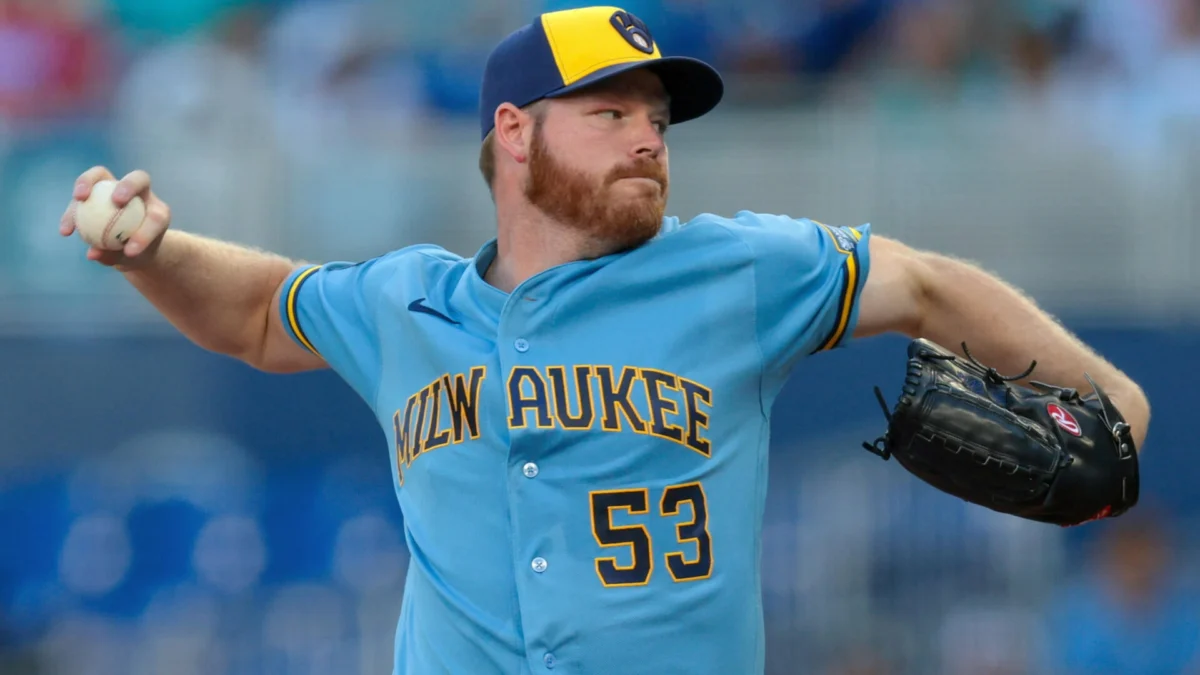
However, Brandon Woodruff is currently orchestrating a masterclass in defying conventional wisdom. As he navigates his return from major shoulder surgery—a procedure that historically acts as a career death knell for fastball-dependent hurlers—Woodruff has emerged as an anomaly. His performance isn’t just surviving the drop in velocity; it is thriving in spite of it.
The Velocity Dip and the Statistical Defiance
When Woodruff returned to the mound last season after a year-long hiatus, his average fastball velocity had plummeted by nearly 3 mph. By all traditional metrics, this should have been a disaster. Instead, the results were historic. In 2025, his whiff rate on his four-seamer actually climbed higher than it was in 2023, his overall strikeout rate saw an uptick, and he posted the lowest expected ERA (xERA) of his career.
This trend continued into this past Monday’s start against the Cincinnati Reds. Woodruff averaged a pedestrian 91.6 mph on his four-seamer—the second-lowest mark for a full start in his professional career. Yet, the Reds were powerless. Over six shutout innings, Woodruff allowed only one hit and tallied 10 strikeouts. He generated six whiffs on just 23 swings with his heater.
How does a pitcher who relies heavily on the fastball continue to dominate when the radar gun suggests he should be getting hammered? The answer lies in elite command and a calculated shift in pitch-mix reliance.
Chronology of a Resilient Campaign
Woodruff’s journey back to the mound has been anything but linear. After the initial surgery, he struggled to find his rhythm, only to suffer a lat strain just two months into his 2024 campaign. This season, despite a heavily monitored workload during Spring Training, he found himself back on the injured list (IL) early on due to recurring shoulder discomfort.
Key Milestones in the 2025/2026 Comeback:
- Early 2025: Initial return from shoulder surgery; velocity deficit noted (minus 3 mph).
- Mid-2025: Career-best xERA achieved; whiff rates exceed pre-surgery levels.
- Early 2026: Re-aggravation of shoulder issue forces another IL stint.
- June 2026: Dominant 10-strikeout performance against Cincinnati, proving that "diminished" velocity can still be lethal with pinpoint command.
During his most recent start, Woodruff simplified his approach. He leaned on his four-seamer, sinker, and changeup for 91% of his offerings. By eschewing his secondary offerings—throwing only two curveballs and five cutters—he forced the Reds to commit to the fastball, only to find that his ability to tunnel the pitch and spot it on the edges rendered their contact quality effectively hollow. While the Reds managed an average exit velocity of 94.8 mph on the nine balls they put in play, that small sample size of contact was the only success they found all night.
The Data Behind the Dominance
The secret to Woodruff’s success isn’t raw power; it is the generation of "harmless contact." Even when opponents make contact, they aren’t squaring the ball up. In his latest outing, only three of the balls put in play by the Reds had an expected batting average (xBA) over .350.
Woodruff remains one of the premier pitchers in baseball at inducing harmless pop-ups. This is a direct byproduct of his ability to elevate his fastball with precision. When a pitcher can command the upper quadrants of the zone, the velocity matters less than the vertical approach angle and the deception created by his changeup.
While his overall whiff rate has seen a minor decline compared to his absolute peak, his ability to suppress hard contact has kept his ERA at a stellar 3.00 for the 2026 season, building upon his 3.20 ERA from the previous year.
The "Sell-High" Implication
Despite the brilliance of his recent performance, a cold reality remains: Brandon Woodruff is a high-risk asset. For fantasy managers and team architects alike, the question is not whether Woodruff can pitch effectively, but whether he can stay on the mound long enough to make a difference.
The history of his injury recovery is rocky. Every time he takes the mound, there is an underlying concern that he is one pitch away from another extended stay on the IL. His workload has been meticulously managed, yet the body has repeatedly signaled fatigue or damage.
Strategic Recommendation: If you possess Woodruff on a roster, this is the optimal window to trade him. His value is at a seasonal high following a dominant 10-strikeout shutout. His performance-based doubts have been silenced by his results, but his health-based doubts are more valid than ever. Selling now allows you to capitalize on the "name brand" value and the recent eye-popping box score before the inevitable risk of another physical setback manifests.
Broader Context: The State of the League
Woodruff’s situation is part of a larger, evolving landscape in Major League Baseball. As the league grapples with a wave of pitching injuries, the focus is shifting toward command and efficiency over raw, unsustainable velocity.
Waiver Wire and Trade Market Developments
- Kyle Teel (C, White Sox): After a hamstring injury sidelined him for the first half, Teel is poised to provide immediate value. His second-half projection includes a 20-homer, 5-steal pace, making him a must-roster candidate in most formats.
- Emilio Pagan (RP, Reds): With Tony Santillan struggling to secure the closer role in Pagan’s absence, expect Pagan to reclaim his job upon returning from his rehab assignment next week.
- Hurston Waldrep (SP, Braves): Following elbow surgery, Waldrep is nearing a return to the Braves’ rotation. While he may not possess the ace-level ceiling of others, his background and organizational support make him a high-floor rotation filler.
- Jake Bennett (SP, Red Sox): A revelation in Boston. His recent six-inning, nine-strikeout shutout at Coors Field highlights his emergence as a genuine rotation asset, thanks to high-extension mechanics that allow his 93-mph heater to play up.
Trends to Watch
- Kyle Bradish (Orioles): After a rocky start to the season, Bradish is back in the top-30 SP conversation. His shift back to a heavy slider usage proved fruitful against the Angels, signaling a potential permanent correction.
- Framber Valdez (Astros): The perennial "inconsistent" ace is showing signs of life. His back-to-back quality starts suggest his curveball is once again generating the required spin and movement to baffle hitters.
- Kumar Rocker: The young pitcher is experimenting with a new mix, leaning heavily on a 51% slider usage. While skeptical of long-term sustainability, his recent 20-swinging-strike outing suggests he has found a weaponized approach that could define the next stage of his career.
- Gerrit Cole (Yankees): A cautionary tale. Despite his pedigree, Cole is struggling to regain his form post-Tommy John surgery. His recent shellacking by the Tigers serves as a reminder that even the greats require significant time to re-calibrate their feel for the game.
Conclusion
Brandon Woodruff is the exception that proves the rule. He has mastered the art of pitching with less, proving that velocity is merely a tool—not the entire workshop. However, in the high-stakes world of competitive baseball, durability remains the ultimate skill. As we approach the halfway point of the 2026 season, the lesson from Woodruff is twofold: appreciate the brilliance while it lasts, but be prudent enough to mitigate the risk before the physical reality of his recovery catches up to his performance on the mound.