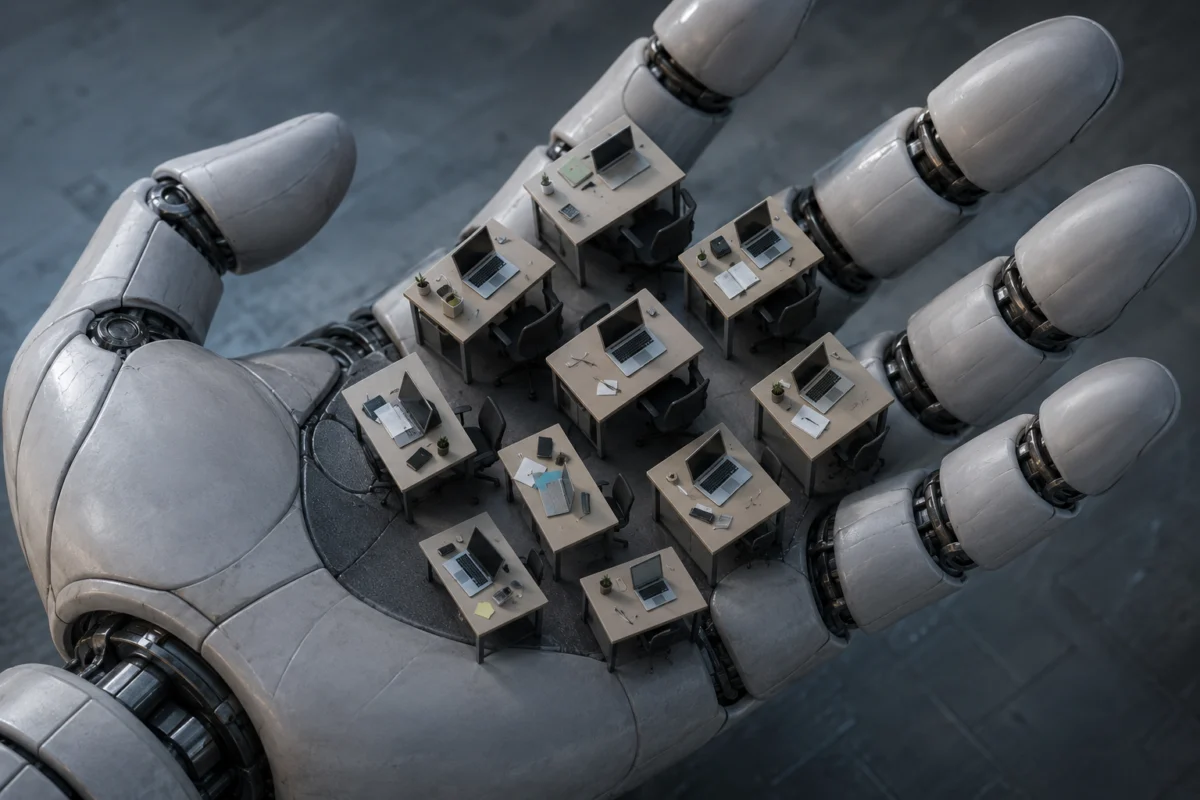
The technology sector is currently navigating a profound and unsettling transformation. As the promise of artificial intelligence shifts from speculative hype to tangible corporate strategy, the industry is witnessing a paradoxical trend: record-breaking revenues paired with aggressive, systemic workforce reductions.
Oracle’s recent annual regulatory filing serves as a stark catalyst for this conversation. The company disclosed that it has slashed its global workforce by 21,000 employees over the past 12 months—a 13% reduction that exceeds previous market estimates. More telling than the scale of the cuts is the justification provided by the tech giant: “The adoption and deployment of AI technologies across our operations have resulted, and may continue to result, in reductions to our workforce.”
This admission confirms what has been a growing suspicion among labor analysts and industry observers. AI is no longer just a product feature; it is being deployed as a primary engine for corporate restructuring and headcount optimization. As companies report fiscal quarters with unprecedented profitability, the "AI efficiency" narrative is being used to justify the culling of thousands of roles, setting a new, precarious precedent for the modern knowledge economy.
The Chronology of an Industry Pivot
The trend toward AI-driven downsizing has accelerated throughout 2026. The following timeline tracks how major technology players have systematically reduced their headcounts under the banner of AI-fueled "restructuring" and "re-balancing."
- June 2026 (GitLab): GitLab eliminated 14% of its staff (approx. 350 workers) to prioritize AI infrastructure. CEO Bill Staples cited the need for a "generational rebuild" to support agentic workloads, even as the company reported a 23% year-over-year revenue increase.
- May 2026 (Google, Intuit, Meta, Cisco, Cloudflare): May became a bellwether month for these cuts. Google continued quiet, rolling layoffs in its Cloud division despite revenue growth of 63%. Intuit shed 3,000 roles (17% of staff) to focus on AI, while Meta cut 8,000 employees while simultaneously shifting thousands of others into AI-specific roles. Cisco eliminated 4,000 jobs to pivot toward silicon and AI, and Cloudflare cut 20% of its workforce, with CEO Matthew Prince explicitly noting that AI had rendered certain middle-management roles obsolete.
- April 2026 (Snap, Microsoft, IBM): Snap cut 16% of its global workforce, citing AI’s ability to reduce "repetitive work." Microsoft initiated voluntary separation programs, with CFO Amy Hood signaling that headcount would continue to decline as the company prioritizes AI-related agility.
- Q1 2026 (Atlassian, Dell, Oracle, Block, Salesforce, Amazon): The first quarter set the tone. Block cut nearly 50% of its workforce, with Jack Dorsey asserting that AI-enabled "one-person teams" are the future of corporate structure. Amazon followed a similar path, cutting 16,000 corporate roles to remove "bureaucracy"—a move CEO Andy Jassy had signaled as a long-term goal for AI-led efficiency.
The Financial Disconnect: Growth vs. Headcount
The most contentious aspect of this wave of layoffs is the financial health of the companies involved. In nearly every case, the organizations reporting these cuts are not failing; they are thriving.
Cisco, for instance, reported better-than-expected profit and revenue when it announced its 4,000-person layoff. Similarly, Cloudflare posted the highest quarterly revenue in its history just as it cut 1,100 jobs. These decisions suggest that the motivation for these layoffs is not financial desperation, but a strategic desire to increase operating margins by replacing human capital with automated workflows.
Financial analysts point to "restructuring costs" as a significant short-term burden—GitLab alone expects to spend up to $35 million in this process—but the long-term objective is clear: lowering the "cost per unit of output." By automating middle management, legal, and internal auditing functions, firms are attempting to decouple revenue growth from headcount growth.
The Rationale: Efficiency or Over-Correction?
The industry-wide narrative—that AI is simply replacing "obsolete" tasks—deserves closer scrutiny. Many of the roles currently being eliminated were hired during the pandemic-era growth surge. When tech companies experienced a period of hyper-hiring between 2020 and 2022, they built bloated organizational structures.
Now, with the rise of Large Language Models (LLMs) and agentic AI, executives have a convenient justification to "flatten" these structures. The "AI layoff" is, in many instances, a mechanism to correct for the over-hiring of the past four years while masking the correction as a forward-looking technological pivot.
However, this strategy carries risks. As seen at companies like Meta, where employees have expressed frustration with the new, AI-centric internal culture, the forced migration of talent into AI roles can lead to a drop in morale and the loss of institutional knowledge.
Official Responses and Corporate Strategy
The language used by leadership has remained strikingly consistent. Terms like "re-balancing," "reducing complexity," "removing bureaucracy," and "increasing velocity" appear in almost every official filing.
- The "Agentic" Shift: CEOs like Brian Armstrong of Coinbase and Jack Dorsey of Block have argued that AI is changing the fundamental physics of work. They posit that small, AI-augmented teams can now achieve what once required large departments.
- The "Measure" Problem: Cloudflare’s CEO Matthew Prince provided a rare moment of candidness when he described the workers cut as "measurers"—employees in finance, legal, and auditing. This suggests that the next phase of the AI transition will target administrative and white-collar professional services more aggressively than frontline engineering.
Broader Implications for the Workforce
The ripple effects of this trend are likely to be felt across the entire economy, not just within the tech sector.
1. The Death of the Middle Manager
The most immediate casualty of the AI era is the traditional middle-management layer. Companies are finding that AI agents can handle reporting, scheduling, and basic performance monitoring, making large layers of management redundant.
2. A Shift in Hiring Patterns
While companies are laying off thousands, they are simultaneously hiring in niche fields. IBM, for example, is cutting thousands of traditional roles while tripling its hiring for AI-specific positions. This creates a "skills chasm" where the existing workforce is left behind, and entry-level positions become increasingly competitive and specialized.
3. The Psychological Toll
The "AI-first" environment creates a culture of constant surveillance and performance anxiety. When employees are told that their work is being measured and optimized by the very tools they are using to build the next generation of AI, it fosters an environment of instability.
4. Regulatory and Policy Challenges
The scale of these layoffs—thousands at a time across major public companies—raises questions for regulators. If AI is consistently used to reduce labor demand while corporations see record revenue, we may see a resurgence in discussions regarding a "robot tax" or, at the very least, heightened scrutiny on corporate social responsibility.
Conclusion: The New Reality of Work
The "AI layoff" is not a temporary blip; it is the structural manifestation of a new economic era. Companies have discovered that by combining the aggressive streamlining of the post-pandemic era with the automation capabilities of generative AI, they can achieve unprecedented operational efficiency.
For the modern worker, the implication is clear: the era of static job descriptions is over. The tech industry is signaling that the future belongs to those who can integrate AI agents into their daily workflows to provide exponential value. For the millions of employees in the "bloated" middle, however, the message is far more sobering: the efficiency gains promised by AI are being realized, but they are currently coming at the direct expense of human labor.
As 2026 continues, the industry will likely see further consolidation. Whether this leads to a new era of human-AI collaboration or a permanent thinning of the professional class remains the defining question of our time. For now, the numbers from Oracle, Meta, and the rest of the sector confirm one thing: the AI revolution has arrived, and it is reshaping the workforce from the top down.