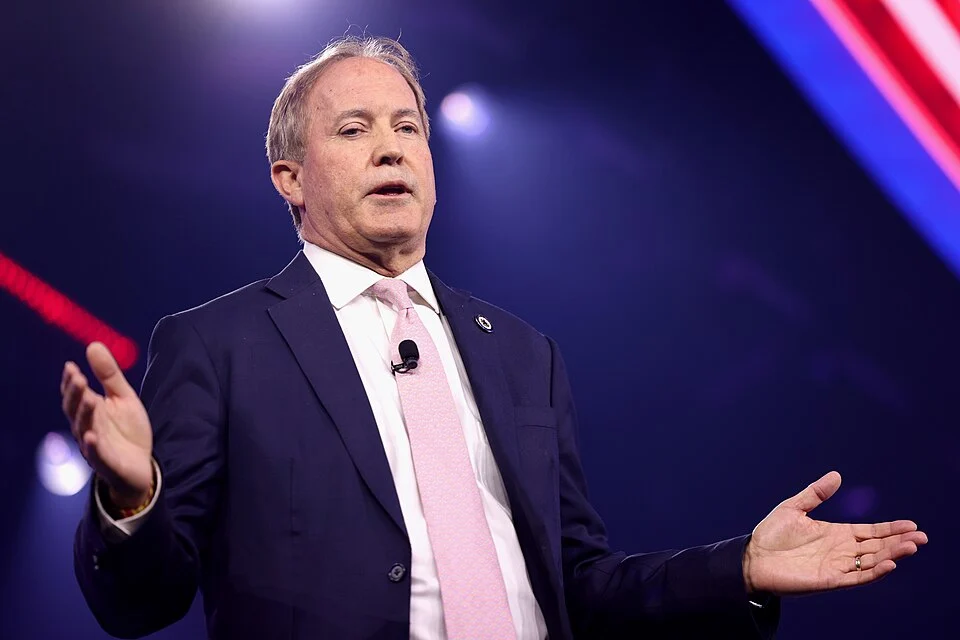
In a landmark ruling that reinforces the constitutional protections afforded to political speech and campaign fundraising, the U.S. District Court for the District of Massachusetts has granted a preliminary injunction against Texas Attorney General Ken Paxton. The decision effectively halts Paxton’s ongoing litigation against ActBlue, the prominent Democratic fundraising platform. Federal Judge Richard Stearns delivered a stinging rebuke of the Attorney General’s conduct, characterizing the state’s lawsuit not as a legitimate consumer protection effort, but as a politically motivated retaliatory strike against a platform that facilitated contributions for Paxton’s political rival, James Talarico.
The ruling represents a significant victory for the nonprofit organization, which has become the primary financial engine for Democratic candidates across the United States. By securing this injunction, ActBlue has successfully fended off an aggressive legal campaign that threatened to disrupt its operations and chill the participation of small-dollar donors nationwide.
The Core Facts: A Battle Over Political Speech
At the heart of the dispute is ActBlue, a massive fundraising clearinghouse that has processed approximately $19 billion in donations since its inception in 2004. The organization serves as a critical infrastructure for democratic participation, allowing everyday citizens to donate small sums to candidates, causes, and organizations that align with their political values.
Texas Attorney General Ken Paxton initiated an investigation into the platform in December 2023, alleging violations of the Texas Deceptive Practices Act. Paxton contended that the organization’s practices regarding donor verification were fraudulent. However, as the legal battle unfolded, the U.S. District Court found that the substance of these claims lacked credibility. Judge Stearns observed that when pressed during a June 4 hearing, Paxton’s legal representatives could not articulate a concrete harm to Texas consumers, offering only vague, philosophical arguments about the state’s interest in business transparency.
The court’s decision to grant the injunction hinges on the First Amendment. Judge Stearns emphasized that the facilitation of political donations is an act of protected speech, representing both the platform’s right to curate political content and the individual donor’s right to support their preferred candidates.
Chronology of the Dispute
The timeline of the investigation suggests a direct correlation between political events and the Attorney General’s legal actions.
- December 2023: Paxton launches an investigation into ActBlue, citing concerns under the Texas Deceptive Practices Act.
- Early 2024: ActBlue enters a period of cooperation, complying with numerous requests for documentation. State investigators even traveled to the organization’s Somerville, Massachusetts, headquarters to review materials on-site.
- The Catalyst: The investigation remained largely dormant for over a year and a half. It was revived only after James Talarico, a political opponent of Paxton in the U.S. Senate race, reported significant fundraising successes facilitated by ActBlue.
- Two Months Prior to the Ruling: Paxton formally filed a lawsuit in Texas, immediately pivoting to a media tour across conservative podcasts and campaign newsletters to tout the legal action.
- The Counter-Suit: In response, ActBlue filed a complaint in the District of Massachusetts, seeking an injunction to halt the Texas state proceeding.
- June 2026: Judge Richard Stearns issues a preliminary injunction, rejecting Paxton’s jurisdictional challenges and finding that the evidence of bad faith in the state’s case is "overwhelming."
Jurisdictional Maneuvering and Judicial Rejection
A primary component of Paxton’s defense was his attempt to have the Massachusetts case dismissed on the grounds of personal jurisdiction. Paxton argued that he, in his capacity as the Texas Attorney General, had no sufficient "minimum contacts" with Massachusetts to be subject to the court’s authority. He maintained that he had not purposefully availed himself of the forum and that the exercise of jurisdiction was unreasonable.
Judge Stearns dismissed these arguments as legally meritless. The court noted that Paxton’s own office had proactively engaged with the state of Massachusetts by serving Civil Investigation Demands on ActBlue within the state and sending investigators to the company’s Somerville headquarters to conduct a document review. By utilizing the state’s territory to advance his investigation, Paxton effectively submitted himself to the court’s jurisdiction. As Judge Stearns succinctly put it, "the exercise of jurisdiction is both reasonable and constitutional."
Furthermore, the court rejected Paxton’s attempt to invoke the Younger v. Harris doctrine, which generally dictates that federal courts should refrain from interfering in pending state criminal or quasi-criminal proceedings. The court agreed with ActBlue’s counsel that an exception to Younger exists in cases of proven bad faith—a threshold that, according to the court, was easily met given the timing of the lawsuit and the lack of substantive legal basis for the consumer fraud claims.
Analysis: The "Bad Faith" Threshold
The court’s decision is particularly notable for its scathing analysis of Paxton’s intent. Judge Stearns offered three distinct reasons for concluding that the lawsuit was an act of political retaliation:
- Dormancy and Timing: The court pointed to the year-and-a-half period of inactivity, noting that the litigation was only accelerated immediately following Talarico’s fundraising announcement.
- The "Hollow" Theory of Harm: The inability of the Attorney General’s office to provide a concrete example of consumer harm in Texas led the court to conclude that the lawsuit was pretextual.
- Public Declarations: Paxton’s own media campaign—where he explicitly linked the lawsuit to his Senate candidacy—served as the "smoking gun" that confirmed the retaliatory motive behind the litigation.
The court stated unequivocally: "The truth is plain and captured in Paxton’s own declarations: The lawsuit was filed in retaliation for (and in an attempt to suppress) ActBlue’s efforts to fund Talarico’s campaign."
Implications for Political Fundraising and the First Amendment
This ruling serves as a vital precedent for the protection of political intermediaries. In an era where digital fundraising is the lifeblood of American politics, the potential for state officials to use consumer protection laws to "chill" the speech of political platforms is a significant threat to democratic integrity.
The Chilling Effect
By granting the preliminary injunction, the court acknowledged that the suppression of political speech constitutes "irreparable harm." If allowed to proceed, the state’s lawsuit would have undoubtedly created a chilling effect, causing donors to fear that their contributions could be targeted, tracked, or publicly linked to investigations, thereby deterring them from exercising their constitutional right to financially support candidates.
Merging Equities and Public Interest
In the final analysis, the court determined that the public interest is best served by preventing government overreach. When the state acts as a partisan actor rather than a neutral arbiter of the law, the "inherent public interest in ensuring that state officials respect the explicit guardrails set out in the U.S. Constitution" takes precedence. By prioritizing the First Amendment, the court has signaled that political fundraising platforms are not merely commercial entities, but integral components of the democratic process that warrant robust protection from state-level retaliation.
Official Responses and Future Outlook
Following the ruling, ActBlue’s leadership expressed relief and vindication. Lawrence Oliver, the Chief Legal Officer for ActBlue, stated that the organization was pleased the court had "clearly chose[n] the Constitution over partisan politics." The sentiment within the Democratic fundraising community is that this ruling provides a necessary shield against the increasing weaponization of state attorney general offices.
Conversely, the office of the Texas Attorney General has faced sharp criticism from legal observers who argue that the case was an abuse of power. While Paxton may seek to appeal the ruling, legal experts suggest that the court’s detailed findings on bad faith and lack of jurisdictional merit make the prospect of a successful reversal unlikely.
As the 2026 election cycle continues, this case will likely remain a focal point for discussions surrounding campaign finance law, the limits of state regulatory power, and the continued relevance of the First Amendment in a polarized political climate. For now, ActBlue continues its operations, with the court’s injunction ensuring that it can continue to facilitate the political contributions of millions of Americans without the threat of imminent state-sanctioned retaliation.