The Restoration of a Landmark: Kennedy Center Removes Trump’s Name Following Federal Court Mandate

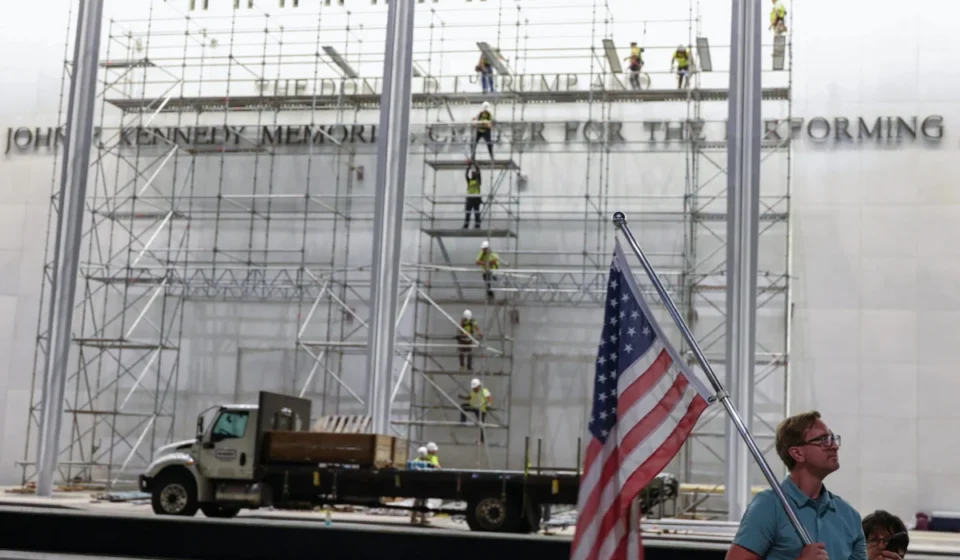
WASHINGTON, D.C. — In the pre-dawn silence of Saturday morning, the facade of the John F. Kennedy Center for the Performing Arts underwent a symbolic transformation. Under the cover of heavy white tarps and the cloak of night, construction crews began the labor-intensive process of prying the name "Donald J. Trump" from the institution’s exterior, effectively reversing a controversial renaming effort that had sparked months of legal, political, and cultural firestorms.
The operation, which commenced just past 3 a.m., marked the final physical step in a judicial mandate that declared the renaming of the nation’s premier performing arts venue not only improper but fundamentally illegal. As the metallic letters were stripped away, the act served as the closing chapter of a high-stakes standoff between the executive branch and the judiciary regarding the legacy and legal status of one of Washington’s most cherished monuments.
A Chronology of Conflict: From Renaming to Removal
The saga began in late 2025, when the Kennedy Center’s board of trustees—an body recently overhauled and populated by presidential appointees—voted to append Donald Trump’s name to the institution. The move was met with immediate backlash from lawmakers, historians, and the public, many of whom viewed it as an attempt to hijack a memorial dedicated to the memory of the 35th president for partisan optics.
Following the renaming, the administration further escalated tensions by announcing that the Center would close for a "complete rebuilding" starting July 4, 2026. This announcement, framed by the White House as a necessary safety measure, was widely interpreted by critics as a pretext to shutter the venue indefinitely.
The legal counter-offensive was swift. In December 2025, Representative Joyce Beatty (D-Ohio) filed a lawsuit against the president and the board of trustees, arguing that the renaming violated the 1964 federal statute that established the institution as "The John F. Kennedy Center for the Performing Arts."
On May 29, 2026, U.S. District Judge Christopher Cooper delivered a decisive ruling. He found that the board had exceeded its authority and acted in direct violation of the original authorizing legislation, which explicitly prohibited the addition of any other name to the building. The judge issued a two-week deadline for the removal of the name from the building, website, and all official materials. While the board requested a 12-hour extension to the June 12 midnight deadline, citing localized storm activity, the judicial order remained firm, leading to the early morning removal on Saturday.
The Legal and Structural Battleground
The heart of the dispute rested on the intersection of administrative power and the sanctity of legislative intent. Judge Cooper’s ruling was precise: the 1964 law was designed to honor John F. Kennedy specifically, and the board’s hand-picked members did not possess the legal standing to override that foundational directive.
By ordering the name’s removal, Judge Cooper also blocked the proposed two-year shutdown. The administration had justified the closure by labeling the Kennedy Center "structurally dangerous," a claim that legal experts and engineering advocates for the Center had vehemently disputed. By tying the name removal to the cessation of the "rebuilding" plans, the court effectively protected the institution from a prolonged period of dormancy that many feared would lead to its permanent decline.
The friction between the executive and judicial branches was palpable. Following the May 29 ruling, Donald Trump took to public channels to lambast Judge Cooper, criticizing his judicial history and reasserting the claim that the building was a "failing institution" that posed a public safety threat. The president’s rhetoric—calling for the Commerce Department to transfer the "failing institution" back to Congress—revealed an ongoing desire to divest the government of the venue, an outcome that many cultural advocates fear remains a long-term goal for the administration.
Public Sentiment and the "Take It Down" Movement
While legal briefs were being filed, a more visceral movement was taking shape on the plaza outside the Center. Throughout the week, crowds gathered in front of the building, creating a visible display of dissent. Friday evening, in particular, saw a surge in attendance, with protesters breaking into synchronized chants of "Take it down," a rallying cry that echoed through the halls of the nearby Potomac.
For many in the D.C. arts community, the presence of the name was seen as an affront to the spirit of the arts, which the Center was built to foster. The removal of the letters, while hidden behind tarps, was a moment of victory for the activists who had spent months petitioning for the restoration of the building’s original identity.
"Today’s victory is the beginning of returning the Kennedy Center to the American people," Representative Joyce Beatty said in a statement released Saturday morning. "The rule of law prevailed, and that is worth celebrating. Let this send a message across the country: when we stand up, fight back, and defend our democracy, we can win. This is just the beginning."
Implications for Future Governance
The resolution of this case carries significant implications for the future of federal cultural institutions. First, it reinforces the principle that federal statutes—specifically those establishing memorials or cultural landmarks—cannot be unilaterally altered by administrative boards, even those appointed by the president. The ruling creates a robust legal precedent for protecting national landmarks from partisan rebranding.
Second, the case has highlighted the vulnerability of independent cultural boards to political capture. The fact that a board hand-picked by the executive branch could move so quickly to rename a congressionally mandated landmark has prompted calls from several lawmakers to codify stricter requirements for board appointments, ensuring a balance of non-partisan expertise rather than pure political alignment.
Finally, the incident has brought the issue of infrastructure maintenance to the forefront. By using "structural safety" as a justification for a political agenda, the administration has muddied the waters for legitimate maintenance projects. Moving forward, Congress will likely face increased pressure to ensure that funding for the Kennedy Center’s upkeep is handled through transparent, non-partisan channels, shielded from the whims of the current administration.
The Road Ahead
As the sun rose over the Potomac on Saturday morning, the facade of the Kennedy Center looked vastly different than it had the day before. The missing letters left behind a faint outline—a ghost of a brief, contentious period in the institution’s six-decade history.
While the name is gone, the political friction remains. The administration’s continued insistence that the Center is a "failing institution" suggests that the battle over the building’s future may shift to the budgetary arena. With the threat of a two-year shutdown now legally neutralized, the Center’s management must now focus on restoring its reputation and ensuring its financial viability without the interference of the board members who initiated the renaming.
For now, however, the Kennedy Center stands as it was intended: a monument to the arts, dedicated to the legacy of John F. Kennedy. The rapid removal of the signage serves as a stark reminder of the limits of executive power and the enduring strength of the federal laws that guard the nation’s cultural heritage. As the scaffolding is dismantled and the tarps are pulled away, the city turns its attention to the next act, but for the patrons of the arts, the restoration of the name—and the venue—is a hard-won triumph.