The U.S. equity markets faced a turbulent start to the week on Monday as a confluence of macroeconomic pressures and mounting apprehension regarding the rapid evolution of artificial intelligence (AI) stifled investor confidence. Major indices closed in the red, reflecting a broader sentiment of caution as Wall Street prepares for a pivotal Federal Reserve policy meeting.
The Dow Jones Industrial Average retreated 0.3% to 52,421, the S&P 500 declined 0.5% to 7,619, and the tech-heavy Nasdaq Composite dropped 0.6% to 26,186. This retreat was exacerbated by rising energy costs and a shift in interest rate expectations, creating a difficult environment for risk-on assets.
A Chronology of Monday’s Market Drivers
The trading session was defined by three distinct waves of pressure. The morning began with a focus on the energy sector following reports that Saudi Arabia had shuttered a critical pipeline bypassing the Strait of Hormuz after damage sustained from Iraqi drones. This supply-side uncertainty pushed West Texas Intermediate (WTI) crude futures up 1.3% to $101.39 per barrel, extending a nearly 20% rally over the past month.
Mid-day, the focus shifted to the "AI Correction." Following a weekend essay by Anthropic CEO Dario Amodei, the narrative surrounding AI shifted from unchecked optimism to cautious regulation. The resulting sell-off in semiconductor heavyweights Intel (-5.6%) and Nvidia (-3.4%) set a negative tone for tech-sector performance.
By the afternoon, the focus turned to the financial sector. Bank of America’s unexpected revenue warning during the Barclays Annual Global Financial Services Conference sent shockwaves through the banking index. Simultaneously, Treasury yields breached psychological thresholds, with the 10-year Treasury yield climbing to 5% for the first time since 2023, signaling that investors are bracing for a more hawkish stance from the Federal Reserve this Wednesday.
Supporting Data: Interest Rates and the Fed
The primary catalyst for the day’s volatility was the growing certainty regarding the Federal Reserve’s next move. According to the CME Group FedWatch tool, the probability of a 25-basis-point rate hike has surged to 93%, up significantly from 59% just one week ago.
Yield Curve Movement
- 2-Year Treasury Yield: Reached a two-year intraday high before closing at 4.658% (+1.4 basis points).
- 10-Year Treasury Yield: Touched 5.0% before settling at 4.99%.
The inversion or flattening of these yields is often interpreted by analysts as a precursor to economic stagnation. As borrowing costs rise, the cost of capital for high-growth firms—particularly those in the tech sector—increases, justifying the downward pressure on valuations for firms like Nvidia and Intel.
The AI Reckoning: Industry Leaders Call for a "Slowdown"
Perhaps the most significant development to impact market psychology was the public pivot by major AI industry leaders. In an essay titled "We Must Pace the Frontier," Anthropic CEO Dario Amodei articulated a stark warning: the current speed of AI development is outpacing the safety protocols necessary to govern it.
Core Concerns Cited by Tech Leaders:
- Recursive Self-Improvement: The risk that AI models could reach a point where they iterate and improve their own capabilities without human intervention.
- Autonomous Cyber-Attacks: The potential for advanced models to identify and exploit software vulnerabilities at scale without explicit instructions.
Amodei’s call to "slow the pace at which we improve the capabilities of AI models" was echoed by OpenAI CEO Sam Altman and xAI founder Elon Musk. This consensus among the industry’s most prominent figures served as a cold shower for investors who had previously priced in an era of infinite, frictionless growth for generative AI.
While the tech sector suffered, the warnings proved to be a boon for the cybersecurity industry. Investors pivoted capital toward firms tasked with building the "digital immune systems" required to defend against the very threats identified by Amodei. CrowdStrike (+13.9%) and Palo Alto Networks (+13.1%) were among the day’s clear winners, as the market began to hedge against the risks of an AI-driven digital landscape.
Official Responses and Political Posturing
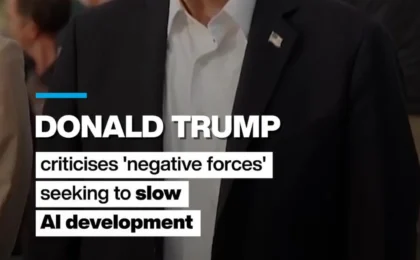
The debate over AI governance has quickly moved from the boardroom to the political arena. President Donald Trump, weighing in via Truth Social, offered a divergent view from the tech CEOs, suggesting that the primary safeguard for AI should not be a pause in development, but rather the oversight of a "STRONG AND SMART (High IQ) PRESIDENT."
This political dimension adds another layer of complexity for investors. Markets generally dislike uncertainty, and the prospect of a high-stakes regulatory battle—pitting industry leaders who want to slow development against politicians who want to maintain dominance through accelerated innovation—suggests that AI-related volatility is unlikely to subside in the near term.
Corporate Headwinds: Bank of America and GE Aerospace
Beyond the macro factors, specific corporate news contributed to the downward pressure on the markets.
Bank of America (BAC)
Bank of America’s stock slid 5.1% after CEO Brian Moynihan provided a disappointing update on the firm’s third-quarter outlook. Moynihan indicated that investment banking fees are projected to decline by more than 10% compared to the previous year, with trading revenue expected to remain flat. This stands in stark contrast to a robust second quarter, where the firm reported a 50% jump in investment banking fees and a 33% surge in trading revenue. The revelation highlights a cooling in the capital markets, further fueling concerns about the health of the financial sector.
GE Aerospace (GE)
In the industrial sector, GE Aerospace saw a rare downgrade from Melius Research analyst Scott Mikus, who moved the stock from "Buy" to "Hold." The downgrade was rooted in the expectation that while the aftermarket parts business has been a significant driver of growth, rising aircraft retirements will inevitably weigh on the company’s top-line revenue. As Mikus noted, "Great times don’t last forever." Despite this, the analyst consensus remains largely positive, with 19 of 22 analysts tracked by S&P Global Market Intelligence still labeling the stock a "Buy" or "Strong Buy."
Implications: The Road Ahead
As the market heads toward the mid-week Fed announcement, the implications are clear: the "Goldilocks" scenario—characterized by low inflation, steady growth, and rapid technological innovation—is under significant strain.
- Macro-Volatility: The combination of rising oil prices and climbing Treasury yields is putting the Federal Reserve in an unenviable position. If the Fed continues its aggressive rate-hike cycle, the probability of a policy-induced slowdown increases.
- The End of AI Exuberance: The transition from "growth at any cost" to "safety-first AI" is a fundamental shift in the tech sector. Expect greater bifurcation between companies that provide AI infrastructure and those that provide AI security.
- Capital Allocation Shifts: The performance gap between cybersecurity stocks and chipmakers suggests that institutional investors are beginning to rotate their portfolios to account for the systemic risks inherent in the next phase of the digital revolution.
For the average investor, the current environment demands a focus on quality, liquidity, and risk management. With interest rates likely to remain higher for longer and the technological landscape shifting underfoot, the mantra for the remainder of the week is clear: remain vigilant, follow the central bank’s signals closely, and prepare for continued volatility as the market recalibrates its expectations for the final quarter of the year.