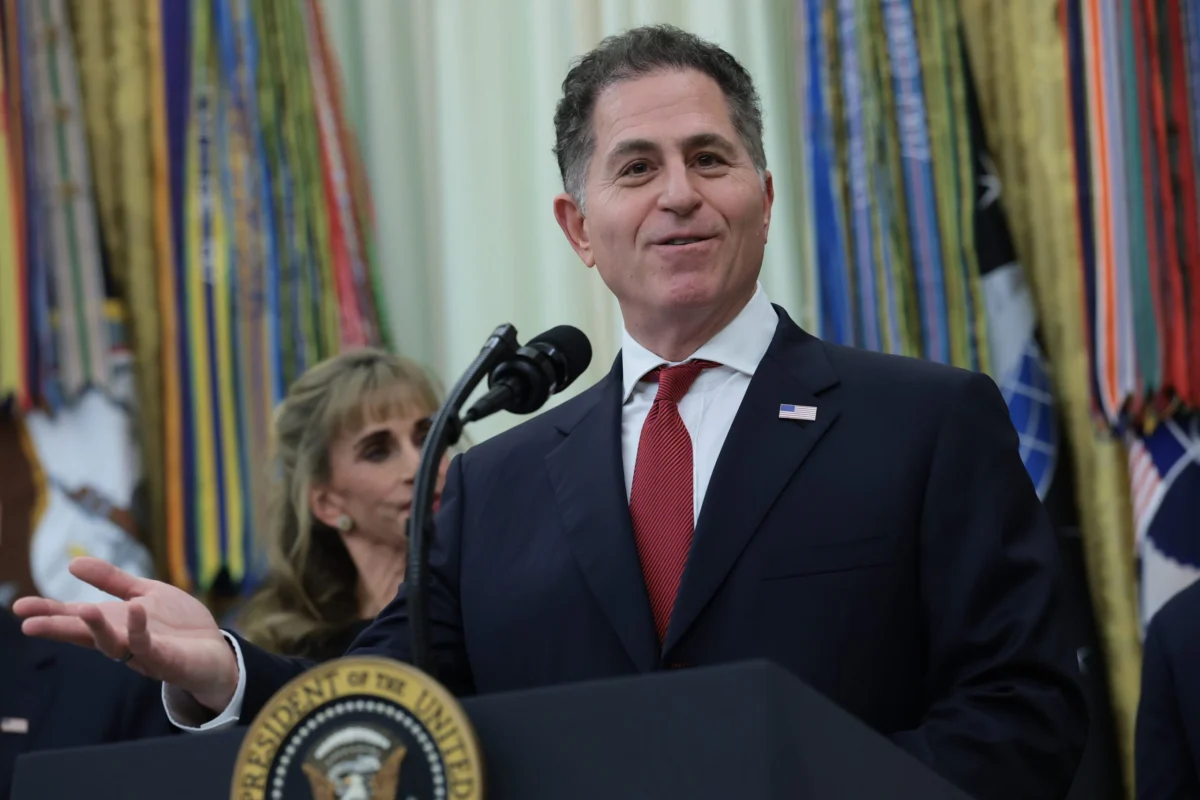
When President Donald Trump rang the opening bell of the stock market from the Oval Office on a recent Monday, the ceremony—typically a symbolic nod to American capitalism—morphed into a high-stakes fusion of personal finance, executive boosterism, and corporate strategy. Surrounded by Cabinet officials and top-tier CEOs, the President turned his attention to Michael and Susan Dell, who stood just feet away.
“They are truly incredible people, go out and buy a Dell computer,” Trump stated, offering a direct endorsement rarely heard from the Resolute Desk. He further added a cryptic but suggestive remark regarding the billionaire couple’s contributions to his "Invest America" initiative: “We’re going to get him that money back one way or the other.”
In the hours following the endorsement, Dell Technologies shares surged by nearly 9% before settling at a 4.4% gain. This marked the third time since February that a public commendation from Trump coincided with a significant same-day spike in Dell’s valuation. The recurring pattern has sparked a fierce debate among financial analysts, ethics lawyers, and political strategists: Is Dell’s extraordinary 2024 run a product of the "Trump Effect," or is it simply the result of a legacy hardware giant successfully pivoting to the artificial intelligence (AI) gold rush?
Main Facts: A Convergence of Interest
The relationship between the Trump administration and Dell Technologies is multifaceted, involving personal investments, philanthropic pledges, and massive government contracts.
At the heart of the controversy is a financial disclosure revealing that an account in Donald Trump’s name purchased between $1 million and $5 million in Dell stock just nine days before his first public endorsement of the company in February. This personal stake has grown significantly as Dell’s stock price skyrocketed throughout the year, driven by the company’s aggressive expansion into the AI server market.
Simultaneously, Michael and Susan Dell have become central figures in the "Invest America" program, colloquially known as "Trump Accounts." This initiative aims to provide investment accounts for children from working-class families. The Dells have pledged billions to this cause, a move the White House describes as an act of "patriotism," but which critics view as a vehicle for securing executive favor.
Chronology: The Endorsement Trail
To understand the synergy between the President’s rhetoric and Dell’s market performance, one must look at the timeline of events beginning in early 2024.
- Early February 2024: Financial filings indicate that a brokerage account belonging to Donald Trump acquires a significant position in Dell Technologies, valued between $1 million and $5 million.
- February 19, 2024: During a rally in Rome, Georgia, Trump first publicly praises Dell. On this day, Dell’s stock experiences a notable uptick, increasing Michael Dell’s paper wealth by an estimated $606 million.
- May 8, 2024: At a White House Mother’s Day luncheon, Trump explicitly names Michael and Susan Dell, linking their $6.25 billion pledge to the Trump Accounts with the company’s success. Following these remarks, Dell shares climb again, adding an estimated $8 billion to Michael Dell’s net worth in a single trading session.
- May 27, 2024: The Department of Defense (DoD) announces a five-year contract awarded to Dell, worth up to $9.7 billion. The contract focuses on consolidating Microsoft software licensing across the department, cementing Dell’s role as a critical federal partner.
- May 29, 2024: Dell reports record quarterly earnings, including a massive backlog of AI server orders. The stock jumps 32.8% in a single day—the largest move in the company’s history—driven by fundamental business performance.
- July 6, 2024: Trump hosts the stock market opening bell ceremony in the Oval Office, telling the public to "buy a Dell." The stock rises 4.4% by the closing bell, adding another $4.6 billion to the Dell family’s paper fortune.
Supporting Data: AI Fundamentals vs. Political Sentiment
While the timing of Trump’s comments is conspicuous, market data suggests that Dell was already positioned for a breakout year regardless of political backing. The primary driver is the "hyperscaler" market—large-scale cloud service providers like Microsoft, Meta, and Google that are currently in an arms race to build AI data centers.
The AI Server Boom
According to Patrick Moorhead, chief analyst at Moor Insights & Strategy, Dell is currently locked in a "two-horse race" with Supermicro to supply the specialized servers required for large language models. In its most recent quarterly filing, Dell reported:
- $24.4 billion in AI-related orders.
- $16.1 billion in AI server revenue.
- An upward revision of full-year AI server revenue expectations to approximately $60 billion.
Moorhead argues that while Trump’s comments may move the needle for retail investors—those trading on apps like Robinhood who are susceptible to "meme" culture and political loyalty—institutional investors remain focused on the balance sheet. "There are no institutional investors that have ever said, ‘Trump said this, increase the valuation by this,’" Moorhead told Fortune. "It’s all retail. There is a meme that says: ‘I just should have listened to Trump.’"
The Federal Connection
The $9.7 billion DoD contract awarded in late May provides a different kind of data point. While the $9.7 billion figure represents a "ceiling" rather than immediate cash-on-hand, it signals a long-term revenue stream. Critics suggest that the President’s public praise creates an environment where federal agencies feel pressured to favor certain vendors, or where investors assume such favoritism is happening, thereby driving up the stock price.
Official Responses and Ethical Critique
The intersection of a sitting president’s personal portfolio and his public endorsements has drawn sharp criticism from ethics experts, while the White House maintains that the President is simply supporting American innovation.
The Ethics Perspective
Richard Painter, who served as the chief White House ethics lawyer under President George W. Bush, described the situation as "egregious." Painter points to the Standards of Ethical Conduct for Employees of the Executive Branch, which generally prohibit federal officials from using their public office for the private gain of themselves or others.
“The baseline rule is, even if the president is not trading, there should never be an endorsement of a particular company,” Painter explained. He noted that the prohibition is designed to prevent the appearance of a "pay-to-play" system. When a president says "go out and buy a Dell," Painter argues, it signals to the market that the company has a "protected" status with the federal government. "Investors assume Trump knows when Dell is about to land a federal contract… and they trade on that assumption."
The White House Stance
In response to inquiries, the White House defended the President’s comments, framing them as a celebration of corporate philanthropy. A spokesperson stated that Trump was "rightfully praising the Dells among many other wealthy individuals and corporations" for their contributions to the youth investment initiative. The administration described the Dells as "patriots" who are helping millions of working-class families through their multi-billion dollar pledge.
The Corporate Silence
For its part, Dell Technologies has remained largely silent. The company did not respond to requests for comment regarding the President’s endorsements or the potential conflict of interest regarding his stock ownership. Historically, Michael Dell has maintained a non-partisan approach to executive relations, having served on advisory councils for Presidents George W. Bush, Barack Obama, and Donald Trump.
Implications: A New Era of Market Volatility?
The saga of Trump and Dell raises profound questions about the future of market integrity and the traditional boundaries of the presidency.
1. The Normalization of Political Stock Picking
For decades, the executive branch operated under a norm of neutrality regarding specific private entities. By "picking winners," the current administration may be setting a precedent where future presidents—regardless of party—use the bully pulpit to reward allies and punish rivals in the private sector. This could lead to a market where "political alignment" becomes a key metric for equity valuation, complicating the work of fundamental analysts.
2. The Rise of the "Political Retail Investor"
The "Trump Effect" on Dell stock highlights the growing power of retail investors who trade based on social cues and political identity rather than P/E ratios. If a significant portion of a company’s valuation is tied to the favor of a single political figure, that stock becomes inherently more volatile, subject to the whims of election cycles and daily press briefings.
3. The AI Arms Race and Federal Procurement
As AI becomes a matter of national security, the companies that build the infrastructure—like Dell—will naturally draw closer to the federal government. The challenge for the coming years will be ensuring that the procurement of this vital technology remains a meritocratic process based on technical specifications and cost-effectiveness, rather than proximity to the Oval Office.
In conclusion, while Dell’s success in 2024 is undeniably rooted in its technical prowess and the global demand for AI hardware, the shadow of political patronage looms large. As Michael Dell’s net worth continues to climb toward the top of the global rankings, the debate over how much of that wealth was built on silicon, and how much on political capital, is likely to intensify.