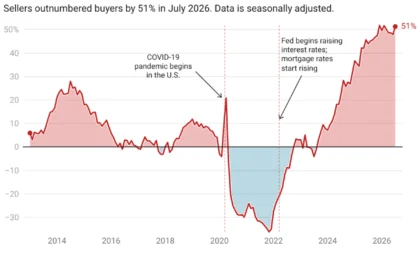
The frantic, high-octane real estate environment of the pandemic era—defined by sight-unseen bidding wars and aggressive, speculative pricing—has firmly retreated into the rearview mirror. Today’s housing market is defined by a more cautious, deliberate pace, where buyers are exercising their newfound leverage with patience and precision. For homeowners, this shift represents a fundamental change in the rules of engagement. As roughly 20.2% of active listings nationwide currently feature a price reduction, the ability to read the market and pivot strategically has become the most valuable tool in a seller’s arsenal.
The New Real Estate Reality: A Market in Flux
To understand the current climate, one must first accept that the era of "list it and watch it sell" is over. We have entered a period of recalibration. While the percentage of listings with price cuts is slightly lower than the 21% observed a year ago, the frequency of these reductions remains elevated compared to pre-2020 benchmarks.
"Earlier this year, homes were lingering on the market and price drops were fairly common as sellers worked to attract buyers," says Justin Gomez, a Redfin Premier Agent. "But sellers have become more in tune with current market conditions and are pricing accurately from the start to minimize risk."
This heightened awareness is crucial. Today’s buyers are hyper-informed; they have access to robust data, neighborhood comparables, and historical listing trends at their fingertips. When a home is priced beyond its market value, it does not merely sit idle—it accumulates "days on market" (DOM), a metric that can quickly stigmatize a property and erode its perceived value.
Chronology of a Listing: When to Act
Determining when to lower an asking price is a delicate exercise that balances analytical data against the emotional weight of a home sale. The objective is to avoid the "stale listing" trap—a phenomenon where a property sits for so long that prospective buyers begin to wonder if there is an underlying structural or legal defect.
The First 14 Days: The "Honeymoon" Window
The first two weeks on the market are critical. This is when your listing receives the highest volume of traffic from new search alerts. If you reach the two-week mark with zero requests for showings or a complete lack of saved listings on real estate portals, the market is sending you a clear message: the entry price is out of alignment with buyer expectations.
The 30-Day Threshold
By the one-month mark, if you have had showings but no offers, you have entered the "danger zone." At this stage, your listing is no longer "new." If you have not received feedback suggesting a contract is imminent, you are likely chasing the market rather than leading it.
Identifying the Signs of Overpricing
Data rarely lies, even when sellers might want it to. If your home is failing to gain traction, look for these five key indicators that a price adjustment is mandatory:
- High Traffic, Low Commitment: If your listing is seeing a high number of digital views and saved searches, but those views are not converting into physical showings, the price is likely just high enough to be "out of reach" for the target demographic.
- Consistently Negative Feedback: If your agent reports that buyers love the floor plan and the neighborhood but are "waiting for the price to drop" or comparing your home unfavorably to lower-priced neighbors, the market has spoken.
- The "Competitive Drift": If similar homes in your immediate vicinity are entering the market at lower price points or going under contract within a week, you are effectively acting as the "price anchor" for your competitors, making their homes look like better deals by comparison.
- Lowball Offers: While frustrating, low offers are a diagnostic tool. If you receive multiple offers that are significantly below your asking price, it is a strong indicator that the consensus valuation of the market is lower than your initial assessment.
- Appraisal Gaps: If a prospective buyer’s financing is contingent on an appraisal, and that appraisal comes in significantly below the agreed-upon price, it suggests that the lending market does not support your current valuation.
The Art of the Adjustment: How Much is Enough?
When a price reduction is deemed necessary, there is a temptation to perform "micro-adjustments"—a series of small, incremental drops of $1,000 or $2,000. In a market where buyers are filtering by price brackets (e.g., $500,000 to $550,000), these small cuts often fail to move the needle. They do not trigger fresh search alerts for buyers, and they do not shift the home into a new, more competitive search tier.
Instead, industry experts recommend a decisive, meaningful price reduction in the range of 2% to 5%. A single, clear reduction not only signals to the market that the seller is serious and motivated, but it also triggers a new round of notifications to anyone who previously saved the listing. This "re-engagement" can often be the catalyst that finally sparks a bidding war or secures a clean offer.
Strategic Alternatives: Price Cuts vs. Seller Concessions
Not every hurdle in the selling process is a result of an inflated price. In the current interest-rate environment, many buyers are not struggling with the price of the home itself, but with the monthly cost of borrowing. If your home is objectively priced correctly but still isn’t moving, you may need to pivot from a price reduction to a seller concession.
When to Offer Concessions
Seller concessions—credits provided by the seller at closing to cover buyer costs—are currently at near-record highs. This is a powerful tactical tool. For instance, if you reduce your price by $15,000, you lose $15,000 in gross proceeds. However, if you offer a $15,000 credit for a "2-1 buydown" on the buyer’s mortgage, you are providing the buyer with a significant reduction in their monthly payment for the first two years of their loan.
| Issue | Recommended Strategy | Strategic Benefit |
|---|---|---|
| Lack of Interest | Direct Price Drop | Refreshes listing status and visibility. |
| Affordability Issues | Seller Concessions | Reduces buyer’s monthly out-of-pocket costs. |
| Physical Repairs | Credit at Closing | Avoids the hassle of fixing items yourself. |
By offering to pay for a mortgage rate buydown, you are essentially solving the buyer’s affordability problem without having to lower your home’s total value on public records. This preserves your property’s standing as a high-value asset in the neighborhood.
The Long-Term Implication: Don’t Chase the Market
The most dangerous position a seller can occupy is that of the "market chaser." This occurs when a seller lowers their price by 1% while the market trends downward by 2% or 3%. In this scenario, the seller is perpetually overpriced, even after multiple reductions.
As inventory levels in many markets begin to climb, the window of opportunity to capitalize on current demand is narrowing. Sellers who remain tethered to the pricing metrics of 2022 or early 2023 are finding themselves in a race against the calendar.
Final Recommendations for Success
- Audit the Competition Weekly: Don’t just watch your own home; watch the new listings that hit the market every Monday. If they are priced lower than yours and have similar features, you have a problem.
- Listen to Your Agent: A professional real estate agent sees the feedback you don’t. If they advise a price correction, it is rarely out of a desire to make a "quick sale"—it is usually because they understand that the cost of waiting often outweighs the potential gain of holding out.
- Be Decisive: If the data suggests a price reduction, do it quickly and do it in a way that is visible to the market. Half-measures only prolong the period of uncertainty and lead to further, more painful price drops down the road.
Ultimately, selling a home in today’s market is not about finding a buyer who will pay the most; it is about finding the market-clearing price that aligns with the reality of current economic conditions. By being proactive, analytical, and willing to utilize concessions when appropriate, sellers can avoid the pitfalls of a stale listing and move toward a successful closing.